Understanding mill order meaning helps buyers read a steel requirement before production starts. In structural steel sourcing, this term often signals the intended grade, size range, standard, tolerance, finish, and delivery condition. A clear reading of mill order meaning reduces avoidable questions, improves quote comparison, and helps align expectations with the steel mill before capacity is booked.
Why mill order meaning matters before production
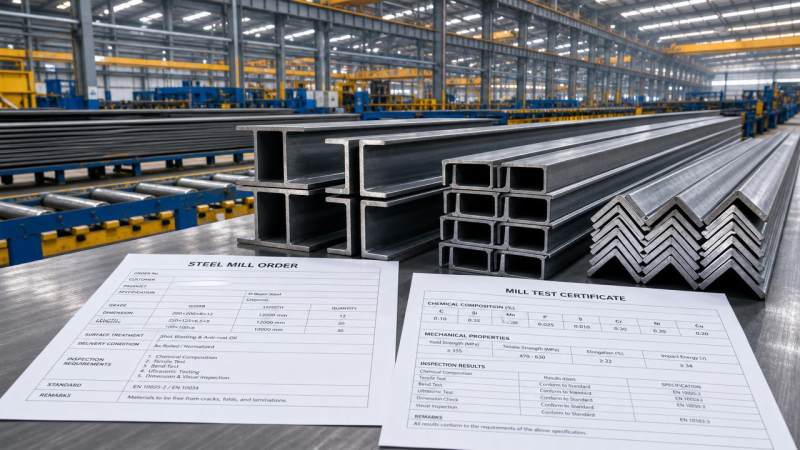
In steel trading, a mill order is more than an internal production note. It connects commercial requirements with actual manufacturing instructions. If the wording is incomplete, the finished steel may still be usable, yet unsuitable for the intended project standard.
The practical value of mill order meaning is simple. It tells you what the mill believes it must produce. That includes chemistry, mechanical properties, dimensions, rolling route, coating, testing scope, and packaging expectations.
For structural steel, this matters because small differences create large downstream effects. A mismatch in flange thickness tolerance, impact test temperature, or coating class can delay fabrication, documentation approval, or site installation.
A reliable structural steel supplier should translate project language into production language. Hongteng Fengda, a structural steel manufacturer and exporter from China, supports global projects with angle steel, channel steel, steel beams, cold formed profiles, and customized steel components produced to ASTM, EN, JIS, and GB requirements.
Checklist: what mill order meaning should reveal
Use the following checklist to judge whether a mill order is complete enough for production release.
- Confirm the steel grade first, including the exact standard reference, revision year, and any project-specific substitution limits accepted for the order.
- Check all dimensions carefully, covering section size, thickness, length range, straightness, camber, and any tolerance tighter than standard mill practice.
- Verify the delivery condition, such as as-rolled, normalized, galvanized, pickled, or coated, because process route changes affect cost and lead time.
- Review mechanical property requirements, especially yield strength, tensile strength, elongation, and impact testing when low-temperature service is involved.
- Read chemical composition limits, including carbon equivalent or restricted residual elements, when welding performance or forming behavior is important.
- Specify testing and inspection scope, including mill test certificate format, third-party inspection, ultrasonic testing, coating checks, and traceability marking.
- Match quantity details to production reality by stating tonnage, piece counts, batch split, and acceptable over-roll or under-roll allowances.
- Define packaging and logistics instructions, such as bundle weight, tagging, seaworthy protection, container loading limits, and destination-specific marking needs.
- Ask for drawing alignment when ordering customized structural components, because the mill order meaning must match fabrication details, not only the commercial quotation.
How to read mill order meaning in real steel documents
Mill order meaning is often spread across several documents. It may appear in the quotation, sales confirmation, technical annex, drawing list, inspection plan, and packing note. Reading only one file is risky.
Start with the product description line. If it says only “steel beam” or “channel,” it is not enough. A usable mill order should identify standard, grade, size, length, and quantity in one controlled description.
Then compare the specification against project drawings. A drawing may request a hole pattern, cut length, bevel, or surface treatment that a basic mill order line does not include. In that case, the order is incomplete for production.
Certification references also matter. If the project requests ASTM or EN compliance, the mill order should not rely on a generic “equivalent grade” statement without agreed technical acceptance.
The same logic applies outside large sections. For corrosion-sensitive applications, even a wire product needs clear order language covering tensile class, diameter, coating thickness, and standard. One example is 0.7mm 0.8mm 1.2mm 1.6mm 1.8mm 2mm diameter Galvanized Steel Wire Rope, where details such as 1470Mpa to 1960Mpa tensile strength, zinc coating category, rope construction, and standard compliance directly affect suitability before production starts.
Scenario notes for different steel applications
Standard structural sections
For angle steel, channel steel, and steel beams, mill order meaning should emphasize grade, sectional size, length, tolerance class, and testing requirement. These products often look similar across suppliers, but specification control determines whether they pass design review and fabrication checks.
When export compliance is involved, include the requested standard exactly. ASTM, EN, JIS, and GB are not interchangeable by assumption. Equivalence must be reviewed, not guessed.
Cold formed profiles and OEM parts
For cold formed steel profiles, shape accuracy and material thickness are often more sensitive than total tonnage. Here, mill order meaning should include profile drawing number, bend geometry, hole position, surface finish, and packing method.
Custom structural components need revision control. If the mill works from an outdated drawing, production may be technically correct but commercially unusable.
Coated and corrosion-exposed steel products
Galvanized products require another layer of review. Mill order meaning should identify coating process, coating mass range, and expected service environment. “Galvanized” alone is too broad for marine, mining, or outdoor infrastructure use.
For wire rope and similar products, construction type also changes performance. A second review of the 0.7mm 0.8mm 1.2mm 1.6mm 1.8mm 2mm diameter Galvanized Steel Wire Rope specification shows why rope model, zinc layer thickness, and core design must be fixed before production planning.
Common oversights and risk signals
One common mistake is accepting a quote line that lists only grade and tonnage. That is not enough to define production. Without dimensions and tolerances, the mill order meaning remains incomplete.
Another risk is hidden substitution language. Phrases like “equivalent material” or “as per mill standard” may be acceptable in some cases, but they should never replace explicit technical agreement.
Lead time confusion is also frequent. A mill order may appear approved commercially, while production cannot start because testing scope, coating class, or drawing clarification is still open.
Packaging is often ignored until shipment. However, export steel can suffer from rust staining, deformation, or unloading problems if bundling, labeling, and container limits were never written into the mill order.
Document inconsistency is the strongest warning sign. If quotation, order confirmation, and drawing notes describe different standards or sizes, stop and reconcile them before production release.
Practical execution steps before placing the order
- Build a one-page specification summary using the final grade, size, standard, quantity, finish, and inspection requirements.
- Cross-check every item against drawings, project specifications, and shipment constraints before asking for production confirmation.
- Request a pre-production review when customized sections, OEM parts, or coated products are involved.
- Lock document versions so that the mill order meaning remains identical across sales, production, quality, and logistics files.
- Ask for sample MTC formats or inspection plans in advance when project approval depends on documentation.
These actions are especially useful when sourcing from overseas. A capable exporter should convert technical intent into production-ready instructions, then maintain traceability through manufacturing, inspection, and delivery.
Conclusion: use mill order meaning as a pre-production control tool
Mill order meaning is not a minor sales term. It is an early control point that shows whether a steel order is truly ready for manufacturing. When the order clearly defines standard, grade, dimensions, finish, testing, and packaging, production risk drops sharply.
Before confirming any structural steel purchase, review the mill order as if it were the factory’s instruction sheet. If anything is vague, correct it first. That single step improves supplier communication, quote accuracy, and delivery confidence long before steel enters the production line.
Please give us a message


Please enter what you want to find