Verifying ASTM A312 TP304 seamless quality is essential for quality control and safety teams responsible for pressure, structural, and industrial applications.
From material certificates and dimensional accuracy to surface finish, mechanical properties, and corrosion resistance, each checkpoint reduces sourcing uncertainty and service risk.
This guide explains how to evaluate ASTM A312 TP304 seamless products through practical inspection steps, standard references, and acceptance criteria used in steel supply chains.
For global projects, reliable verification also supports traceability, installation consistency, and long-term performance in aggressive operating environments.
Basic Overview of ASTM A312 TP304 Seamless
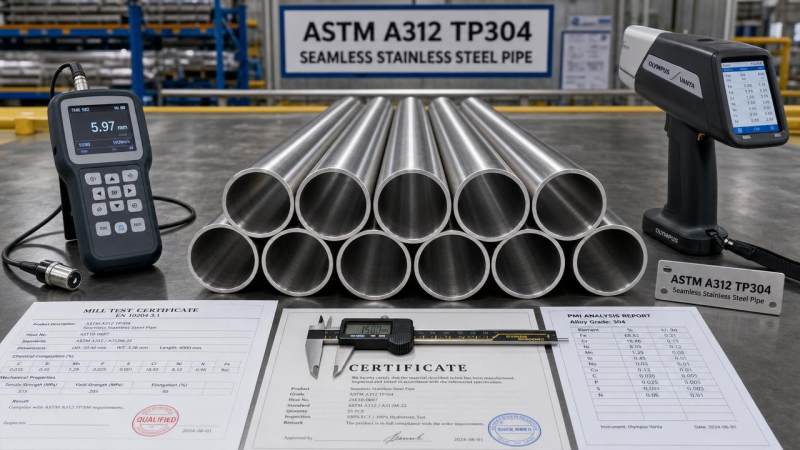
ASTM A312 TP304 seamless refers to austenitic stainless steel pipe produced without a welded seam under ASTM A312 requirements.
TP304 is widely selected for corrosion resistance, formability, weldability, and stable performance across industrial and structural service conditions.
The seamless form is commonly preferred where pressure integrity, clean internal flow, and reduced weld-related concerns are important.
However, ASTM A312 TP304 seamless quality cannot be confirmed by appearance alone. Verification requires document review and physical inspection together.
What the standard usually covers
- Manufacturing process and heat treatment requirements
- Chemical composition limits for TP304 grade
- Mechanical property expectations
- Dimensional tolerances and finish requirements
- Hydrostatic or nondestructive examination options
- Marking, traceability, and testing documentation
Because ASTM A312 TP304 seamless is often used in critical service, small deviations may affect corrosion life, fabrication quality, and inspection acceptance.
Current Industry Focus in Quality Verification
Quality concerns have increased as global supply chains become broader and project documentation becomes stricter.
Buyers now pay more attention to consistency between certificates, actual dimensions, and laboratory results.
This is why ASTM A312 TP304 seamless inspection should follow a structured sequence rather than a single visual check.
Key Methods to Verify ASTM A312 TP304 Seamless Quality
1. Review the material test certificate
Start with the MTC. It should show product description, size, heat number, specification, grade, and test values.
Check whether the certificate clearly states ASTM A312 TP304 seamless and whether the heat numbers match the pipe markings.
Pay attention to chemical composition, tensile strength, yield strength, elongation, heat treatment condition, and inspection method.
2. Confirm grade by PMI or chemical analysis
Positive material identification is one of the fastest checks for ASTM A312 TP304 seamless quality verification.
Portable XRF instruments can confirm major alloying elements such as chromium and nickel.
If higher assurance is needed, laboratory analysis can provide more complete chemical confirmation, including carbon and other controlled elements.
3. Measure dimensions and tolerances
Use calibrated tools to inspect outside diameter, wall thickness, length, straightness, and end squareness.
ASTM A312 TP304 seamless products must remain within standard tolerances for safe fitting and predictable performance.
Thickness variation is especially important because under-thickness can reduce pressure capacity and shorten service life.
4. Inspect surface and internal finish
Visual inspection should identify pits, seams, scale, cracks, laminations, excessive roughness, or handling damage.
For ASTM A312 TP304 seamless, clean surface condition supports corrosion resistance and reliable fabrication.
The pipe ends should also be checked for burrs, deformation, and improper bevels.
5. Verify mechanical properties
Mechanical testing helps confirm that ASTM A312 TP304 seamless material meets strength and ductility expectations.
Common checks include tensile testing, flattening tests, flaring tests, and hardness review when relevant to the specification.
Test reports should align with the certificate and the delivered lot identification.
6. Check hydrostatic or nondestructive examination records
ASTM A312 TP304 seamless pipes are commonly supplied with hydrostatic testing or equivalent nondestructive examination.
Review UT, ET, or hydro test records when available. These help reveal leaks or internal discontinuities before installation.
Business Value of Reliable Verification
A disciplined inspection process creates value far beyond simple acceptance or rejection.
When ASTM A312 TP304 seamless quality is verified correctly, projects gain stronger control over safety, cost, and schedule.
- Lower risk of unexpected leaks, corrosion, or early failure
- Better alignment with engineering specifications and code reviews
- Reduced rework during welding, fitting, and installation
- Improved documentation for audits and project handover
- More predictable performance in chemical, energy, and processing systems
In broader steel sourcing, similar discipline also applies to flat and structural products.
For example, Galvanized Steel Sheet often requires coating checks, dimensional verification, and standard confirmation before use in construction and industry.
Materials with grades such as DX51D, SGCC, and S350GD are commonly evaluated for zinc layer, strength, and forming performance.
Typical Application Scenarios and Inspection Priorities
Different service conditions can shift the inspection emphasis for ASTM A312 TP304 seamless products.
This application-based review helps prioritize testing budgets while still protecting essential quality requirements.
Practical Inspection Suggestions and Common Mistakes
Recommended inspection sequence
- Check markings, quantity, size, and packaging condition on arrival
- Match heat numbers to MTC documents
- Perform dimensional measurements on sampled pieces
- Review chemistry through PMI or certified test data
- Inspect surface and end condition carefully
- Confirm mechanical and NDT records before release
Common mistakes to avoid
- Accepting ASTM A312 TP304 seamless based only on supplier labels
- Ignoring wall thickness variation across the pipe circumference
- Using certificates that do not match delivered heat numbers
- Skipping PMI for mixed lots or urgent shipments
- Overlooking minor surface defects that may grow in service
Reliable steel supply also depends on stable manufacturing systems, controlled processes, and international standard familiarity.
Hongteng Fengda, a structural steel manufacturer and exporter from China, supports global projects with consistent quality control and customized steel solutions.
Its product range covers angle steel, channel steel, steel beams, cold formed profiles, and other steel components meeting ASTM, EN, JIS, and GB requirements.
Next-Step Quality Control Actions
To verify ASTM A312 TP304 seamless quality with confidence, create a repeatable inspection checklist tied to project specifications.
Include certificate review, PMI, dimensional checks, surface inspection, and test record confirmation in one controlled workflow.
For higher-risk applications, define sampling levels, third-party witness points, and acceptance criteria before shipment begins.
A clear verification method helps ensure ASTM A312 TP304 seamless products deliver dependable performance in demanding steel and industrial environments.
Please give us a message


Please enter what you want to find