From tying and fastening to spring making, welding, filtration, and cable protection, stainless steel coil wire is used in more practical ways than many operators realize. Its corrosion resistance, flexibility, and strength make it a dependable material across construction, industrial processing, and equipment manufacturing. Understanding where and why it performs best helps users choose the right specification and improve daily efficiency.
Where is stainless steel coil wire actually used on the job?
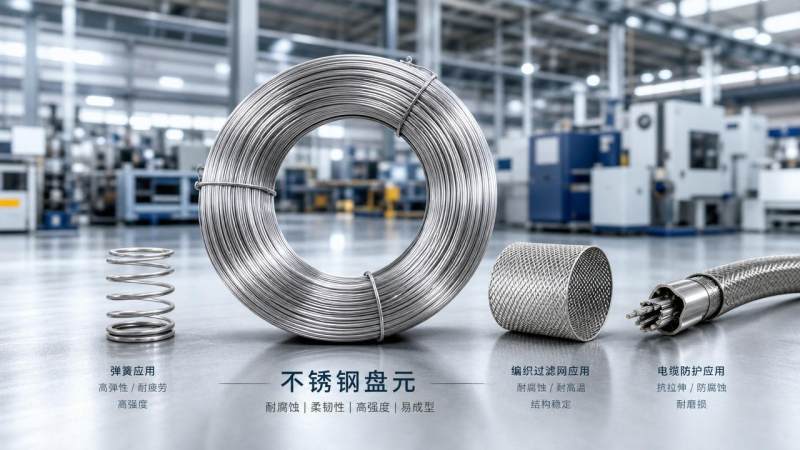
For operators in steel-related work, stainless steel coil wire is rarely just a simple consumable. It often solves daily problems such as unstable fastening, corrosion in wet environments, repeated bending, and contamination risks in production lines.
In practice, the material appears in workshops, fabrication plants, construction sites, maintenance teams, and equipment assembly lines. The reason is straightforward: it combines formability with resistance to rust, heat, and mechanical stress better than many plain carbon wire options.
- Binding and securing steel parts, mesh, insulation, pipes, and temporary assemblies during installation or transport.
- Spring production for valves, tools, clips, and mechanical components that need repeated elastic recovery.
- Welding and filler applications where stable composition and clean performance matter for joint reliability.
- Filtration and woven wire products used in industrial screening, fluid control, and protective barriers.
- Cable armoring, hose reinforcement, and protective wrapping in corrosive or vibration-prone environments.
The practical value of stainless steel coil wire increases when operators match wire grade, diameter, temper, and finish to the task. Using the wrong wire may still work at first, but it often leads to premature breakage, surface staining, or rework.
Common site and workshop uses
On construction and steel fabrication sites, operators use it for tying rebar accessories, securing insulation, fastening wire mesh, and organizing bundled parts. In manufacturing, it supports springs, baskets, fixtures, racks, and machine subassemblies.
Where moisture, chemicals, or outdoor exposure are present, stainless steel coil wire usually outperforms low-carbon alternatives because it reduces maintenance interruptions and keeps assemblies cleaner over time.
Which application scenarios benefit most from stainless steel coil wire?
The table below helps operators compare how stainless steel coil wire performs in different practical scenarios. This is useful when choosing wire for steel construction support, equipment manufacturing, or industrial maintenance work.
For most users, the best scenario is not simply the one with the highest wire strength. The right choice depends on whether the work requires frequent bending, exposure to moisture, contact with chemicals, or clean processing conditions.
Why this matters in steel-related operations
In the steel industry, operators often handle mixed environments. A wire used near galvanized sections, structural frames, machinery, or plant utilities must hold shape without adding avoidable corrosion risk. That is why specification control matters as much as base material selection.
For example, a fabrication team working with purlins, wall members, brackets, or support systems may need stainless steel coil wire for temporary fixing, accessories, or reinforcement-related tasks while using structural sections for the main load-bearing frame.
How does stainless steel coil wire compare with other wire options?
Operators often ask whether stainless steel coil wire is necessary or whether cheaper alternatives can do the same work. The answer depends on lifecycle cost, environment, and the consequences of failure.
If the job is temporary, dry, and non-critical, galvanized or carbon wire may be acceptable. If the wire must stay in service, resist corrosion, or support quality-sensitive operations, stainless steel coil wire is often the safer long-term choice.
Cost is not only the purchase price
A lower-cost wire can become more expensive when replacement labor, downtime, rust contamination, or customer complaints are included. Operators and buyers should compare total working cost rather than invoice price alone.
What technical points should operators check before buying?
When purchasing stainless steel coil wire, many problems come from incomplete specification review. Diameter alone is not enough. Wire grade, surface condition, hardness, packaging form, and processing method all affect actual use.
Key selection checklist
- Confirm the environment: indoor dry use, outdoor exposure, chemical contact, heat, or food-related cleanliness requirements.
- Define the function: tying, spring making, weaving, welding support, or reinforcement.
- Check forming needs: repeated bending needs different properties than static fastening.
- Review dimensional consistency: stable diameter improves machine feeding and manual handling.
- Ask about supply continuity: for recurring production, batch consistency reduces setup changes and scrap.
The next table gives a practical selection view for operators and purchasing teams who need to match stainless steel coil wire to everyday industrial work.
For busy operators, this checklist prevents a common issue: buying wire that looks acceptable in stock but performs poorly under actual site or machine conditions.
How does it connect with broader structural steel applications?
Stainless steel coil wire is not a substitute for structural sections, but it plays a supporting role in many steel systems. In steel buildings, machinery frames, and light industrial fabrication, wire often helps with fastening, accessory assembly, temporary stabilization, and protective integration.
For projects that also require cold formed members, purlins, wall beams, or light framing components, buyers often source related steel products from one reliable supplier to reduce coordination problems and shipment delays.
A good example is C Sections Steel, which is widely used in purlins and wall beams of steel structure buildings, lightweight roof trusses, brackets, and mechanical light industry supports. Available materials include Q195, Q235, Q345, A36, SS400, and s235jr, with standards such as AiSi, ASTM, bs, DIN, GB, and JIS.
For operators and project teams, this matters because the main frame and the auxiliary materials must work together. When galvanized coated C-shaped members, perforated sections, and processed components are supplied with bending, welding, punching, decoiling, or cutting support, installation becomes more predictable and field modifications are easier to control.
Why combined sourcing reduces risk
- It simplifies communication on standards, tolerances, and delivery planning.
- It improves compatibility between structural steel components and supporting metal accessories.
- It reduces the chance of mismatched documents, packaging issues, and partial shipment delays.
Hongteng Fengda supports this kind of coordination with structural steel manufacturing and export experience, standard and OEM supply capability, and quality control aligned with commonly used international standards including ASTM, EN, JIS, and GB.
What mistakes do users make with stainless steel coil wire?
Many field issues come from assumptions rather than material defects. Operators may treat all stainless wire as identical, or buyers may select only by price without checking the real operating environment.
Frequent misconceptions
- Assuming every stainless steel coil wire grade handles chemicals, salt, and moisture equally well.
- Ignoring hardness and then finding the wire too stiff for tying or too soft for spring use.
- Overlooking surface cleanliness in filtration, weaving, or welding-related jobs.
- Buying small trial quantities without considering later batch consistency for production runs.
The best prevention is early technical confirmation. A short discussion about application, environment, and processing method can avoid expensive replacement, machine stoppage, or installation delays later.
FAQ: practical questions operators often ask
Is stainless steel coil wire always better than galvanized wire?
Not always. For dry indoor jobs or short-term fastening, galvanized wire may be enough. Stainless steel coil wire becomes the better option when corrosion resistance, hygiene, repeated bending, or longer service life matters.
What should I focus on first: diameter or grade?
Start with the application environment and function. Grade determines corrosion behavior and suitability. Diameter then affects handling strength, flexibility, and equipment compatibility. Choosing only by diameter can lead to the wrong material decision.
Which jobs need tighter specification control?
Spring making, filtration, wire weaving, welding-related work, and machine-fed production usually require more control over diameter tolerance, temper, and surface quality than simple manual tying operations.
Can one supplier support both structural steel and related metal product needs?
Yes, and this is often beneficial. A supplier with experience in structural steel, cold formed profiles, and export coordination can help reduce sourcing complexity, improve document consistency, and support project scheduling more effectively.
Why choose us for steel products and project support?
For buyers, operators, and project coordinators, the challenge is rarely just finding a product name. The real challenge is getting the right specification, stable quality, compatible standards, and dependable shipment timing. That is where Hongteng Fengda adds value.
As a structural steel manufacturer and exporter from China, Hongteng Fengda supplies angle steel, channel steel, steel beams, cold formed steel profiles, and customized structural steel components for global construction, industrial, and manufacturing projects. Our team supports standard supply and OEM requirements with controlled production and practical communication.
- Parameter confirmation for steel sections, processing needs, and related application conditions.
- Product selection support based on project use, standards, and budget targets.
- Lead time discussion for recurring orders, export shipments, and project schedules.
- Customized solutions for perforation, cutting, bending, welding, and other processing services.
- Communication on certification expectations, sample support, and quotation details before order confirmation.
If you are evaluating stainless steel coil wire use alongside structural steel components, or you need support on section selection, coating, processing, standards, or delivery planning, contact us with your drawings, application details, and quantity requirements. That allows faster quotation, clearer specification matching, and lower sourcing risk.
Please give us a message


Please enter what you want to find