A steel conduit price list is more than a simple quotation sheet—it often reflects material grade, size range, coating, standards, packaging, and delivery terms. For buyers comparing suppliers, understanding what is actually included helps avoid hidden costs and sourcing risks. This guide explains how to read a steel conduit price list clearly and make better purchasing decisions for construction and industrial projects.
What buyers really want to know from a steel conduit price list
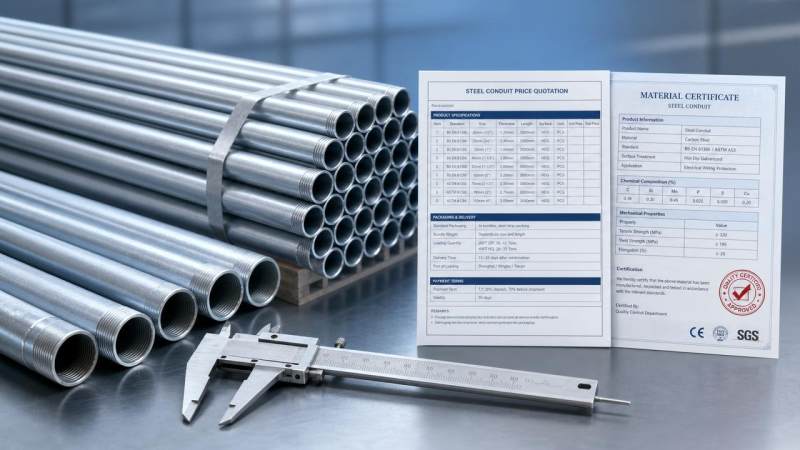
When people search for a steel conduit price list, they usually do not want numbers alone. They want to know what those numbers include and what extra costs may appear later.
That is the key issue. A low listed price can look attractive at first, but it may exclude coating, testing, packaging, port delivery, or compliance documents.
For project buyers, contractors, and sourcing teams, the real value of a price list is clarity. It should help them compare offers fairly and understand the total landed cost.
In practice, a useful steel conduit price list should show product specifications, applicable standards, surface treatment, unit basis, quantity assumptions, and commercial terms. Without these details, comparison becomes risky.
What is normally included in a steel conduit price list
A professional steel conduit price list usually starts with the basic product description. This includes conduit type, outside diameter, wall thickness, length, and manufacturing method.
It should also identify the raw material or steel grade. Even when two products look similar, differences in material quality can affect strength, corrosion resistance, and service life.
Another common item is surface finish or protective coating. Depending on the application, conduit may be supplied as black steel, pre-galvanized, hot-dip galvanized, or with other protective treatment.
Standards matter as well. Reliable suppliers normally indicate whether the product meets ASTM, EN, JIS, GB, or other relevant requirements for dimensional tolerance and performance.
Many price lists also state the pricing unit. For example, the quotation may be per ton, per meter, per piece, or per container. This affects how buyers compare offers.
Packaging information is often included or should be requested. Bundling, strapping, end protection, marking, and export packing can change logistics costs and reduce transit damage.
A complete list may also mention lead time, production capacity, minimum order quantity, and shipment terms. These details are essential for project planning, not just budgeting.
What a steel conduit price list often does not include
This is where many buyers make mistakes. A steel conduit price list may appear complete, but some important cost items are frequently excluded unless clearly stated.
Freight is one of the most common exclusions. A quoted factory price is very different from FOB, CFR, CIF, DDP, or delivered-to-site pricing.
Testing and inspection can also be separate charges. Third-party inspection, mill test certificates, coating thickness reports, and special quality verification may cost extra.
Tooling or customization fees may not be shown in a general list. If the conduit requires special threading, cutting, bending, punching, or custom marking, pricing changes.
Import duties, local taxes, customs clearance, and inland transportation are usually not part of the supplier’s list unless a full delivery package is negotiated.
Price validity is another hidden point. Steel prices fluctuate with raw material markets, zinc cost, energy prices, and shipping rates. A quote without a validity period is incomplete.
How to compare two suppliers beyond the listed price
Smart buyers compare on a like-for-like basis. The first step is to confirm that the conduit dimensions, grade, coating, and standards are exactly the same in both offers.
If one supplier quotes thinner wall tolerance, lower coating weight, or a shorter fixed length, the lower price may not represent better value at all.
Lead time should be checked carefully. A slightly higher price from a stable manufacturer may save more money if it reduces project delays or urgent replacement sourcing.
Quality consistency is equally important for import buyers. Ask whether the supplier has modern production lines, internal inspection procedures, and experience with export documentation.
It is also wise to review how the supplier handles packaging and loading. Better export packing can reduce damage, claims, and unloading issues at the destination port.
Communication quality matters more than many buyers expect. A responsive supplier who clarifies specifications quickly can reduce procurement errors and approval delays.
Which specification details have the biggest impact on price
Several technical factors can change conduit pricing significantly. Wall thickness is one of the most direct cost drivers because it immediately changes steel consumption per unit.
Diameter also affects cost, but not always in a simple linear way. Different production setups, tooling needs, and market demand can create price differences across size ranges.
Coating method is another major factor. Hot-dip galvanized conduit usually costs more than black or pre-galvanized options because of extra processing and zinc consumption.
Required standards and tolerances can raise the price too. Tighter dimensional control, stricter testing, and project-specific certification all add manufacturing and quality assurance costs.
Order quantity influences unit price as well. Larger orders may reduce setup cost per unit, improve material purchasing efficiency, and allow better container utilization.
Packaging and delivery conditions also matter. Export-grade bundles, waterproof wrapping, palletizing, and mixed-size loading may all affect the final quotation.
Why commercial terms are just as important as the product price
Many buyers focus on the numeric price and overlook Incoterms. However, commercial terms define where the seller’s responsibility ends and where the buyer’s cost begins.
EXW pricing may seem low, but the buyer must handle loading, inland transport, export clearance, ocean freight, insurance, and import processes. That changes the real total cost.
FOB pricing includes delivery to the port and export handling, which often makes supplier comparison easier for overseas buyers who control international freight separately.
CIF prices include ocean freight and insurance to the destination port, but local port charges and inland delivery are still usually the buyer’s responsibility.
Payment terms also affect procurement decisions. A lower price tied to difficult advance payment conditions may create cash flow pressure or increase transaction risk.
For long-term sourcing, predictable execution is often more valuable than chasing the lowest headline number on a steel conduit price list.
How documentation affects sourcing risk and project approval
In construction and industrial purchasing, documentation is not a side issue. It is often part of what the buyer expects to be included in a reliable quotation framework.
Common documents include mill test certificates, certificates of origin, packing lists, commercial invoices, and inspection records. Some markets also need compliance declarations.
If the project is tied to public works, infrastructure, or regulated industrial use, missing documentation can delay customs clearance or site approval even when the product itself is acceptable.
Buyers should therefore ask not only for price, but also for the exact documentation package supplied with each shipment. This prevents avoidable downstream problems.
Manufacturers experienced in export business usually understand these requirements better and can prepare documents in line with customer and destination market expectations.
How product knowledge from related steel categories can improve buying decisions
Although conduit buyers focus on pipe and tube products, broader material knowledge can improve procurement judgment. Corrosion resistance, finish options, and application matching all influence lifecycle cost.
For example, in highly corrosive or specialized industrial settings, buyers often compare different steel solutions for adjacent systems, supports, or equipment protection components.
A good reference point is 316 Stainless Steel Plate, which is widely used in chemical, food processing, marine-related, medical, and high-temperature environments.
Its performance advantages come from 316 stainless steel composition, especially molybdenum content, which improves resistance to pitting, corrosion, and acidic exposure in demanding conditions.
Typical properties include tensile strength of at least 520, yield strength of at least 275, elongation around 55 to 60, and hardness up to 183HB or 100HRB.
Available thickness can range from 0.3mm to 200mm, with multiple width and length options. Finishes may include BA, 2B, NO.1, NO.4, 4K, HL, and 8K.
This does not mean conduit should always be replaced with stainless materials. It means buyers should evaluate environment, corrosion risk, standards, and maintenance cost together rather than price alone.
Questions buyers should ask before accepting a quotation
Before placing an order, ask whether the quoted steel conduit price list covers exact size tolerance, length tolerance, coating specification, and applicable manufacturing standards.
Confirm the unit basis clearly. Is the price per ton, per length, or per piece? Does theoretical weight or actual weight apply for billing?
Ask whether the offer includes packaging, marking, mill test certificates, and third-party inspection support. These details can affect both compliance and logistics cost.
Check the delivery term, payment term, minimum order quantity, and quote validity period. Without these, the price is not fully actionable for procurement planning.
It is also useful to ask about production lead time under current mill load. A supplier’s standard lead time may differ from actual timing during peak market periods.
Finally, ask how claims are handled if dimensions, coating, or documents do not match the agreed specification. Good after-sales clarity reduces sourcing risk.
What a trustworthy supplier quotation should look like
A trustworthy quotation is specific, transparent, and easy to verify. It does not rely on vague wording such as standard quality or normal export packing without definition.
It should identify the product exactly, list measurable specifications, state standards, define quantity assumptions, and explain the commercial basis of the offer.
Strong suppliers also make room for customization. For global projects, buyers may need specific lengths, mixed sizes, OEM marking, or special packing arrangements.
For this reason, experienced structural steel manufacturers and exporters often provide more than product pricing. They help customers align specification, cost control, and delivery planning.
That is particularly valuable when sourcing from China or other major manufacturing hubs, where supplier capability can vary widely despite similar-looking quotations.
Conclusion: read the price list as a risk and value document
A steel conduit price list is not just a table of numbers. It is a snapshot of product scope, quality level, commercial terms, and potential hidden cost exposure.
The best way to use it is to ask what is included, what is excluded, and what assumptions sit behind the quoted figure. That is how meaningful comparison begins.
For information-focused buyers, the goal is not simply to find the lowest visible price. It is to identify the quotation that offers the best combination of clarity, compliance, reliability, and total cost control.
When you evaluate specifications, coating, standards, documentation, packaging, and delivery terms together, a steel conduit price list becomes a practical decision tool rather than a source of confusion.
Please give us a message


Please enter what you want to find