What does API steel pipe certification really prove?
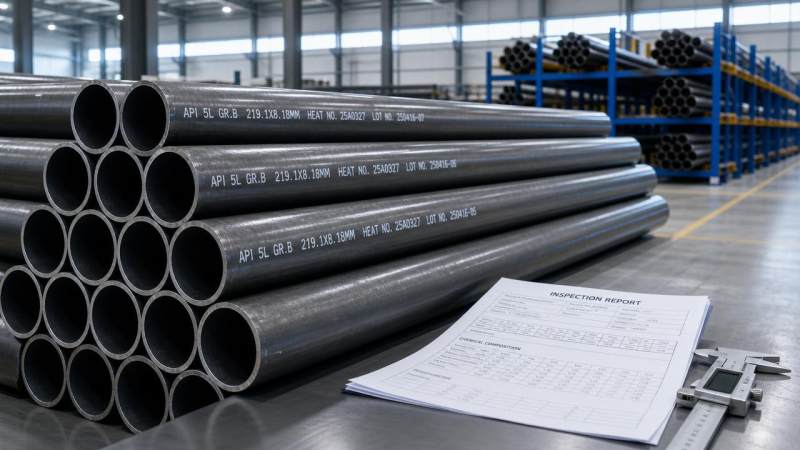
For industrial steel projects, API steel pipe certification is no longer treated as a simple compliance mark.
It increasingly proves manufacturing discipline, documented control, material traceability, and repeatable performance under demanding service conditions.
As global projects face tighter safety rules, API steel pipe certification helps reduce uncertainty before orders become irreversible.
It supports technical comparison, supplier evaluation, risk control, and long-term cost judgment in petroleum and industrial steel supply chains.
Certification is becoming a risk filter, not only a quality document
The meaning of API steel pipe certification has changed with market expectations.
In earlier procurement cycles, certificates were often checked near shipment or customs documentation.
Today, API steel pipe certification is reviewed much earlier during technical clarification and supplier prequalification.
This shift reflects rising pressure on pipeline integrity, energy infrastructure reliability, and cross-border project accountability.
A certified API steel pipe does not only indicate that a product passed selected tests.
It also shows that production was controlled through an approved quality management framework.
That distinction matters when steel pipe must perform under pressure, corrosion exposure, welding stress, or remote installation conditions.
What API steel pipe certification actually proves
API steel pipe certification proves several practical points when documentation is authentic and linked to the delivered batch.
It confirms that the pipe was produced against a recognized API specification, such as API 5L or related petroleum standards.
It also confirms that chemical composition, mechanical properties, dimensional tolerances, and inspection requirements were controlled.
- Material grade alignment with the stated API steel pipe specification.
- Traceable heat numbers, batch records, inspection results, and mill test certificates.
- Controlled manufacturing procedures for forming, welding, heat treatment, and finishing.
- Testing evidence for strength, toughness, dimensional accuracy, and pressure-related performance.
- Supplier accountability through documented audits, procedures, and corrective action systems.
However, API steel pipe certification does not automatically prove suitability for every environment.
Project media, temperature, pressure class, coating system, soil condition, and welding method still require separate confirmation.
Why the value of certification is rising across steel supply chains
Several industry changes are making API steel pipe certification more influential in steel sourcing decisions.
The trend is not limited to oil and gas pipelines.
It also affects industrial plants, energy facilities, terminals, fabrication yards, and infrastructure projects using certified pipe systems.
These drivers explain why API steel pipe certification is now examined together with mill capability and export reliability.
How certification changes technical and commercial decisions
API steel pipe certification influences both engineering confidence and commercial negotiation.
When certificates, test reports, and markings match, technical review becomes faster and less ambiguous.
When documents are incomplete, the apparent price advantage may disappear through extra inspection or schedule delay.
- Engineering teams gain clearer evidence for grade, wall thickness, and test compliance.
- Project controllers can compare total risk, not only unit price.
- Fabricators can plan welding, cutting, coating, and inspection with fewer surprises.
- Logistics teams can reduce rework caused by document mismatch or unclear markings.
For a structural steel exporter, this logic is familiar across different product families.
Hongteng Fengda applies quality control across angle steel, channel steel, steel beams, cold formed profiles, and customized components.
The same documentation mindset also supports related coated materials, including Galvanized Steel Sheet for construction and industrial use.
Available grades include DX51D, SGCC, S350GD, and S550GD, with thickness from 0.12mm to 6.00mm.
Its zinc layer options and corrosion resistance show why documented standards matter beyond API steel pipe applications.
What certification does not replace
A common misunderstanding is that API steel pipe certification removes the need for project-specific judgment.
Certification proves conformity to a standard, but it does not define every design or service requirement.
For example, sour service, low-temperature toughness, offshore exposure, and aggressive media may require additional specifications.
Coating compatibility, bevel preparation, weldability, and packaging also remain important when API steel pipe moves internationally.
Key limits to check before approval
- Is the API steel pipe grade suitable for the operating pressure and design code?
- Do the heat numbers match the mill test certificates and pipe markings?
- Are supplementary tests needed for impact toughness or sour service?
- Are inspection reports issued by a recognized and acceptable party?
- Does packaging protect pipe ends, coating, and markings during export transport?
These questions help separate real certification value from incomplete paperwork.
Documentation is becoming part of product performance
The market increasingly treats documentation as part of the API steel pipe product itself.
This trend is practical, not administrative.
A pipe without reliable records can create uncertainty even if the surface appearance seems acceptable.
A properly certified API steel pipe gives evidence that can be reviewed, stored, audited, and defended later.
The strongest suppliers manage documents and production data as one continuous system.
What to focus on when comparing certified suppliers
API steel pipe certification should be evaluated with production capability, export experience, and response speed.
A certificate alone cannot compensate for unstable delivery, unclear communication, or weak quality control.
The more complex the project, the more important the supplier’s internal discipline becomes.
- Check whether API steel pipe documents can be provided before shipment approval.
- Confirm whether ASTM, EN, JIS, or GB requirements are also relevant.
- Review whether customization, cutting, coating, or bundled supply is available.
- Assess whether lead times are realistic for the order size and destination.
- Verify whether corrective actions are documented when deviations occur.
Hongteng Fengda supports global steel projects with stable production capacity and standard-based quality control.
Its structural steel supply experience helps align specifications, documents, and delivery expectations for international projects.
A practical way to judge API steel pipe certification
A useful approach is to treat API steel pipe certification as a starting point for verification.
The next step is connecting the certificate to actual production data and project requirements.
This staged method makes certification more useful and reduces avoidable disputes.
The next direction: more transparent, traceable steel sourcing
The future value of API steel pipe certification will depend on transparency.
Digital records, faster verification, and clearer batch traceability are becoming expected in international steel trade.
Certified API steel pipe will remain important, but the strongest advantage will come from complete evidence chains.
That means matching standards, production discipline, inspection proof, and reliable export execution.
For upcoming steel projects, start by defining the required API steel pipe standard and service conditions.
Then request matching certificates, mill test reports, inspection records, and shipment documentation before final approval.
Hongteng Fengda can support specification review, structural steel supply, and customized solutions for global industrial projects.
Clear requirements and verified documentation remain the best path to safer, more predictable steel sourcing.
Please give us a message


Please enter what you want to find