Before any beam enters a load-bearing structure, quality and safety teams must verify that the I section steel meets project specifications, applicable standards, and real working conditions.
A careful pre-use inspection helps identify dimensional deviations, surface defects, material inconsistencies, and documentation gaps that could affect structural performance.
For steel projects, knowing what to check and how to check it reduces risk, prevents rework, and supports reliable service life.
Why I section steel must be checked before structural use
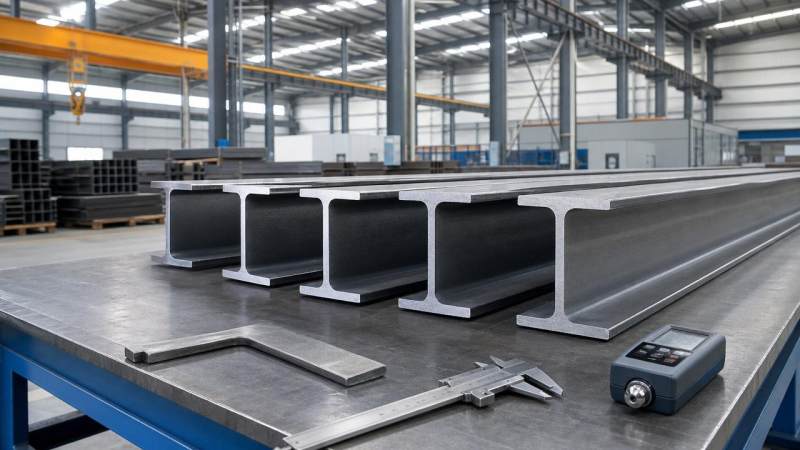
I section steel carries bending, shear, and compression forces in frames, bridges, platforms, warehouses, and industrial structures.
Small defects may become serious when beams face high loads, vibration, welding heat, or long-term outdoor exposure.
A checklist-based inspection makes the process repeatable. It also creates clear evidence for acceptance, rejection, or corrective action.
The goal is not only to find visible problems. It is to confirm that I section steel matches design drawings, standards, and site conditions.
Core checklist for checking I section steel
Use the following checklist before cutting, welding, painting, assembling, or installing I section steel in any structural application.
- Verify the purchase order, drawings, and mill certificate. Confirm grade, section size, heat number, standard, and required mechanical properties.
- Check the beam designation and markings. Ensure the identification on each I section steel piece matches documents and traceability records.
- Measure overall depth, flange width, web thickness, and flange thickness. Compare results with ASTM, EN, JIS, or GB tolerances.
- Inspect length accuracy and cutting squareness. Excessive deviation can cause assembly gaps, bolt misalignment, and field installation delays.
- Check straightness along the beam length. Use a string line, straightedge, laser tool, or calibrated measuring method.
- Look for flange tilt, web waviness, twisting, camber errors, or local deformation. Record any shape deviation before fabrication starts.
- Examine the surface for cracks, folds, heavy scale, laminations, dents, sharp gouges, and harmful rolling defects.
- Inspect edges and ends after cutting. Remove burrs, slag, or irregular notches that may create stress concentration.
- Confirm chemical composition when required. Review carbon, manganese, sulfur, phosphorus, and alloy elements against the specified grade.
- Review mechanical test results. Yield strength, tensile strength, elongation, and impact values must satisfy the structural design requirement.
- Check weldability requirements. For welded frames, confirm carbon equivalent, preheating needs, and compatibility with the selected welding procedure.
- Assess corrosion condition before use. Light rust may be acceptable, but pitting, deep corrosion, or contamination needs evaluation.
Dimensional checks that affect structural fit
Dimensional control is critical because I section steel usually connects to plates, bolts, columns, channels, or other beams.
If the section is oversized, undersized, twisted, or curved, connection details may not align correctly during erection.
Use calibrated tapes, calipers, micrometers, squares, and gauges. Avoid relying only on visual judgment for acceptance.
- Measure at several points, not only at one end, because rolling deviation may vary along the full length.
- Record actual values in an inspection form, including location, tool number, tolerance, and inspector signature.
- Separate nonconforming I section steel before fabrication, so rejected material does not enter production by mistake.
Recommended measurement points
Surface, corrosion, and coating inspection
Surface condition directly affects fatigue resistance, coating adhesion, weld quality, and long-term durability of I section steel.
Check the full beam, including flange edges, web-to-flange junctions, handling marks, and cut ends.
Cracks, seams, deep pits, and laminations should be evaluated carefully. Some defects require grinding, repair, testing, or rejection.
For outdoor or coastal structures, corrosion protection planning should start before installation, not after rust becomes visible.
In related steel supply chains, galvanized flat products are often used for corrosion-resistant components, covers, panels, or formed profiles.
For example, Steel Coil Galvanized supports zinc-coated fabrication where barrier protection and extended service life are required.
Available grades include DX51D+Z, SGCC, S350GD+Z, and S550GD+Z, with thickness from 0.12mm to 3.5mm.
Its zinc layer range of 60-275g/m² or 80-275g/m² helps protect steel from environmental attack.
Material documents and traceability checks
Documentation is part of quality control. Without reliable records, even good-looking I section steel may create acceptance problems.
Review mill test certificates for grade, heat number, size, standard, chemical composition, and mechanical test results.
Check whether the certificate follows project requirements. Common standards include ASTM A36, ASTM A572, EN 10025, JIS G3101, and GB standards.
- Match each bundle tag with the certificate, delivery note, and inspection report before unloading or storage acceptance.
- Confirm that test values meet or exceed required yield strength, tensile strength, elongation, and impact toughness.
- Request third-party inspection when the project involves high-risk structures, export compliance, or special owner requirements.
Traceability should remain clear after cutting. Mark offcuts and fabricated parts to avoid material mixing during production.
Application-based inspection focus
Building frames and warehouses
For building frames, check I section steel straightness, flange condition, and connection dimensions before drilling or welding.
Misalignment at beam-column joints can create erection difficulty and additional site correction work.
Industrial platforms and equipment supports
Industrial platforms often face dynamic loads, vibration, and concentrated equipment loads.
Give extra attention to web thickness, weld zones, stiffener locations, and impact toughness where machinery is involved.
Outdoor structures and exposed environments
Outdoor structures require stricter corrosion evaluation, especially in humid, marine, chemical, or polluted environments.
Confirm whether shot blasting, primer, hot-dip galvanizing, or other coating systems are specified before installation.
Common overlooked risks during I section steel inspection
Ignoring hidden deformation: A beam may look acceptable from one side but still have twist, camber error, or web distortion.
Accepting unclear certificates: Missing heat numbers, unmatched grades, or incomplete test values can block project approval later.
Skipping cut-end inspection: Flame cutting, sawing, or transport damage can leave notches that increase local stress concentration.
Overlooking storage damage: Poor stacking may bend flanges, trap moisture, damage coating, or contaminate weld areas.
Failing to control substitutions: A similar size or grade is not automatically acceptable without engineering confirmation.
Practical execution steps before approval
- Prepare the latest drawings, material standard, tolerance table, inspection tools, and acceptance criteria before checking begins.
- Inspect I section steel immediately after arrival, before it is mixed with existing stock or moved into fabrication.
- Use a sampling plan for normal deliveries, but inspect more pieces when defects, damage, or documentation issues appear.
- Photograph nonconforming areas with scale reference, beam number, date, and location for clear communication.
- Apply hold tags to questionable material. Do not cut, weld, drill, or install it until disposition is confirmed.
- Keep inspection records with certificates, packing lists, purchase orders, and corrective action reports for project traceability.
A reliable structural steel supplier should support technical documents, consistent manufacturing, and stable lead times for global projects.
Hongteng Fengda manufactures and exports structural steel from China, including angle steel, channel steel, steel beams, and cold formed profiles.
Products can follow ASTM, EN, JIS, and GB requirements, with standard specifications and customized OEM solutions available.
Summary and next action
Checking I section steel before structural use is a practical safety step, not a formal routine.
The inspection should cover documents, dimensions, straightness, surface defects, material properties, corrosion condition, and traceability.
When results meet the specified standard, the beam can proceed to fabrication or installation with lower risk.
When deviations appear, isolate the material, document the issue, and request technical confirmation before further processing.
For upcoming steel projects, build a written I section steel inspection checklist and apply it consistently from delivery to final erection.
Please give us a message


Please enter what you want to find