For international construction projects, material standards directly affect compliance, cost control, and project risk. Many global buyers ask whether GB steel can meet overseas engineering requirements and how it compares with ASTM, EN, or JIS standards. As China’s structural steel manufacturing capabilities continue to mature, GB steel is increasingly used in global building, industrial, and infrastructure projects when properly specified, tested, and documented. This article explains what decision makers should know before sourcing GB steel for international construction work.
What does GB steel mean in construction sourcing?
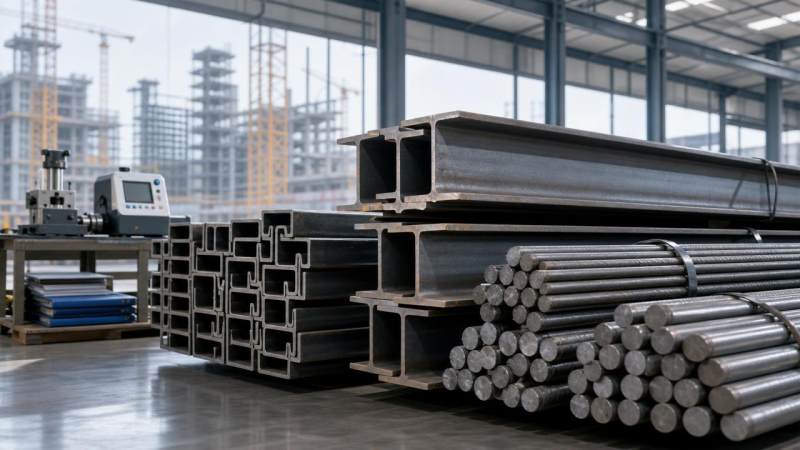
GB steel refers to steel produced according to Chinese national standards, known as Guobiao standards.
These standards define chemical composition, mechanical properties, dimensions, tolerances, testing rules, and delivery conditions.
In construction, GB steel may include angle steel, channel steel, beams, plates, bars, and cold formed profiles.
Common grades include Q235, Q355, Q420, Q460, and other structural grades used for load-bearing applications.
The key point is not whether GB steel is “local” or “international.”
The real question is whether the specified grade matches project design codes and inspection requirements.
For many overseas projects, GB steel can be acceptable when supported by mill certificates, third-party tests, and clear equivalency documents.
Is GB steel accepted for international construction projects?
GB steel can be used internationally, but acceptance depends on the project specification, local code, and approval process.
Some projects allow equivalent standards if performance values meet or exceed the required design grade.
Other projects require ASTM, EN, JIS, or specific national standards without substitution.
Before ordering GB steel, the technical package should be reviewed against drawings, structural calculations, and contract documents.
Approval is usually easier when the supplier provides traceability, heat numbers, mechanical tests, and chemical analysis.
For public infrastructure, industrial plants, bridges, and high-rise buildings, documentation is especially important.
For secondary structures, platforms, fencing, frames, and general fabrication, GB steel may be approved more quickly.
When is GB steel a practical option?
- The project accepts equivalent material standards.
- The design engineer confirms grade compatibility.
- The supplier can provide complete mill test certificates.
- The shipment includes clear marking and batch traceability.
- Third-party inspection is available before loading.
How does GB steel compare with ASTM, EN, and JIS standards?
GB steel is not automatically identical to ASTM, EN, or JIS steel.
Each standard system has its own grade naming, test methods, tolerances, and delivery conditions.
For example, Q235 is often compared with mild structural grades, but direct substitution needs verification.
Q355 is frequently evaluated against higher strength structural grades, depending on impact and yield requirements.
The safest comparison starts with yield strength, tensile strength, elongation, carbon equivalent, and impact toughness.
Dimensional tolerances also matter, especially for bolted assemblies, modular fabrication, and automated welding lines.
A formal equivalency table should be project-specific, not copied from a generic online chart.
This approach keeps GB steel selection aligned with actual engineering needs.
Which GB steel products are useful for global projects?
International construction uses many structural shapes, depending on the building system and fabrication method.
Angle steel and channel steel are common in supports, frames, bracing, racks, and secondary structures.
Steel beams serve columns, roof systems, mezzanines, warehouses, and industrial workshops.
Cold formed profiles are useful for lightweight framing, purlins, cladding systems, and prefabricated structures.
Round bars are often selected for machining, reinforcement details, pins, shafts, handrails, and fabrication components.
For projects needing carbon steel bar stock, Hot rolled Carbon Steel Round Bar can be specified in multiple grades.
Available grade references include A53, A106, 16Mn, 10#, 20#, 45#, S235JR, S355JR, Q320, Q360, Q410, and Q460.
Typical dimensions include lengths of 2m, 5m, 6m, 12m, and diameters from 5mm to 2500mm.
Surface options may include oiling, passivation, lacquer sealing, phosphating, galvanizing, PVC coating, or anti-rust oil.
These options help GB steel meet different construction, decoration, railing, staircase, balcony, fence, and furniture needs.
The right finish should match transport distance, storage conditions, welding plans, and final exposure environment.
What documentation is needed before approving GB steel?
Documentation often determines whether GB steel is accepted smoothly or delayed during project review.
A complete file should show exactly what material is supplied and how it was tested.
Mill test certificates should include heat number, grade, standard, chemical composition, and mechanical properties.
Inspection reports may cover dimensions, appearance, surface treatment, packing condition, and quantity verification.
For demanding projects, third-party inspection by recognized agencies can strengthen confidence.
Additional tests may include ultrasonic testing, Charpy impact testing, hardness testing, or coating thickness testing.
Recommended approval checklist
- Confirm whether GB steel is allowed by contract documents.
- Compare required grade values with the proposed GB grade.
- Request mill certificates before mass shipment.
- Review tolerances against fabrication drawings.
- Define inspection points before production begins.
- Agree on packaging, marking, and seaworthy loading.
This checklist reduces confusion between design intent, procurement documents, and delivered material.
What risks should be avoided when sourcing GB steel overseas?
The main risk is assuming that one grade name guarantees full equivalence across all standards.
Grade comparison should be based on data, not only on market habit or verbal confirmation.
Another risk is ignoring fabrication requirements such as weldability, straightness, and surface cleanliness.
GB steel may perform well, but poor specification can still cause cutting, drilling, or welding problems.
Logistics also affects quality, especially for long sea shipments and humid port storage.
Standard export seaworthy packing, rust protection, and clear bundle marking should be confirmed early.
A reliable supplier should discuss these risks before production, not after shipment.
How should cost and lead time be evaluated?
GB steel is often considered for international projects because China offers strong production capacity and competitive supply chains.
However, the lowest unit price is not always the lowest project cost.
Cost evaluation should include testing, inspection, packing, inland transport, sea freight, customs, and possible rework.
Lead time also depends on grade availability, section size, surface treatment, quantity, and export schedule.
Standard GB steel specifications may be shipped faster than special sizes or custom profiles.
For many carbon steel products, production may take 7 to 15 working days after deposit or L/C.
That timeline should still be checked against vessel booking, destination port congestion, and inspection arrangements.
A stable supplier helps control uncertainty through transparent scheduling and consistent communication.
FAQ: quick answers about GB steel for international construction
Final guidance: is GB steel fit for international construction work?
GB steel is fit for many international construction projects when selected through an engineering-based process.
It should not be approved only because it is available or cost-effective.
It should be approved because the grade, tests, tolerances, and documents satisfy project requirements.
Hongteng Fengda supplies structural steel products and customized solutions for global construction, industrial, and manufacturing projects.
Products can be supplied under major standards including ASTM, EN, JIS, and GB.
For a safer decision, share drawings, grade requirements, dimensions, surface treatment, destination, and inspection expectations before ordering.
With proper specification and professional support, GB steel can become a reliable choice for international construction work.
Please give us a message


Please enter what you want to find