Many buyers focus on price and basic specs, but welded mesh export orders often involve hidden risks in standards, coating quality, packaging, and delivery consistency. As a trusted Stainless Steel Welded Mesh exporter with broad structural steel manufacturing experience, Hongteng Fengda helps distributors, agents, and wholesalers avoid costly sourcing mistakes and secure reliable products for long-term market success.
What buyers often miss before placing a welded mesh export order
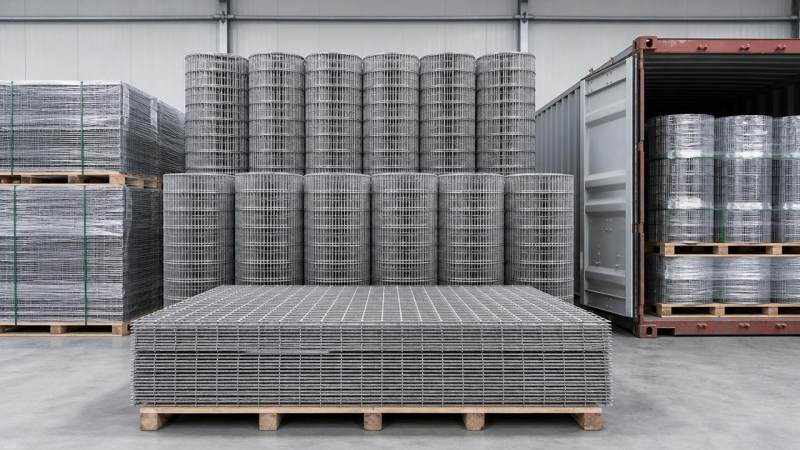
For distributors and agents, the biggest risk is rarely the quoted unit price. It is the gap between the sample, the paperwork, and the actual shipped goods.
Many importers assume welded mesh is a straightforward commodity. In practice, export orders can fail on wire diameter tolerance, mesh opening accuracy, welding strength, material grade, surface finish, and loading protection.
These details matter because your downstream customers do not judge a shipment by the invoice. They judge it by installation performance, corrosion resistance, appearance consistency, and whether every bundle matches the promised specification.
If one container arrives with mixed sizes, weak welds, or poor packaging, the problem quickly becomes bigger than a product issue. It becomes a claim, a delay, and a threat to your reputation.
That is why buyers searching for a reliable Stainless Steel Welded Mesh exporter are usually not only comparing prices. They are trying to reduce risk and improve repeat order confidence.
Standards confusion is one of the most common hidden problems
One of the first things buyers miss is the difference between “meeting a standard” and “matching the exact standard version, test method, and market expectation” required in the destination country.
Welded mesh may be discussed using ASTM, EN, JIS, or local commercial descriptions. Yet two suppliers using similar wording may still produce different tensile properties, tolerances, weld quality, or corrosion performance.
For distributors, this creates a serious issue. If your market expects one tolerance range or one material composition, a broadly compliant product may still trigger complaints or rejection.
Before confirming an order, buyers should verify the exact reference standard, raw material grade, wire processing method, and inspection basis. Do not rely only on a general statement such as “export standard.”
Ask the supplier to confirm what is controlled during production: wire diameter tolerance, spacing tolerance, panel flatness, welding point integrity, surface treatment thickness, and final dimensional verification.
The safest approach is to turn every commercial assumption into a written technical confirmation before deposit payment. This step prevents disputes that are difficult to solve after shipment.
Material grade and surface treatment deserve closer review
When buyers compare offers, they often focus on stainless versus galvanized and stop there. But long-term performance depends on more detailed factors than the top-level product description.
For stainless welded mesh, the actual grade affects corrosion resistance, fabrication behavior, and suitability for coastal, chemical, or humid environments. For galvanized products, coating mass and coating uniformity are equally important.
Some exporters quote attractive prices by reducing coating thickness, using less consistent raw material, or relaxing production tolerances. The goods may still look acceptable at first glance but perform poorly in service.
Distributors should request clear material declarations, coating details, and inspection records. If the order is intended for resale into industrial or construction channels, these records support your own customer communication.
Suppliers with broader steel manufacturing capability are often better positioned to explain coating systems, base metal behavior, and processing suitability across multiple applications.
For example, buyers handling related steel products may also source Galvanised Steel Sheet Metal for construction, appliances, transport, or light industry projects.
That category covers grades such as DX51D, SGCC, and S350GD, with thickness options from 0.12mm to 6.00mm and standards including ASTM, JIS, EN, and GB.
Understanding how coating quality and base material influence durability in one product family often helps buyers make better decisions in welded mesh procurement as well.
Packaging is not a minor detail in export performance
Many buyers only discover packaging problems after the goods arrive damaged, wet, bent, or mixed. By then, the commercial loss is already real and difficult to reverse.
Export packaging for welded mesh should be designed around loading method, transit route, climate exposure, unloading conditions, and final warehouse handling. Generic packing is often not enough.
Panels can deform if stacking pressure is poorly distributed. Rolls can loosen if binding is weak. Surface damage can occur when moisture protection is insufficient or when metal-to-metal friction is not controlled.
Distributors should confirm bundle weight, protective wrapping, palletization method, container loading pattern, edge protection, labels, and whether mixed sizes are loaded in a way that supports fast receiving.
Good packaging does more than protect the product. It reduces warehouse confusion, lowers labor time during sorting, and makes resale operations smoother for wholesalers and regional stockists.
If you regularly import multiple specifications, ask the exporter for packing photos from previous shipments. Real loading evidence is often more useful than a general promise on the quotation sheet.
Delivery consistency matters more than a single fast shipment
Another issue buyers often overlook is that one on-time first order does not automatically mean the supplier can support a stable supply relationship over six or twelve months.
Distributors and agents usually care about repeatability. Can the exporter maintain the same quality level, lead time discipline, and specification control when order volume increases or market conditions change?
This is where production capacity and internal process control become important. A capable exporter should explain raw material planning, production scheduling, inspection flow, and shipment coordination clearly.
Ask practical questions: What is the normal lead time by specification? How are urgent orders handled? How is consistency maintained across different batches? What happens if one dimension needs repeated production?
Dependable exporters do not treat these questions as pressure. They answer them because professional buyers are evaluating supply risk, not just product availability.
Hongteng Fengda serves buyers across North America, Europe, the Middle East, and Southeast Asia with a focus on stable production, consistent quality, and dependable lead times.
That matters for channel partners who need predictable replenishment rather than occasional spot success. In distribution, consistency is often the real source of margin protection.
Inspection documents should support claims prevention, not just customs clearance
Some buyers request certificates only because import procedures require them. A better approach is to use documents as part of your internal risk control and customer assurance process.
For welded mesh export orders, useful documentation may include material certificates, dimensional inspection records, coating-related reports where relevant, packing lists, heat or batch traceability, and shipment photos.
What matters is not document quantity alone. It is whether the documents connect clearly to the actual goods loaded into the container and to the specification agreed in the contract.
If you are buying as a wholesaler or regional distributor, this documentation can help resolve downstream questions quickly. It also strengthens your position if any claim arises later.
A reliable Stainless Steel Welded Mesh exporter should be willing to align inspection items with the market you serve, especially when goods are intended for industrial, construction, or resale channels.
Whenever possible, agree on acceptance criteria before production starts. Post-shipment arguments usually happen because pre-shipment definitions were too vague.
How experienced buyers evaluate an exporter before scaling orders
Seasoned importers rarely depend on brochure language alone. They evaluate whether the supplier can perform under commercial pressure, technical complexity, and timeline constraints.
First, they check whether the exporter understands destination-market expectations instead of only factory-side terminology. A supplier who asks precise questions usually reduces later misunderstandings.
Second, they review sample consistency, not just sample appearance. One good sample is not enough if mass production control is weak or subcontracting is unclear.
Third, they assess communication speed and clarity. Delays in answering technical questions before payment often become bigger delays when production issues appear.
Fourth, they confirm whether the supplier can support related product categories if needed. This can simplify procurement for customers sourcing broader steel solutions in parallel.
With experience in structural steel manufacturing and export, Hongteng Fengda supports buyers with standard specifications and customized solutions while working to reduce sourcing risk.
That combination is especially valuable for agents and distributors who need a long-term supplier relationship, not a one-time low-cost transaction.
A practical checklist before confirming your next welded mesh order
To avoid common sourcing mistakes, buyers should review a short but disciplined checklist before placing the order and releasing deposit.
Confirm the exact material grade, wire diameter, mesh opening, panel or roll dimensions, weld strength expectations, and applicable standard reference in writing.
Verify surface treatment details, including coating requirement where relevant, finish expectations, and any environmental performance needs tied to the end market.
Review packaging method, bundle identification, pallet or non-pallet loading, moisture protection, and container arrangement according to your receiving process.
Agree on inspection scope, document list, shipment photos, and claim-handling expectations before production starts, not after the vessel departs.
Finally, test the supplier’s consistency with a commercially meaningful order size. Small samples reveal some issues, but real process discipline shows up in actual export execution.
Conclusion: the best welded mesh orders are built on clarity, not assumptions
What buyers often miss in welded mesh export orders is not a single technical point. It is the cumulative impact of small unchecked details across standards, material, coating, packaging, documentation, and delivery.
For distributors, wholesalers, and agents, these details directly affect resale confidence, complaint rates, inventory flow, and customer retention. That is why selecting a Stainless Steel Welded Mesh exporter should be a risk decision as much as a price decision.
When you work with an experienced Chinese steel manufacturer and exporter that values quality control, stable capacity, and clear communication, sourcing becomes more predictable and scalable.
Hongteng Fengda helps global buyers reduce uncertainty with reliable steel products, customized support, and professional export service designed for long-term cooperation.
If your next order needs dependable execution instead of hidden surprises, the right question is not only “What is the price?” but also “How well is every critical detail controlled?”
Please give us a message


Please enter what you want to find