Choosing the right rebar for retaining wall construction affects strength, safety, and long-term performance. This guide explains how to select the best rebar size while considering soil pressure, wall height, and structural steel properties. It also highlights when lightweight structural steel and high strength structural steel solutions may support more efficient, durable retaining wall projects.
For engineers, contractors, buyers, and project managers, the question is rarely just “what bar size should I use?” In practice, rebar selection affects cracking control, wall stability, concrete cover, labor efficiency, inspection compliance, and total installed cost. A small residential wall may perform well with lighter reinforcement, while a commercial or infrastructure retaining wall often demands a more rigorous structural design with larger bars, tighter spacing, and stricter material verification.
Because retaining walls resist lateral earth pressure, surcharge loads, water pressure, and sometimes traffic vibration, the “best” rebar size depends on wall height, footing geometry, backfill condition, drainage quality, and local code requirements. In steel-related procurement, it also matters whether the project prioritizes standardization, easier handling, or optimized strength-to-weight performance across the full structural package.
How Rebar Size Affects Retaining Wall Performance
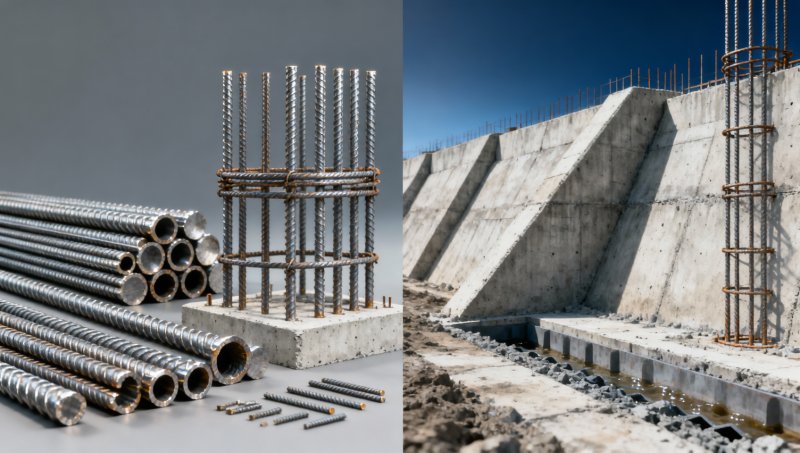
Rebar size directly influences the bending resistance and crack control capacity of a reinforced concrete retaining wall. In many small to medium projects, common bar sizes range from #4 to #6 in the U.S. system, roughly corresponding to diameters of about 12.7 mm to 19.1 mm. These sizes are widely used because they provide a practical balance between structural performance, concrete placement efficiency, and labor handling on site.
A taller wall generally needs either larger rebar, closer spacing, or both. For example, a gravity-style garden wall under 1.2 m may not require the same reinforcement approach as a cantilever retaining wall at 3 m to 5 m height. Once wall height increases, the bending moment at the base rises significantly, which means undersized rebar can lead to excessive cracking, deflection, or reduced service life under repeated wet-dry cycles.
Bar size should not be judged in isolation. Concrete strength, wall thickness, footing size, bar placement tolerance, and backfill drainage all influence real performance. A #5 bar placed correctly with proper cover and compaction can outperform a larger bar placed poorly. For quality control teams, dimensional accuracy and installation discipline are just as important as nominal bar diameter.
Another practical issue is constructability. Larger bars can reduce the total bar count, but they may create congestion at the wall-footing junction, especially in narrow sections. That congestion can interfere with concrete flow and vibration, leading to voids. In many retaining wall projects, the best design is not the largest bar available, but the bar arrangement that meets load requirements while maintaining clean concrete placement and reliable inspection outcomes.
Typical Rebar Sizes Used in Retaining Walls
The table below outlines typical bar size tendencies for common retaining wall situations. These are practical references only and should always be confirmed by a qualified structural engineer based on site loads, soil data, drainage, and code requirements.
The key takeaway is that #4 and #5 bars are among the most common practical choices, but the correct selection changes quickly as wall height, soil pressure, and loading increase. For procurement and approval teams, this means the best rebar size should be tied to the design load case rather than habit or price alone.
Key Design Factors That Determine the Best Rebar Size
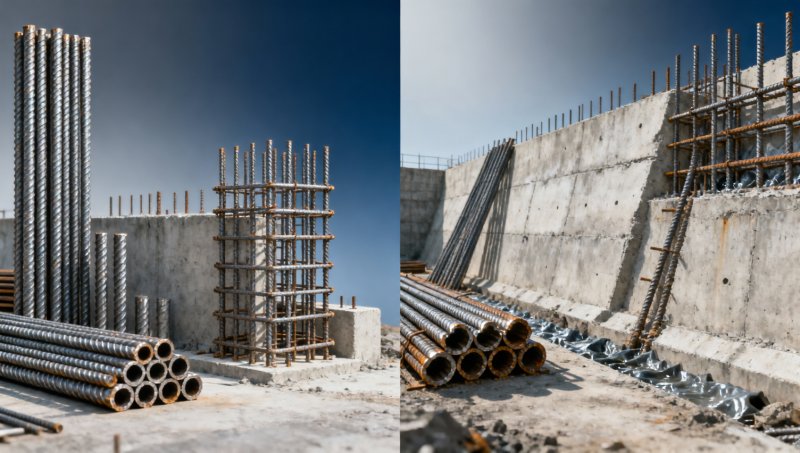
The first factor is wall height. As a rule of thumb, moving from a 1.5 m wall to a 3 m wall can more than double the bending demand near the base, depending on soil density and surcharge. That is why taller retaining walls often require either larger bars such as #5 or #6, or a tighter spacing pattern such as 150 mm to 250 mm on center instead of wider intervals.
The second factor is soil condition. Dense granular backfill behaves differently from saturated clay. If the retained soil has poor drainage or a higher water table, hydrostatic pressure may increase the load far beyond what dry-soil assumptions would suggest. In these cases, designers may increase reinforcement, enlarge the footing, or improve drainage layers to reduce structural demand on the wall stem.
The third factor is surcharge. Parking areas, storage zones, fences, and nearby buildings can introduce extra lateral pressure. Even an apparently moderate wall can require a stronger reinforcement schedule when there is a live load behind it. For project estimators and technical reviewers, surcharge is a frequent source of underdesign if it is not clearly identified early in the planning phase.
The fourth factor is code compliance and durability. Required concrete cover often ranges around 40 mm to 75 mm depending on exposure and construction method. If a larger bar reduces spacing too much or pushes cover below specification, that “upgrade” may actually create compliance and durability issues. Proper bar development length, lap splice length, and corrosion exposure must also be considered.
Four Checks Before Finalizing Rebar Size
- Confirm wall type: gravity, cantilever, counterfort, segmental, or hybrid reinforced system.
- Verify design inputs: retained height, backfill unit weight, groundwater condition, and surcharge load.
- Check constructability: clear spacing, bar congestion, concrete vibration access, and cover tolerance.
- Review standards and inspection points: ASTM, EN, JIS, or GB material compliance plus local structural code requirements.
When lightweight structural steel or high strength structural steel matters
Although rebar is the primary reinforcement inside the concrete wall, the broader project may also include steel frames, rail supports, brackets, access platforms, or prefabricated components. In these cases, lightweight structural steel can reduce handling effort and improve installation speed, while high strength structural steel can help maintain capacity with optimized section weight. This is particularly useful in modular retaining systems, industrial sites, and projects with tight access or lifting constraints.
For global buyers, working with a structural steel supplier that understands ASTM, EN, JIS, and GB requirements can simplify cross-border sourcing. Hongteng Fengda supports this type of coordinated supply approach by offering angle steel, channel steel, steel beams, cold formed steel profiles, and customized structural steel components for international construction and industrial projects.
Practical Rebar Recommendations by Retaining Wall Type
Different retaining wall systems distribute forces differently, so the most suitable rebar size varies by configuration. A poured-in-place cantilever wall usually concentrates tension near the back face of the stem and at the footing heel, while a counterfort wall redistributes loads through triangular webs. Segmental retaining walls may use geogrid rather than heavy internal rebar, but concrete footing sections and attached structural elements may still require reinforced detailing.
For smaller residential walls, #4 bars are frequently chosen because they are easier to bend, tie, and place. For mid-range commercial walls, #5 bars are common where the stem thickness and footing geometry support them. In higher-load applications, #6 or larger bars may be used, but spacing, lap length, and concrete consolidation become more critical as reinforcement density rises.
A common field mistake is assuming vertical bars do all the work. In reality, horizontal reinforcement helps distribute stresses and control cracking, especially near the top and around transitions. Footing reinforcement is equally important because overturning and sliding resistance depend on the wall and base acting together as a stable structural unit.
For procurement teams, the most efficient approach is to review not only the bar size but also bar grade, cutting schedule, bending list, and delivery format. A project with 10% lower bar waste and fewer installation delays can often save more than a project that only focuses on unit price per ton.
Typical selection logic for field use
The following comparison helps technical and purchasing teams match typical wall conditions with a practical reinforcement direction. Final dimensions should still be engineered and checked against local regulations and site-specific load conditions.
From a project control perspective, the best rebar size is the one that satisfies structural calculations, passes inspection, and can be installed consistently within the wall geometry. Oversizing without regard to spacing and placement often creates avoidable site problems.
Inserted material note for broader steel sourcing
In some industrial retaining wall environments, drainage systems, utility sleeves, heat transfer piping, or nearby process equipment may require additional steel products beyond reinforcement steel. Where tubular components are part of the broader package, buyers may also evaluate products such as A36 Steel Pipe for related applications. This product category can be supplied in diameter ranges from 10 mm to 914.4 mm, with thicknesses from 1 mm to 100 mm and unit lengths such as 3 m, 5.8 m, 6 m, 11.8 m, 12 m, or 13.5 m, depending on project needs.
For buyers handling integrated industrial construction packages, it is useful to note that such pipe products may align with standards including ASTM A106, A53, A179, A333, A500, API 5L, EN10210, and GB/T 8163. In applications like tubular heat exchangers, condensers, and similar heat transfer equipment, seamless cold-drawn low-carbon steel tubes with minimum wall thickness control can support reliable performance where process equipment interfaces with civil or structural works.
Procurement, Quality Control, and Installation Risks
Even a well-designed retaining wall can underperform if procurement and installation control are weak. One common issue is receiving rebar with inconsistent dimensional tolerance, unclear marking, or incomplete mill documentation. Another is field substitution, where a bar size is changed without recalculating spacing or development length. For quality and safety managers, these are not minor paperwork issues; they directly affect structural reliability.
Inspection should cover at least 6 items before concrete placement: bar size, bar spacing, lap splice length, concrete cover, anchorage position, and cleanliness of the formwork cavity. On many projects, cover blocks and spacer chairs deserve more attention. A design may specify 50 mm cover, but if the cage shifts during pouring, the actual durability performance can drop quickly in wet or chloride-exposed environments.
Lead time also matters. Standard rebar sizes are easier to source in stable volume, but fabricated cages, custom bends, and coordinated deliveries with structural steel accessories may require 2 to 4 weeks depending on quantity and export routing. Global project buyers often reduce risk by confirming standards, packing, marking, and shipping sequence before production begins rather than after the first lot is completed.
For distributors and contractors, supplier capability should include more than price competitiveness. Stable production capacity, consistency across batches, and familiarity with export documentation can affect total project performance. That is especially true when structural steel, channels, beams, and customized profiles are supplied alongside reinforcement-related materials in one construction package.
Common mistakes that increase retaining wall risk
- Using a larger bar but widening spacing too much, which reduces crack distribution control.
- Ignoring drainage design, causing water pressure to exceed the intended structural load case.
- Failing to coordinate footing steel with stem steel, leading to weak force transfer at the wall base.
- Substituting material grades or sizes on site without engineering approval.
- Overlooking corrosion exposure, cover requirements, or lap splice congestion in tight sections.
What buyers should ask suppliers
Before placing an order, purchasing and commercial teams should ask for standard compliance details, available size range, rolling or fabrication tolerance, packing method, traceability documents, and expected shipment cycle. If the project includes structural steel supports or custom fabricated components, it is also wise to confirm whether the supplier can coordinate multiple product types under one inspection and delivery plan.
FAQ: Choosing Rebar Size for Retaining Walls
The following questions reflect common search intent from contractors, specifiers, buyers, and property owners. They also help clarify where practical rules of thumb end and engineering review must begin.
Is #4 rebar enough for a retaining wall?
#4 rebar is often enough for smaller retaining walls, especially around 1.2 m to 2 m in height, when the wall has proper footing dimensions, effective drainage, and no significant surcharge load. However, if the wall retains saturated soil, supports vehicle loading, or exceeds typical residential height, #4 may be insufficient. The wall design should be verified against site conditions rather than assumed from common practice alone.
When should #5 or #6 rebar be considered?
#5 and #6 bars are more often considered when wall height rises above about 2.5 m, when surcharge is present, or when soil and groundwater conditions increase design pressure. They are also used where engineering calculations show higher moment demand at the wall base. The decision may involve larger bars, closer spacing, or a combination of both depending on stem thickness and footing geometry.
Does closer spacing work better than a larger bar?
In some cases, yes. Closer spacing with moderately sized bars can improve crack control and concrete distribution compared with fewer oversized bars. For example, a well-detailed layout using #4 or #5 bars at 150 mm to 200 mm spacing may offer better constructability than larger bars placed too far apart. The final choice depends on structural demand, wall thickness, and practical installation limits.
What is the most overlooked factor in retaining wall reinforcement?
Drainage is one of the most overlooked factors. A correctly reinforced wall can still fail prematurely if hydrostatic pressure builds up behind it. Weep holes, drainage aggregate, filter fabric, and discharge path planning are often just as important as rebar size. In many real projects, better drainage can reduce structural stress more effectively than simply increasing bar diameter.
Selecting the best rebar size for a retaining wall means balancing structural demand, constructability, durability, and procurement efficiency. In many practical cases, #4 and #5 bars are common choices, while #6 or larger bars are reserved for taller or more heavily loaded walls. The right answer always depends on wall height, soil pressure, drainage, surcharge, and detailing quality rather than a one-size-fits-all rule.
For companies sourcing reinforcement-related materials together with structural steel sections, cold formed profiles, or customized components, coordinated supply can reduce risk and improve schedule control. Hongteng Fengda supports global buyers with reliable structural steel manufacturing, international standard compliance, and stable export service for construction and industrial projects.
If you need support evaluating retaining wall steel requirements, matching structural steel products to project conditions, or planning a more efficient procurement package, contact us today to get a tailored solution, request product details, or discuss your next project with our team.
Please give us a message


Please enter what you want to find