What is angle steel, and when does it make the most sense for a project? As a versatile structural steel profile, angle steel is widely used in construction, fabrication, and support systems thanks to its strength, simple shape, and cost efficiency. Understanding its common uses, material standards, and selection factors can help buyers, engineers, and project planners choose the right option with greater confidence.
What Is Angle Steel and Why Is It So Common?
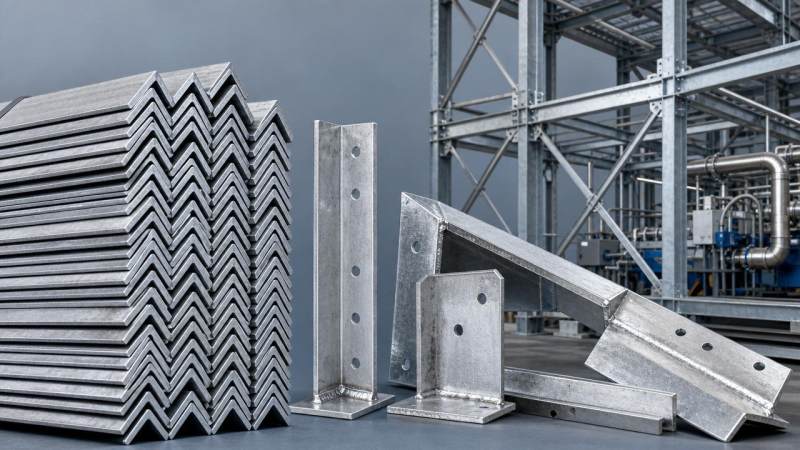
Angle steel is a long steel section formed into an L shape, with two legs joined at a right angle. It is one of the most widely used structural profiles.
When people search for what is angle steel, they usually want more than a definition. They want to know where it is used, why it is chosen, and whether it fits a project.
In practical terms, angle steel is often the right choice when a structure needs reliable support, easy fabrication, and lower material cost than more complex steel sections.
It is commonly used in frames, brackets, towers, equipment supports, edge protection, reinforcement parts, and many secondary structural applications in commercial and industrial projects.
Its popularity comes from a simple advantage: angle steel offers a strong shape that is easy to cut, drill, weld, bolt, transport, and install.
How Angle Steel Is Made and What Types Buyers Usually See
Angle steel is typically produced by hot rolling, although some lighter profiles may be formed by cold processing. Hot rolled angles are the most common in structural applications.
The two main categories are equal angle steel and unequal angle steel. Equal angles have two legs of the same length, while unequal angles have different leg lengths.
Equal angles are often chosen for general structural use because they are simple to specify and widely available. Unequal angles are useful where loading or connection geometry is not symmetrical.
Buyers also need to distinguish between mild carbon steel angles and higher strength low alloy options. The right grade depends on the mechanical demands and code requirements.
Surface condition can vary as well. Some angle steel is supplied black, while other material may be galvanized, primed, or further processed for corrosion resistance.
What Is Angle Steel Used For in Real Projects?
Angle steel is used across construction, infrastructure, machinery, and manufacturing because it works well as both a load carrying member and a support component.
In buildings, it often appears in stair framing, bracing systems, lintel supports, rack structures, handrail frames, platform supports, and connection details.
In industrial settings, angle steel is commonly used for equipment bases, maintenance walkways, pipe supports, cable tray framing, and protective guarding structures.
It is also widely used in transmission towers, storage systems, trailers, agricultural equipment, and workshop fabrication where practical strength matters more than architectural appearance.
For many fabricators, angle steel is a preferred material because it can be adapted quickly in the workshop without complicated forming or expensive machining.
When Is Angle Steel the Right Choice?
Angle steel is usually the right choice when the project needs efficient structural support without the higher cost or weight of larger steel sections such as wide flange beams.
It performs especially well in secondary framing, bracing, and connection applications where compact shape, easy fastening, and moderate load capacity are key requirements.
If the member will be exposed and must resist bending from several directions, another profile may sometimes perform better. But for many support roles, angle steel remains highly competitive.
It is also a smart option when fabrication speed matters. The L shaped profile is easy to integrate into welded assemblies and bolted structures.
For buyers balancing budget and function, angle steel often delivers a strong value ratio because it is standard, versatile, and available in many sizes and grades.
When Angle Steel May Not Be the Best Option
Although angle steel is highly useful, it is not ideal for every structural problem. Choosing it without considering loading conditions can lead to overdesign or inefficient fabrication.
For example, if a member must carry heavy loads over a long span, an I beam or H beam may provide better bending efficiency with less deflection.
If torsional performance is important, or if the load path is complex, hollow sections or channels may be better suited than angle steel.
Appearance can also matter. In architectural applications where clean symmetry is important, rectangular hollow sections may offer a more refined visual result.
This is why understanding function first matters more than simply choosing a familiar product. Angle steel is excellent, but only when its strengths match the job.
What Buyers Should Check Before Selecting Angle Steel
For information-focused readers, the most useful question is not just what is angle steel, but how to judge whether one specification is right for a project.
Start with loading requirements. The thickness, leg size, and steel grade all affect strength, stiffness, and suitability for welding or bolting.
Next, consider whether equal or unequal angles make more sense. The decision often depends on connection layout, available space, and how the force is transferred.
Then review material standards. International buyers often request compliance with ASTM, EN, JIS, or GB, depending on the project region and contract requirements.
Corrosion environment is another major factor. Outdoor, coastal, or chemical exposure may require galvanized angle steel or additional protective coating systems.
Tolerance and straightness should also be reviewed, especially for projects involving precision fabrication or automated downstream processing.
Finally, think about supply consistency. Even if a section works on paper, unreliable production or unstable lead times can create avoidable project risk.
Material Standards, Grades, and Why They Matter
Angle steel is not a single universal product. Mechanical performance depends heavily on steel grade, chemical composition, dimensional tolerances, and production standard.
Common standards may include ASTM, EN, JIS, and GB. These define key requirements such as yield strength, tensile strength, chemistry, dimensions, and inspection criteria.
For example, a buyer comparing offers should not evaluate price alone. Two angle steel products may look similar but perform differently in welding, load bearing, or corrosion exposure.
Documentation is therefore important. Mill test certificates, inspection records, and standard compliance details help buyers confirm that the material fits design expectations.
For export projects, working with a manufacturer familiar with multiple international standards can simplify specification matching and reduce approval delays.
How Angle Steel Compares with Other Structural Steel Profiles
Compared with channel steel, angle steel is usually simpler and lighter for small support applications, though channels may offer better directional stiffness in some layouts.
Compared with steel beams, angle steel is less suitable for major primary load carrying spans, but far more economical for brackets, braces, and local framing tasks.
Compared with hollow sections, angle steel is easier to access for bolting and welding, especially in open assemblies and retrofit work.
Its open profile also makes inspection and field modification simpler. That can be valuable in maintenance heavy environments and custom fabrication workshops.
The tradeoff is that angle steel may be less efficient in certain structural directions. Good selection always depends on how the profile will actually work in service.
Why Fabricators and Global Buyers Often Prefer It
From a sourcing perspective, angle steel has several practical advantages. It is widely recognized, relatively easy to quote, and available in many standard dimensions.
It also helps reduce fabrication complexity. Many workshops already have the tools and routines needed to cut, punch, weld, and assemble angle steel quickly.
For international buyers, this can support cost control across both material purchasing and downstream processing. Less complexity often means fewer delays and fewer errors.
That same logic applies in repair and replacement work. Standard angle sections are often easier to match or substitute than specialized profiles.
In markets where project timing matters, dependable supply and straightforward fabrication can be just as important as theoretical structural efficiency.
Related Steel Products in Broader Manufacturing Supply Chains
Angle steel often appears alongside other steel products in construction and industrial procurement. In some projects, supporting materials are needed for reinforcement, forming, or manufacturing processes.
For example, Wire Rod is widely used in building materials, structural steel bar applications, auto manufacturing, shipbuilding, petrochemical plants, and precision tools.
Available in grades such as GB1499.2 HRB400, HRB500, ASTM A615 Grade 60, and BS4449 460B, it offers excellent formability and weldability for a wide variety of uses.
With carbon steel rebar and materials such as Q235, Q345, St37, and related grades, it is commonly supplied in round shape and lengths from 1 to 12 meters.
For buyers managing mixed steel demand, understanding how different products fit together can improve procurement planning and reduce supply coordination issues.
How to Decide with More Confidence
If you are evaluating angle steel for a future project, begin with the application rather than the product name. Ask what the member must support, resist, and connect to.
Then compare profile options based on structural role, fabrication method, exposure conditions, and code requirements. This quickly reveals whether angle steel is a logical fit.
It is often the best answer for practical support structures, secondary framing, reinforcement, and fabrication friendly components that need dependable performance without unnecessary cost.
It may be less suitable for long span primary members or situations requiring more symmetrical strength and stiffness. That distinction is where good selection decisions begin.
For sourcing teams, working with a manufacturer that offers standard compliance, customization capability, and stable delivery can further reduce risk.
Conclusion
So, what is angle steel? It is an L shaped structural steel section valued for its strength, versatility, ease of fabrication, and cost efficiency.
The right time to choose angle steel is when a project needs practical support, simple connections, and reliable structural performance in a widely available form.
For buyers, engineers, and planners, the key is not only understanding the definition, but also knowing the limits, standards, and real use cases that affect selection.
When matched to the right application, angle steel remains one of the most useful and economical structural steel products in global construction and manufacturing.
Please give us a message


Please enter what you want to find