Understanding galvanized steel sheet specifications is becoming more important as steel sourcing grows more standardized, global, and quality-driven.
Small errors in reading galvanized steel sheet specifications can cause coating mismatch, forming problems, delivery disputes, or failed compliance checks.
For steel distribution and project supply, correct interpretation supports better cost control, safer substitution decisions, and more predictable performance.
This guide explains how to read galvanized steel sheet specifications clearly, why market expectations are changing, and what details deserve closer attention.
Why galvanized steel sheet specifications now matter more than before
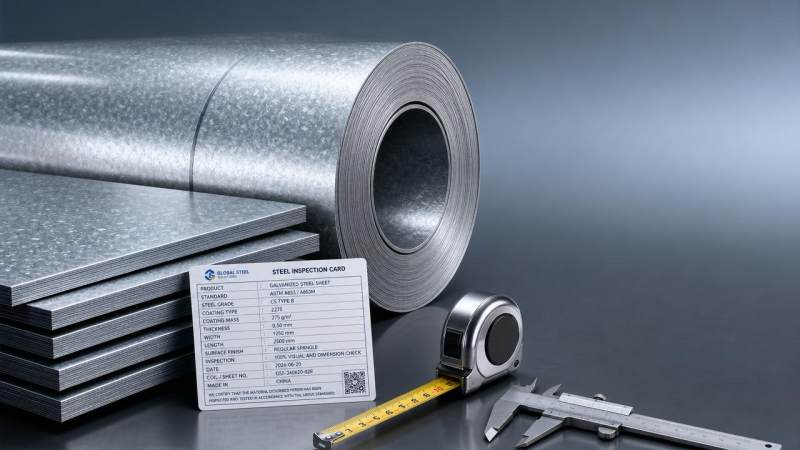
The market no longer accepts vague descriptions like “standard galvanized sheet” without supporting technical detail.
Today, galvanized steel sheet specifications often determine whether material fits roofing, ductwork, appliance panels, framing, or fabrication uses.
Buyers also compare products across ASTM, EN, JIS, and GB systems, making specification literacy a practical sourcing skill.
As coating expectations rise and fabrication becomes more precise, specification gaps are easier to detect and harder to excuse.
The strongest trend signals behind tighter specification reading
Several industry shifts explain why galvanized steel sheet specifications receive greater scrutiny across supply chains.
In short, galvanized steel sheet specifications are not just technical labels. They are commercial risk controls.
How to read galvanized steel sheet specifications without missing critical details
A complete specification line usually combines base steel, thickness, width, coating, surface treatment, grade, and reference standard.
For example, a sheet may include nominal thickness, coating mass such as Z120 or Z275, and a grade tied to forming or structural use.
1. Base metal thickness is not always the delivered total thickness
One common mistake is assuming the listed thickness always includes the zinc coating.
Some standards define base steel thickness first, while others state total coated thickness differently in trade documents.
Always confirm whether galvanized steel sheet specifications refer to base metal thickness or finished thickness after coating.
2. Coating designation directly affects corrosion performance
Z coating numbers typically represent zinc coating mass per square meter.
A higher coating mass usually supports better corrosion resistance, but also influences price, forming behavior, and end-use suitability.
Galvanized steel sheet specifications should therefore be matched to exposure conditions, not selected only by cost.
3. Grade tells you how the sheet should perform
Commercial quality, drawing quality, and structural grades serve different needs.
If forming is required, elongation and bendability may matter more than higher strength.
If load-bearing use is expected, yield strength and standard compliance become more important inside galvanized steel sheet specifications.
4. Tolerance details should never be treated as minor notes
Thickness tolerance, width tolerance, camber, and flatness all affect downstream processing efficiency.
These values are especially important for roll forming, laser cutting, stamping, and panel assembly.
5. Surface condition can change usability
Spangle, passivation, oiling, and chemical treatment influence storage, paint adhesion, and visual appearance.
A correct reading of galvanized steel sheet specifications should include the intended surface finish and treatment status.
Why standard names alone do not guarantee equivalent material
Many assume that similar-looking grades from ASTM, EN, JIS, or GB are fully interchangeable.
That assumption creates risk because coating classes, mechanical properties, and test methods may differ.
- Check the exact standard edition, not only the standard family.
- Review coating designation definitions before approving substitutions.
- Compare mechanical property ranges and not just grade names.
- Confirm whether the material is intended for forming or structural service.
This is also true across other carbon steel categories.
For projects needing broader steel procurement, products like Hot rolled Carbon Steel Round Bar show the same need for careful reading of grades, dimensions, finishes, and standards.
That product range covers Carbon Steel materials, multiple models, diameters from 5-2500mm, and standards including AISI, ASTM, DIN, JIS, GB, SUS, and EN.
The lesson is consistent: clear specifications reduce sourcing ambiguity across sheet, bar, and structural steel categories.
How specification errors affect cost, delivery, and project confidence
Misreading galvanized steel sheet specifications can create problems long before material reaches the jobsite or factory line.
As projects become faster and leaner, these mistakes are more expensive than before.
What should be checked first when reviewing galvanized steel sheet specifications
A practical review sequence improves consistency and reduces oversights.
- Confirm the application environment and corrosion exposure level.
- Check the governing standard and exact grade designation.
- Verify thickness basis, width, length, and tolerance range.
- Review coating mass or coating thickness requirement.
- Confirm surface treatment, spangle, and oiling condition.
- Check mechanical properties if forming or structural use is involved.
- Match documentation requirements with mill test certificates.
This checklist makes galvanized steel sheet specifications easier to evaluate under time pressure.
Where reliable suppliers add value beyond the specification line
Strong suppliers do more than quote numbers.
They help clarify equivalent grades, explain tolerance implications, and identify when a lower-cost option may create later risk.
As a structural steel manufacturer and exporter from China, Hongteng Fengda supports global projects with stable production, strict quality control, and customized steel solutions.
With experience across ASTM, EN, JIS, and GB systems, the company helps reduce confusion when specifications cross regional standards.
That support becomes valuable when galvanized steel sheet specifications must align with broader structural steel sourcing plans.
How to make better sourcing decisions from this point forward
The direction is clear: galvanized steel sheet specifications are becoming more exact, more comparable, and more important in final material performance.
Future-ready sourcing depends on reading beyond the basic size and price line.
- Build internal review habits around standards, coating, and tolerance.
- Request complete technical offers before confirming substitutions.
- Use application-based selection instead of generic galvanized sheet descriptions.
- Keep traceable documents for every accepted specification change.
If you are evaluating galvanized steel sheet specifications for upcoming orders, compare technical details early and confirm compliance before production starts.
A clearer specification today often prevents a larger problem tomorrow.
Please give us a message


Please enter what you want to find