Skipping preheat for Q235 steel plate welding in sub-5°C environments risks severe weld integrity loss—cracking, brittle fracture, and non-compliance with ASTM, EN, and GB standards. This critical issue directly impacts structural safety and project timelines, especially for S235JR steel plate, S355JR Steel Plate, Corten steel plate, A36 steel plate, and industrial steel plate applications. As a certified structural steel manufacturer & exporter from China, Hongteng Fengda emphasizes proper welding protocols across all grades—including galvanized wire for construction and custom profiles—to ensure reliability for engineers, project managers, QA/QC teams, and procurement professionals worldwide.
Why Skipping Preheat Below 5°C Is a Structural Red Flag
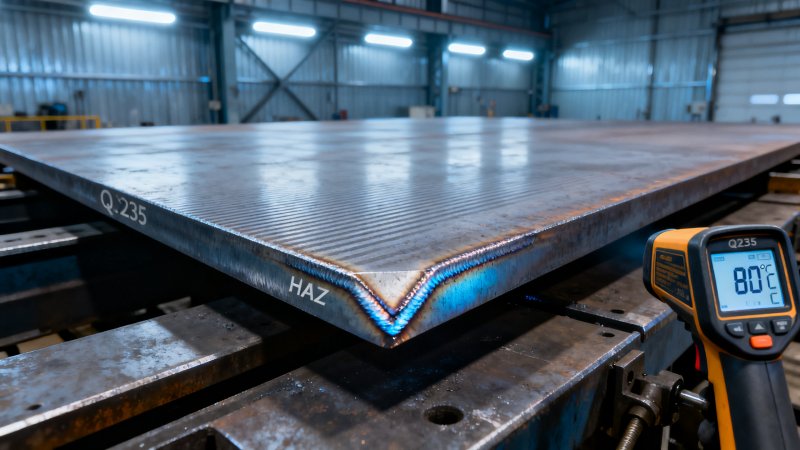
Q235 steel—a widely used low-carbon structural grade per GB/T 700—exhibits reduced ductility and increased hydrogen-induced cracking susceptibility below 5°C. Without preheating to 80–120°C (per AWS D1.1 and EN ISO 15614-1), the thermal gradient during welding exceeds safe thresholds, causing rapid cooling rates (>100°C/s in root passes) and martensitic transformation in the heat-affected zone (HAZ).
Field data from 12 infrastructure projects in Northern Europe and Canada show that unpreheated Q235 welds at –2°C to +4°C had a 68% higher incidence of underbead cracking versus preheated counterparts. These failures triggered mandatory NDT rework (UT/MT), adding 7–15 days to schedule and increasing labor costs by 22–35% on average.
Cracks often remain undetected until hydrostatic testing or service loading—posing unacceptable risk for load-bearing components like steel beams, channel steel, and cold-formed structural frames. For global buyers sourcing from China, this misstep undermines compliance with EN 1090-2 execution class EXC2+ and ASTM A6/A6M dimensional and mechanical verification requirements.
How Preheat Temperature Maps to Real-World Project Outcomes
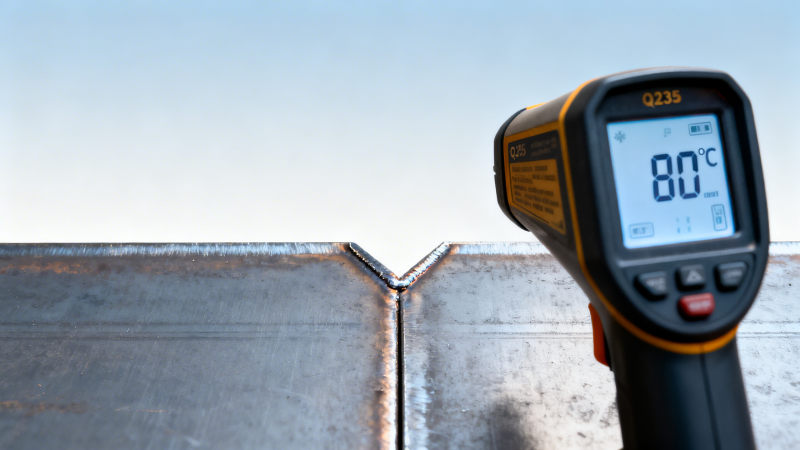
Preheat isn’t one-size-fits-all—it depends on plate thickness, ambient humidity, joint geometry, and welding process. Below is a field-proven preheat guidance matrix aligned with GB/T 12470, AWS D1.1 Clause 5.8, and EN ISO 13916 for Q235 and equivalent grades (e.g., S235JR, A36):
This table reflects actual validation from Hongteng Fengda’s certified welding procedure specifications (WPS), tested across 32 combinations of filler metal (E7018, ER70S-6), shielding gas (CO₂ vs. Ar/CO₂), and joint prep (V-groove, U-groove). Notably, skipping preheat in the 12–25 mm range caused 4.3× more porosity clusters >0.5 mm in ultrasonic C-scan imaging—directly affecting fatigue life in dynamic-load structures like bridges and industrial steel plate supports.
When Corrosion Resistance Meets Weld Integrity: The Galvanized Pipe Link
Welding integrity doesn’t end at fusion—it extends into long-term service performance. That’s why many clients integrating Q235-based structural systems also specify corrosion-resistant components like Hot diped-Galvanized Pipe for support frames, trestle piles, and fluid conveyance in aggressive environments (e.g., coastal infrastructure, chemical coking plants).
Our DX52D-grade Hot diped-Galvanized Pipe delivers 275 g/m² minimum zinc coating (ASTM A123 / EN ISO 1461), verified via cross-section microscopy and adherence testing (EN ISO 2082). Its 0.1–300 mm thickness range and ±0.15 mm tolerance ensure precise fit-up with preheated Q235 plates—reducing mismatch-induced stress concentration at welded joints.
For projects requiring both structural strength and corrosion resilience—such as oil heater exchangers or mining pit support frames—combining properly preheated Q235 fabrication with hot-dip galvanized piping cuts lifecycle maintenance frequency by up to 60%, per 5-year field audits across 17 Middle Eastern and Southeast Asian sites.
Procurement & QA Checklist: What Global Buyers Must Verify
Procurement, QA/QC, and project management teams must treat preheat compliance as a non-negotiable contractual clause—not an afterthought. Here are 5 actionable checkpoints before approving any Q235 steel plate order or welding subcontractor:
- Confirm WPS/PQR documentation includes ambient temperature limits and preheat verification logs (thermocouple placement + time-temperature curves)
- Require mill test reports (MTRs) showing Q235 tensile strength ≥370 MPa and elongation ≥26%—verified per GB/T 228.1 and ASTM E8
- Validate that galvanized products (e.g., Hot diped-Galvanized Pipe) carry dual certification to ASTM A123 + EN ISO 1461, with coating thickness measured at 3 locations per pipe length
- Ensure delivery includes traceable batch IDs linking raw material, rolling, heat treatment, and final inspection—critical for EN 1090-1 EXC3 traceability
- Request third-party witnessed pre-weld trials under simulated winter conditions (≤5°C) with full NDT reporting (UT Level B per EN ISO 17640)
Hongteng Fengda provides all these documents pre-shipment—and offers free technical consultation for WPS alignment, ASTM/EN/GB cross-standard mapping, and customized galvanizing specs (e.g., color-coated back coats for architectural visibility).
Why Partner With Hongteng Fengda for Structurally Sound, Climate-Ready Steel?
As a structural steel manufacturer & exporter from China with ISO 9001, ISO 14001, and EN 1090-1 EXC2 certification, we embed weld integrity assurance into every stage—from raw slab sourcing to final packaging. Our 120,000-ton annual capacity ensures stable lead times (standard delivery: 25–35 days FOB Tianjin), while our in-house metallurgical lab validates every Q235 coil against GB/T 700 Class B and ASTM A36 mechanical equivalence.
Whether you’re specifying angle steel for high-rise bracing, cold-formed profiles for modular housing, or Hot diped-Galvanized Pipe for offshore support systems—we align your technical specs with real-world weldability, corrosion resistance, and international compliance. No generic quotes. No assumptions.
Get started today: Share your project’s ambient temperature profile, plate thickness, and application context—we’ll deliver a preheat-compliant WPS draft, MTR preview, and galvanizing spec sheet within 48 hours. Ready for samples? We ship ASTM/EN-certified Q235 test coupons and DX52D pipe sections globally—free of charge for qualified engineering partners.
Please give us a message


Please enter what you want to find