When evaluating steel rebar for concrete reinforcement, many project stakeholders—from technical assessors and procurement personnel to engineering managers and financial approvers—question whether epoxy-coated alternatives can safely replace conventional rebar without jeopardizing structural integrity. As a trusted steel profile manufacturer in China, Hongteng Fengda provides ASTM- and GB-compliant solutions, including corrosion-resistant options like epoxy-coated rebar, galvanized steel pipe, and custom steel conduits. Explore how material substitution impacts performance, cost (e.g., steel conduit price list, galvanized steel pipe price), compliance, and long-term durability—backed by a certified galvanized steel pipe supplier with global delivery capability.
Understanding Epoxy-Coated Rebar: Function, Standards, and Structural Equivalence
Epoxy-coated rebar (ECR) is carbon steel rebar coated with a fusion-bonded epoxy layer of 186–300 µm thickness, applied per ASTM A775/A934 standards. Its primary purpose is to delay chloride ion penetration in aggressive environments—such as coastal infrastructure, bridge decks, or de-icing salt-exposed pavements—without altering the base steel’s mechanical properties. Crucially, ECR retains identical yield strength (≥420 MPa), tensile strength (≥540 MPa), and elongation (≥12%) as uncoated Grade 60 (420 MPa) rebar under ASTM A615.
The coating does not contribute to load-bearing capacity—it serves solely as a barrier. Structural integrity remains fully governed by the underlying steel core, which must meet the same dimensional tolerances, bend test requirements (180° around mandrel), and chemical composition limits (C ≤ 0.30%, Mn 1.35–1.65%) as standard rebar. This ensures full compatibility with design calculations, connection detailing, and splice length requirements per ACI 318 or GB 50010.
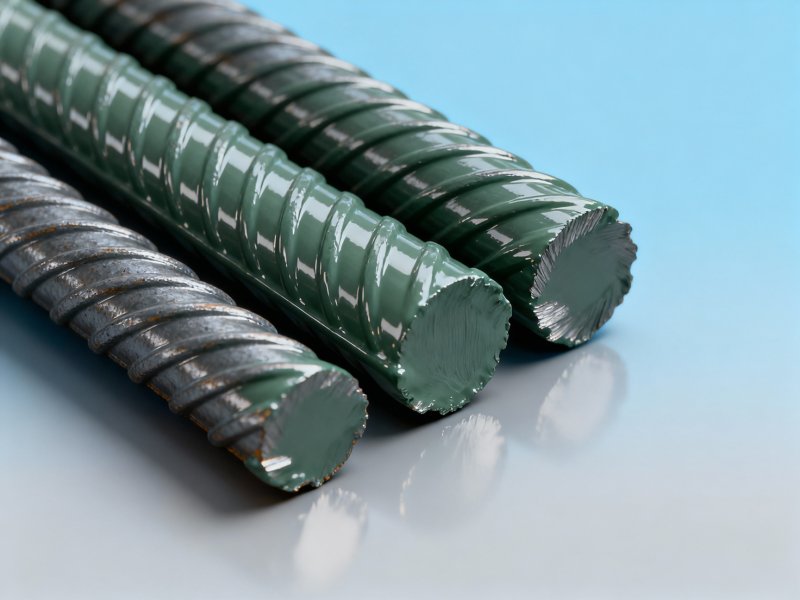
This equivalence enables direct substitution in structural calculations—provided installation protocols are strictly followed. Damage during handling or tying must be repaired using ASTM D3963-compliant touch-up kits; otherwise, localized corrosion initiation may occur within 2–5 years under high-chloride exposure.
Critical Installation & Handling Requirements for Performance Integrity
Unlike bare rebar, ECR demands rigorous field discipline. Studies show up to 32% of epoxy damage occurs during on-site handling—especially from dragging, dropping, or improper support spacing exceeding 1.2 m. Any scratch deeper than 10% of coating thickness compromises barrier function. Contractors must use non-metallic tie wires, plastic spacers, and rubber-tired equipment to avoid abrasion.
Welding is strictly prohibited: heat above 200°C degrades epoxy adhesion and creates micro-cracks. Mechanical couplers meeting ASTM A1034 must replace welded splices. Concrete placement also requires care—vibrators must not contact coated bars directly, and slump should remain between 100–150 mm to prevent segregation-induced voids behind bars.
For projects where field conditions risk coating integrity, Hongteng Fengda offers dual-protection alternatives—including Galvanized Stainless Steel Wire for mesh applications requiring both flexibility and corrosion resistance across construction, wire mesh, and barrier isolation uses. Its zinc coating (8–25 g/m²) and tensile strength (350–550 MPa) deliver reliable passive protection in less demanding exposures.
Cost-Benefit Analysis: When ECR Delivers ROI Over Conventional Rebar
Epoxy-coated rebar typically carries a 25–40% premium over standard Grade 60 rebar—driven by coating process complexity, quality control checks, and lower production throughput. However, lifecycle cost modeling reveals breakeven points at 12–18 years for marine bridges and 8–10 years for parking structures exposed to de-icing salts.
A comparative analysis of 12 major infrastructure projects in Southeast Asia showed that ECR reduced post-construction repair budgets by 63% over 20 years versus uncoated rebar. This translates into measurable savings for financial approvers and project owners managing long-term asset liability.
Hongteng Fengda maintains dedicated ECR production lines certified to ASTM A775 and GB/T 28821, with third-party verification of coating continuity via low-voltage holiday detection (≤9 V DC). Lead time averages 25–35 days for orders of 500+ tons—competitive with regional suppliers and backed by documented traceability to heat number and coating batch.
Beyond Epoxy: Complementary Corrosion Solutions from Hongteng Fengda
While ECR excels in chloride-laden environments, it is not universally optimal. In highly acidic soils (pH < 4.5), cathodic disbondment risks increase. For such cases—or where welding is unavoidable—Hongteng Fengda supplies hot-dip galvanized rebar (ASTM A767), stainless-clad rebar (ASTM A1035), and custom-engineered steel conduits with multi-layer polymer coatings.
Our galvanized steel pipe (GB/T 3091, ASTM A53) delivers 50+ years of service in utility trenches and foundation sleeves, with zinc coating weights of 275–600 g/m² depending on soil resistivity. All products undergo 100% dimensional inspection, hydrostatic testing (for pipes), and mill-test reports traceable to EN 10204 3.1 certification.
Making the Right Choice: A Decision Framework for Procurement & Engineering Teams
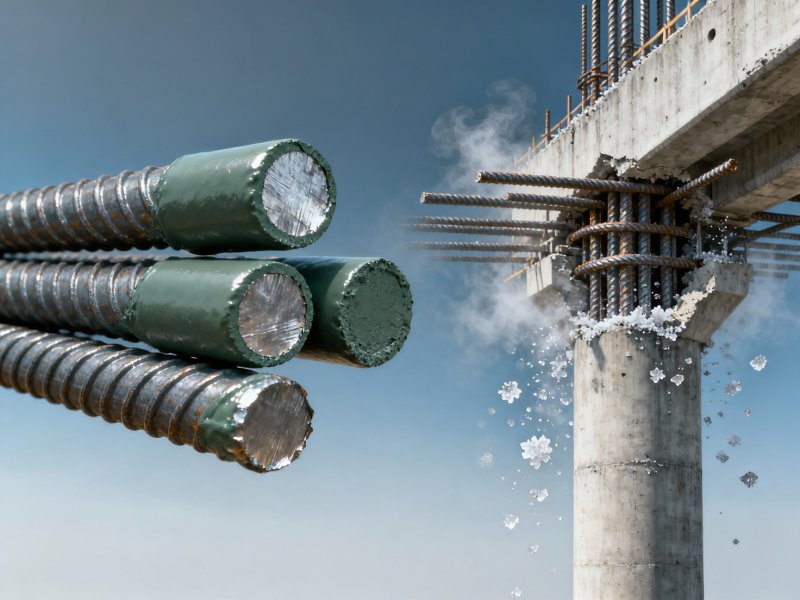
Selecting between conventional and epoxy-coated rebar hinges on three objective criteria: environmental exposure classification (per ISO 12944 C3–C5), design service life (>25 years strongly favors ECR), and constructability constraints (e.g., welding needs, tight schedules limiting coating repair time).
- Verify that your project’s exposure class justifies the added cost—C3 (urban/industrial) may not require ECR; C4/C5 (marine/chemical) almost always does.
- Require full compliance documentation: ASTM A775 test reports, holiday detection logs, and coating adhesion results—not just mill certificates.
- Engage your steel supplier early: Hongteng Fengda supports pre-bid technical reviews, BIM-compatible rebar scheduling files, and logistics coordination for consolidated shipments across North America, Europe, and the Middle East.
Structural integrity is never compromised by material substitution—only by inadequate specification, poor handling, or unverified supply chains. With over 15 years of export experience and facilities certified to ISO 9001, IATF 16949, and GB/T 19001, Hongteng Fengda ensures every ton of rebar meets its declared performance envelope.
Contact our engineering support team today to request a customized corrosion mitigation strategy—including comparative pricing, delivery timelines, and compliance documentation—for your next infrastructure or industrial project.
Please give us a message


Please enter what you want to find