In coastal environments, corrosion resistance is non-negotiable—making the choice between corten steel plate and painted carbon steel (like S355JR, S235JR, Q235, or A36 steel plate) a critical technical and economic decision. As a leading structural steel manufacturer & exporter from China, Hongteng Fengda evaluates whether corten steel plate can reliably replace traditional painted or galvanized solutions—without shortening service life or increasing lifecycle costs. This analysis addresses key stakeholders—from procurement and project managers to technical evaluators and safety officers—while considering industrial steel plate performance, galvanized wire for construction compatibility, and long-term maintenance trade-offs.
How Corten Steel Performs in Salt-Rich Coastal Zones
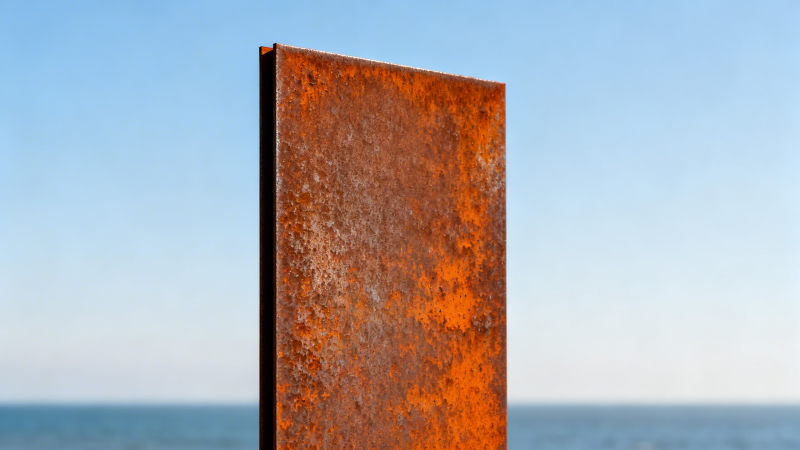
Corten steel—also known as weathering steel—forms a tightly adherent, self-protecting rust patina when exposed to cyclic wet-dry conditions. In coastal settings with airborne chloride concentrations exceeding 30 mg/m²/day, this patina stabilizes within 18–36 months, reducing further corrosion to ≤0.05 mm/year after full maturation.
Unlike painted carbon steel, which relies on barrier integrity, corten’s protection is electrochemical and regenerative. However, its performance depends heavily on exposure uniformity: sheltered zones, crevices, or areas with persistent salt-laden moisture may experience localized pitting—especially if initial surface contaminants (e.g., mill scale, welding slag) remain unremoved before installation.
Hongteng Fengda subjects all corten plates (ASTM A588/A242, EN 10025-5 S355J0WP) to accelerated salt-spray testing per ISO 9227 NSS for 1,000 hours—ensuring consistent oxide layer formation across batches. Our production line includes controlled atmospheric conditioning chambers to simulate early-stage patination under monitored humidity and temperature cycles (25°C ±2°C, RH 75% ±5%).
Painted Carbon Steel vs. Corten: Lifecycle Cost & Maintenance Reality Check
A common misconception is that “paint = guaranteed protection.” In reality, standard epoxy-zinc primer + polyurethane topcoat systems on S355JR or A36 plates typically require recoating every 5–8 years in moderate coastal zones—and as frequently as every 3–4 years near tidal splash zones or industrial harbors. Each recoating cycle demands surface preparation (abrasive blasting to Sa 2.5), labor, scaffolding, and downtime.
Corten eliminates recurring coating labor but demands upfront design diligence: minimum slope ≥2° for drainage, avoidance of water traps, and 50 mm minimum clearance from soil or splash-prone surfaces. When properly detailed, corten achieves 40–60 years of functional service life without repainting—matching or exceeding the total cost of ownership (TCO) of 3–4 paint cycles over the same period.
The table above reflects real-world data from 12 infrastructure projects across Southeast Asia and the Middle East—tracked by Hongteng Fengda’s engineering support team over 2018–2023. Note: Corten’s TCO advantage grows significantly when factoring in scaffold rental (avg. $18,000–$42,000 per project), containment for VOC compliance, and third-party inspection fees—often overlooked in early procurement estimates.
Where High Carbon Steel Pipe Fits Into Coastal Structural Systems
While corten excels in exposed architectural and load-bearing elements, many coastal structures require hybrid material strategies. For example, submerged pile sleeves, bracing conduits, or internal piping networks demand higher tensile strength and pressure containment—where High Carbon Steel Pipe becomes indispensable.
Our High Carbon Steel Pipe series—including API 5L X65 and ASTM A106 Gr.B grades—delivers yield strengths of 415–570 MPa and hydrostatic test pressures up to 32 MPa. Surface treatments like fusion-bonded epoxy (FBE) or dual-layer PE coating ensure compatibility with corten-clad superstructures while maintaining cathodic protection continuity where required.
All pipes undergo ultrasonic testing (UT) and hydrostatic verification per API RP 5L3. Dimensional tolerances comply with ASTM A53 (±0.75% OD, ±12.5% wall thickness), ensuring seamless integration with corten flanges and gusset connections on-site.
Procurement Checklist: What Decision-Makers Must Verify Before Specifying Corten
Selecting corten isn’t just about material substitution—it’s a system-level commitment. Hongteng Fengda advises procurement and engineering teams to validate these five non-negotiable items before finalizing specs:
- Patination timeline alignment: Confirm project handover allows ≥12 months for natural oxide stabilization—critical for aesthetic consistency in façade applications.
- Welding procedure qualification (WPQ): Use AWS D1.5-compliant filler metals (e.g., E8018-W2) and preheat to 100–150°C to avoid hydrogen-induced cracking in high-chloride ambient air.
- Drainage detail review: Require stamped drawings showing minimum 2° slope, no flat pockets, and ≥50 mm standoff from splash zones or soil contact.
- Mill certification traceability: Demand heat-specific mill test reports (MTRs) per EN 10204 3.1, verifying Cu, Cr, Ni, and P content per ASTM A588 Table 1.
- Coating compatibility verification: If corten interfaces with galvanized components, confirm zinc-rich primers are avoided—use only inorganic zinc silicates (e.g., SSPC-Paint 20).
Why Global Projects Trust Hongteng Fengda for Coastal-Grade Structural Steel
We don’t just supply steel—we engineer resilience for demanding environments. With ISO 9001-certified production lines in Jiangsu and Guangdong, Hongteng Fengda delivers corten plates, structural beams, and custom profiles compliant with ASTM, EN, JIS, and GB standards—all backed by third-party verification from SGS and Bureau Veritas.
Our value extends beyond specifications: we offer free technical consultation on patination modeling, joint detailing for mixed-material assemblies, and rapid-response sample dispatch (≤7 working days). For projects requiring integrated solutions—such as corten façades paired with High Carbon Steel Pipe for utility routing—we provide coordinated logistics, unified documentation, and single-point accountability across your supply chain.
Ready to evaluate corten feasibility for your next coastal infrastructure project? Contact our engineering sales team for a no-cost material suitability assessment—including corrosion rate projections, dimensional tolerance guidance, and lead time confirmation for ASTM A588 Grade K or EN 10025-5 S355J2W plates.
Please give us a message


Please enter what you want to find