When delivery slips, buyers often learn more than any brochure can tell them about an H beam manufacturer. A late shipment is rarely just a logistics issue. It can signal weak production planning, unstable raw material purchasing, overloaded capacity, poor communication, or quality problems that force rework. For importers, contractors, distributors, and engineering teams, delays often reveal the true operating strength of a supplier—and that matters not only for H beams, but also for related purchasing decisions involving carbon steel price, steel plate for construction, and steel rebar cost.
Why delivery delays matter more than the delay itself
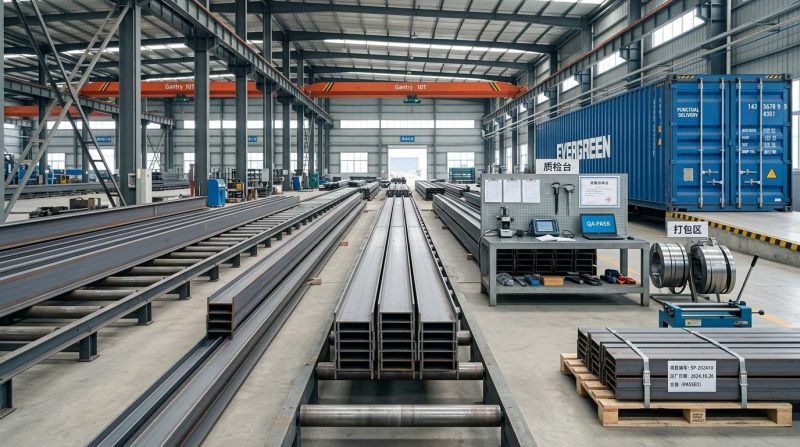
Most buyers initially treat a delay as a scheduling inconvenience. In reality, it is often an early warning sign of deeper risk. A capable structural steel manufacturer usually has systems that keep production, inspection, packing, and shipment under control even when the market is volatile. A supplier that frequently misses lead times may also struggle in other areas that are harder to see during quotation.
For project managers and procurement teams, the real question is not “Will this order be a few days late?” but “What does this delay tell us about future supply reliability, quality consistency, and total project cost?”
That is especially important in structural steel procurement, where one weak link can affect fabrication schedules, site installation, cash flow, and contract performance.
What delays often reveal about an H beam manufacturer
1. Weak production planning
Consistent delays often indicate that the supplier does not have a realistic production schedule. Some manufacturers accept too many orders to keep capacity full, then adjust priorities later. Others lack coordination between rolling, cutting, galvanizing, inspection, and packing. In both cases, lead time becomes a sales promise rather than an operational commitment.
2. Unstable raw material sourcing
H beam production depends on predictable access to steel billets, coils, plates, or other upstream materials. If a manufacturer has poor supplier relationships or buys only when prices drop, production can slow down suddenly. Buyers then face delays that may also reflect future price instability across related materials.
3. Quality issues hidden inside the schedule
Some delays happen because products fail internal inspection or do not meet dimensional tolerance, surface, or mechanical property requirements. Rework, replacement production, or extra testing can quietly extend the delivery date. This is why schedule reliability and quality control are closely linked.
4. Limited export execution ability
For international buyers, delay risk is not limited to manufacturing. Documentation errors, poor container loading plans, missed booking windows, or slow response on customs and certification can all push shipment dates back. A factory may be able to produce steel, but not necessarily manage export delivery professionally.
5. Poor communication culture
One of the strongest warning signs is not the delay itself, but how the supplier communicates it. Reliable manufacturers usually report issues early, explain the cause clearly, and provide a revised action plan. Unreliable ones often wait until the buyer follows up repeatedly.
How delays can affect cost beyond the invoice price
Many buyers focus on unit price when comparing suppliers. But a delayed order can become more expensive than a slightly higher-priced order delivered on time.
Common hidden costs include:
- fabrication line stoppage
- construction schedule disruption
- labor idle time
- higher urgent freight costs
- contract penalties
- cash flow pressure from postponed project milestones
- extra quality inspection or replacement handling
This is why experienced sourcing teams evaluate total supply risk, not just the quoted steel rate. A lower H beam price means little if the supplier cannot maintain dependable lead times.
What buyers should check before choosing a structural steel supplier
To assess whether delays are likely, buyers should verify operational evidence rather than rely only on catalogs or claims. The most useful checks include:
- Actual delivery records: Ask for recent order examples by product type, quantity, destination, and lead time.
- Production capacity details: Confirm whether the factory can handle your order volume alongside existing commitments.
- Quality control process: Review raw material inspection, dimensional checks, test documentation, and final release procedures.
- International standards compliance: Make sure products align with ASTM, EN, JIS, or GB as required by your market.
- Tolerance control: Even when material is available, poor tolerance control can create downstream installation problems.
- Export support: Ask how they manage booking, packing lists, mill test certificates, and destination-specific documents.
- Communication speed: Measure how fast and how clearly they respond during quotation and technical discussion.
These points help technical evaluators, purchasers, and decision-makers identify whether a manufacturer is truly reliable under project conditions.
Reliable delivery usually reflects a stronger factory system
On-time delivery is usually the visible result of invisible discipline. Manufacturers that deliver consistently often share several strengths:
- stable raw material procurement channels
- clear production scheduling
- modern processing equipment
- defined inspection checkpoints
- controlled packaging and loading procedures
- experience with standard and customized export orders
For example, buyers sourcing not only H beams but also purlins, wall beams, and fabricated steel parts often need a partner that can manage mixed structural steel requirements under one supply plan. In such cases, delivery reliability becomes even more important than product-by-product price comparison.
A practical example is C Channel Beam, commonly used in steel structure buildings and mechanical light industry manufacturing. With material options such as Q195, Q235, Q345, A36, SS400, and S235JR, and processing capabilities including bending, welding, punching, decoiling, and cutting, this type of product often supports purlins, wall beams, roof trusses, brackets, and light structural components. When a supplier can maintain controlled tolerance, multiple surface treatments, and a 15–20 day delivery cycle across such products, it usually indicates stronger manufacturing coordination overall.
Questions procurement teams should ask when a shipment is delayed
If a supplier has already delayed an order, buyers should ask targeted questions instead of accepting vague reassurances:
- What exactly caused the delay—raw materials, production, testing, packing, or shipment booking?
- Is the issue isolated to this order or affecting multiple customers?
- Has production started, and what percentage is completed?
- Were any quality issues found during inspection?
- What is the revised shipment date, and what evidence supports it?
- What corrective action will prevent the same issue on the next order?
The quality of these answers often tells you whether the manufacturer is solving a temporary problem or exposing a structural weakness.
How to reduce delay risk in future H beam orders
Buyers can reduce sourcing risk with a more disciplined procurement approach:
- qualify suppliers based on delivery history, not just quotation
- confirm technical standards and tolerances before production
- build realistic buffer time into project schedules
- split critical volume between approved suppliers when necessary
- request milestone updates for production and shipment
- include lead time and delay responsibility in contracts
- prioritize suppliers with stable export experience and quality systems
For distributors, contractors, and overseas importers, these steps can significantly reduce project disruption and total procurement cost.
Final takeaway
Delays often reveal more about an H beam manufacturer than marketing materials ever will. They can expose planning weaknesses, unstable sourcing, quality inconsistency, or poor export execution. For buyers in construction, industry, and distribution, the right response is not simply to push for a faster shipment, but to evaluate what the delay says about the supplier’s long-term reliability.
A trustworthy structural steel partner should combine stable production capacity, clear communication, consistent quality control, and dependable lead times. When buyers assess these factors early, they make better decisions, reduce sourcing risk, and protect project performance across H beams and the broader structural steel supply chain.
Please give us a message


Please enter what you want to find