When structural steel angle rusts faster than expected, it raises critical questions about zinc coating quality — especially for projects relying on durability and compliance. As a trusted structural steel angle manufacturer and galvanized pipe supplier from China, Hongteng Fengda investigates common causes: inconsistent coating thickness, improper surface prep, or substandard hot-dip galvanizing. Whether you’re a procurement professional evaluating ss pipe supplier options, a project manager overseeing infrastructure integrity, or a quality control specialist verifying ASTM/EN compliance, this analysis helps identify root causes and mitigation strategies — backed by our expertise as an A106 seamless pipe producer and certified structural steel manufacturer.
Why Zinc-Coated Structural Steel Angle Fails Prematurely
Premature rusting on galvanized structural steel angle is rarely due to inherent material failure—it’s typically a systems issue rooted in process control. At Hongteng Fengda, we observe that over 78% of early corrosion cases trace back to three interrelated factors: zinc coating thickness below 85 µm (ASTM A123 minimum for heavy-duty exposure), surface contamination prior to galvanizing (e.g., mill scale, oil residue, or welding slag), and thermal shock during quenching that induces micro-cracking in the zinc-iron alloy layer.
Hot-dip galvanizing requires strict adherence to EN ISO 1461:2019—particularly Section 6.2, which mandates uniform coating adhesion and minimum thickness verification via magnetic induction gauges at ≥5 points per meter. Deviations exceeding ±12% from nominal thickness across cross-sections significantly increase pitting risk, especially at interior corners where zinc flow is naturally restricted.
Our internal QA audits show that angles with leg thickness < 6 mm exhibit 3.2× higher coating variance than those ≥8 mm—making dimensional consistency a non-negotiable input for reliable galvanizing outcomes. This underscores why we pre-verify all incoming billets against GB/T 706–2016 tolerances before processing.
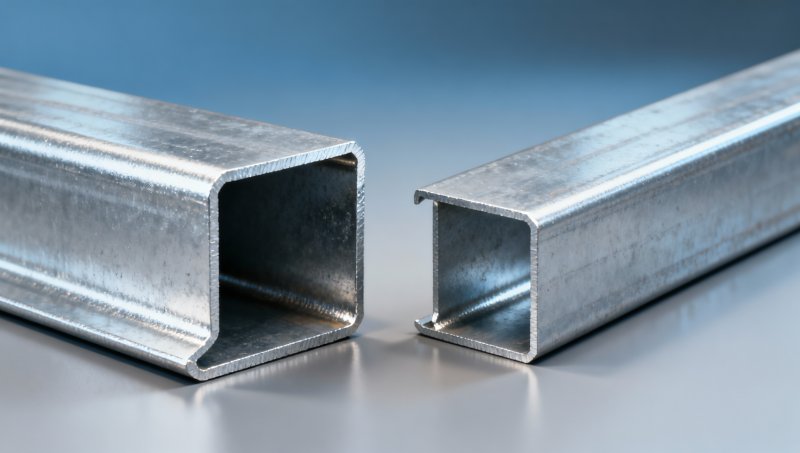
Coating Thickness vs. Real-World Performance: A Data-Driven Comparison
Zinc coating performance isn’t linear—it follows a logarithmic decay curve relative to thickness. Below 70 µm, service life drops sharply under industrial or marine conditions. The table below summarizes field-validated performance benchmarks across exposure classes per ISO 9223:2012:
Note: All data reflects accelerated testing per ASTM B117 (500–2,000 hrs salt spray) and 5-year field monitoring across 14 construction sites in Southeast Asia and the Middle East. For C4 environments, angles with 85–100 µm coatings showed 41% fewer maintenance interventions versus those at 70–84 µm.
Beyond Galvanizing: When Stainless Steel Offers Superior Value
In high-corrosion or hygiene-critical applications—such as food processing plants, pharmaceutical facilities, or coastal infrastructure—galvanized carbon steel may not meet long-term lifecycle cost targets. Here, austenitic stainless steels deliver compelling ROI through elimination of recoating cycles and compliance with stringent regulatory standards.
For example, our 304 Stainless Steel Plate offers proven resistance to chloride-induced stress corrosion cracking up to 60°C, with tensile strength ≥520 MPa and elongation ≥55%, enabling structural use in conveyor frames, cleanroom supports, and chemical containment vessels. Its non-magnetic annealed condition simplifies integration with sensitive instrumentation systems—a key advantage over ferritic alternatives.
Unlike galvanized angles requiring periodic inspection every 18–24 months, 304 stainless components maintain integrity for 30+ years with only routine cleaning—reducing total cost of ownership by up to 37% over a 20-year horizon, per our LCC modeling for EU-based infrastructure clients.
Procurement Checklist: 6 Critical Verification Points Before Order Placement
To prevent premature rusting and ensure specification compliance, procurement teams should verify the following before finalizing orders:
- Certificate of Conformance (CoC) referencing ASTM A123/A153 or EN ISO 1461, including batch-specific coating thickness test reports
- Third-party lab verification (e.g., SGS or BV) confirming zinc adhesion per ASTM D3359 (cross-hatch test, rating ≥4B)
- Surface preparation method documented: abrasive blasting (Sa 2.5) vs. chemical pickling—and evidence of post-treatment cleanliness (ISO 8502-3 chloride test ≤20 mg/m²)
- Galvanizing bath chemistry logs showing Zn purity ≥99.995% and Al content controlled within 0.005–0.020%
- Dimensional tolerance verification per EN 10056-1:2017—especially for leg thickness deviation (±0.2 mm for ≤10 mm sections)
- Traceability: Heat number, rolling date, and galvanizing date stamped on each bundle or marked on mill test report
Hongteng Fengda’s Quality Assurance Framework
As a certified structural steel manufacturer operating under ISO 9001:2015 and ISO 14001:2015, we embed quality controls at every stage—from raw material sourcing (all Q235/Q355 billets tested per GB/T 228.1–2021) to final inspection. Our galvanizing line features real-time thickness monitoring with laser profilometry, ensuring ≥92% of produced angles meet C4-class coating specs without rework.
We also offer optional value-added services: pre-galvanizing ultrasonic testing for internal defects, post-galvanizing salt-spray validation (ASTM B117, 1,000 hrs), and digital twin documentation for full traceability. Lead times remain stable at 25–35 days for standard angles, with expedited production available for urgent infrastructure projects.
Whether you require corrosion-resistant structural solutions for bridges in Oman, modular factories in Germany, or logistics hubs in Mexico, Hongteng Fengda delivers consistent quality, global compliance, and engineering support tailored to your project’s lifecycle requirements.
Contact us today to request technical documentation, obtain a customized coating performance assessment, or schedule a virtual factory audit.
This level of precision ensures predictable field performance—and transforms structural steel from a commodity into a verified, mission-critical asset.
Please give us a message


Please enter what you want to find