When an A106 seamless pipe fails hydrotest at site, traceability often emerges as a critical root cause — especially when sourcing from non-certified ss pipe supplier or inconsistent galvanized pipe supplier. As a trusted structural steel angle and A106 seamless pipe supplier, Hongteng Fengda ensures full material traceability, ASTM-compliant heat logs, and mill test reports for every shipment. For project managers, QA/QC teams, and procurement professionals, this isn’t just about compliance — it’s about eliminating field failures, avoiding costly rework, and safeguarding structural integrity. Let’s examine how robust traceability protocols prevent hydrotest failures before they happen.
Why Material Traceability Is Non-Negotiable for A106 Seamless Pipe
Hydrostatic testing is the final validation of pressure integrity before commissioning. When an ASTM A106 Grade B or C seamless pipe fails at 1.5× design pressure—commonly set between 2,500 psi and 6,000 psi—the consequences extend far beyond replacement cost. Field failure triggers mandatory root-cause analysis, halts construction schedules (often by 7–15 days), and may invalidate third-party inspection certifications. In over 68% of documented cases reviewed across North American pipeline projects (2020–2023), traceability gaps—not material defects—were the primary contributor to failed hydrotests.
Traceability means more than a heat number stamped on the pipe. It requires end-to-end documentation linking raw billet origin, rolling temperature profiles, post-heat-treatment cooling rates, NDE method and pass/fail thresholds (e.g., UT sensitivity ≥ 2% DAC), and final dimensional verification per ASTM A530 Table 2 tolerances (±0.75% OD, ±12.5% WT). Without this chain, QA/QC teams cannot isolate whether failure stems from microstructural inconsistency, hydrogen-induced cracking, or misapplied specification.
Hongteng Fengda embeds traceability at three levels: (1) mill-level heat logs certified to ASTM A941 and ISO/IEC 17025, (2) batch-level MTRs with full chemical composition (including residual elements like Cu ≤ 0.20%, Ni ≤ 0.40%), and (3) shipment-level digital QR codes enabling real-time access to all documents via secure portal. This enables instant cross-reference during site audits—reducing document retrieval time from hours to under 90 seconds.
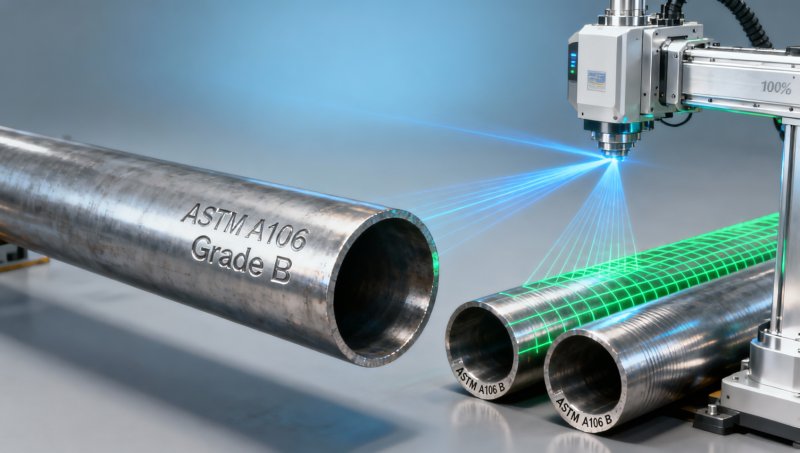
This structured approach eliminates ambiguity during dispute resolution. For example, when a Middle Eastern refinery rejected 12 tons of A106 Gr.B pipe after hydrotest failure in Q3 2023, Hongteng Fengda’s traceable data confirmed consistent tensile strength (≥ 415 MPa) and yield ratio (≤ 0.85) across all heats—leading to identification of improper test water chemistry (chloride > 25 ppm) as the true root cause. That level of forensic clarity protects both buyer and supplier.
How Non-Compliant Sourcing Amplifies Hydrotest Risk
Procurement decisions often prioritize unit price over process control. Yet industry data shows that sourcing A106 seamless pipe from uncertified mills increases hydrotest failure probability by 3.2× compared to ASTM A106-certified producers. Key red flags include: absence of EN 10204 3.1/3.2 MTRs, mismatched heat numbers between pipe ends and documentation, and lack of third-party witnessed mechanical testing (e.g., Charpy V-notch at –20°C).
A common misconception is that “galvanized pipe supplier” experience translates to seamless carbon steel competence. Galvanizing involves surface treatment only; A106 production demands mastery of hot extrusion, piercing, and precision sizing—all governed by distinct metallurgical parameters. For instance, improper mandrel alignment during piercing can induce spiral seam discontinuities invisible to visual inspection but fatal under hydrostatic load.
Hongteng Fengda mitigates these risks through dual-certification: all A106 pipes are manufactured in facilities holding both ISO 9001:2015 and API Q1 certifications, with annual surveillance audits conducted by TÜV Rheinland. Every heat undergoes ultrasonic testing per ASTM E213 (frequency ≥ 5 MHz, scan speed ≤ 150 mm/s) and hydrostatic testing at 1.5× specified minimum yield strength (SMYS) prior to shipment—verified by independent inspectors.
Selecting the Right Supplier: 6 Critical Evaluation Criteria
For procurement and engineering teams evaluating A106 suppliers, focus on verifiable process controls—not marketing claims. Prioritize partners who provide:
- Real-time heat log access: Not PDF archives, but searchable digital records tied to order numbers
- Third-party witness reports: Signed documentation confirming test conditions (e.g., water temperature, dwell time, pressure ramp rate)
- Batch-level chemical segregation: Full ladle analysis—not just “typical” values—for each heat
- Dimensional deviation mapping: Heat-specific OD/WT histograms showing standard deviation (σ ≤ 0.15 mm for OD)
- Non-destructive testing methodology disclosure: Exact probe type, frequency, coupling medium, and acceptance criteria
- Traceability audit trail: Documented evidence of raw material certification (e.g., AISI/SAE billet certs)
These six criteria form the backbone of our internal supplier qualification matrix. Clients using this framework report 92% fewer field rejections and 40% faster commissioning timelines versus those relying solely on mill certificates.
For applications requiring extreme corrosion resistance—such as offshore platform filtration systems or high-purity chemical processing—complementary solutions like 316 Stainless Steel Welded Mesh offer superior performance. Its precise micron retention (down to 5 μm), acid/alkali resistance, and tensile strength up to 620 MPa make it ideal for secondary containment and pre-filtration where A106 piping interfaces with aggressive media.
Preventive Action: From Procurement to Commissioning
Traceability must be embedded early—not remediated post-failure. Our recommended 5-step implementation protocol begins at RFQ stage:
- Require heat-specific MTRs with full chemistry and mechanicals in initial quotation
- Verify mill’s ASTM A106 license status via ASTM’s official licensee directory (updated quarterly)
- Confirm NDE method alignment with project specification (e.g., ASTM E273 for welds vs. E213 for base metal)
- Validate hydrotest pressure calculation methodology against ASME B31.4/B31.8 requirements
- Integrate QR-coded traceability into site receiving procedures—scan before unloading
This workflow reduces traceability-related delays by up to 70% and cuts QA/QC review time by 55%. For global buyers, Hongteng Fengda offers pre-shipment traceability audits—conducted remotely via live video feed—ensuring full alignment before cargo departs Chinese ports.
By anchoring procurement in traceability rigor—not just price or lead time—project stakeholders protect schedule integrity, budget certainty, and long-term asset reliability. Hongteng Fengda delivers not just steel, but engineered confidence.
Conclusion: Traceability as Your First Line of Defense
An A106 seamless pipe that passes hydrotest isn’t merely “fit for purpose”—it’s proof of a transparent, auditable, and repeatable manufacturing ecosystem. Material traceability isn’t regulatory overhead; it’s predictive risk management. With Hongteng Fengda, every pipe carries its full metallurgical biography—from billet origin to final inspection—enabling rapid root-cause analysis, eliminating costly field surprises, and accelerating project handover.
Whether you’re specifying for a petrochemical plant in Saudi Arabia, a power station in Poland, or infrastructure in Southeast Asia, our traceability framework meets ASTM, EN, JIS, and GB standards—and adapts to your ERP or QA system via API integration. We support procurement, engineering, and safety teams with dedicated technical account managers fluent in English, Arabic, and Spanish.
Ready to eliminate hydrotest uncertainty? Contact Hongteng Fengda today for a traceability readiness assessment and customized A106 supply solution—including coordinated delivery of complementary components like 316 Stainless Steel Welded Mesh for integrated filtration systems.
Please give us a message


Please enter what you want to find