Choosing the wrong steel wire gauge can lead to serious performance errors, from load miscalculations to poor fit, durability, and safety issues in real applications. For operators and end users, understanding how gauge affects strength, flexibility, and compliance is essential before making any material decision. This article explains the most common steel wire gauge mistakes and how to avoid costly performance calls.
In steel-related operations, gauge is often treated as a quick size reference, but in practice it directly affects tensile behavior, handling, installation tolerance, service life, and downstream fabrication. A mismatch of even 1 gauge step can change wire diameter enough to alter bend radius, fastening force, screen opening stability, or support capacity in repetitive-use environments.
For operators working with construction supplies, industrial components, welded assemblies, or replacement parts, the consequences are rarely limited to material waste. Wrong performance calls can trigger rework, equipment stoppage, non-compliance with project specifications, or premature failure in wet, acidic, or high-temperature conditions. That is why steel wire gauge decisions should be tied to application data, not habit.
Why steel wire gauge causes so many field mistakes
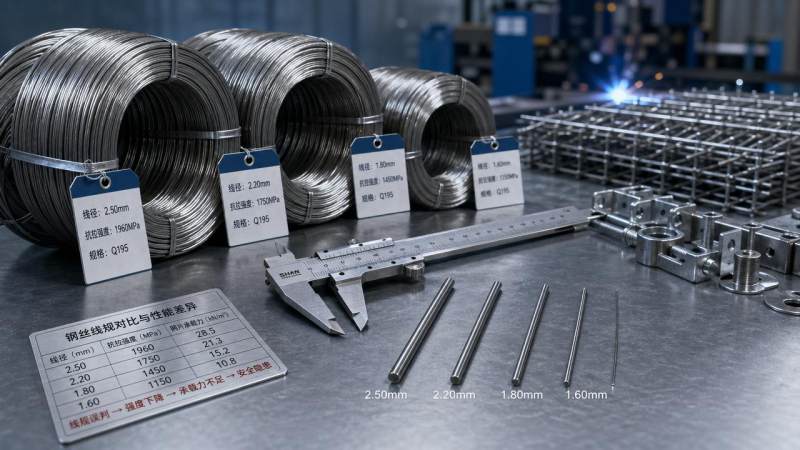
A common source of confusion is that steel wire gauge is not a direct strength rating. Gauge refers to diameter, and diameter influences cross-sectional area, stiffness, elongation behavior, and load response. In field use, many operators assume a lower gauge number simply means “better” because it is thicker. That assumption fails when the job needs flexibility, tighter forming, lighter weight, or compatibility with existing slots, guides, or mesh openings.
Another issue is that gauge systems are not always interpreted consistently across teams. Purchasing may quote nominal gauge, fabrication may work in millimeters, and maintenance staff may compare wire by visual thickness only. A difference between 2.0 mm and 2.3 mm may look small on the shop floor, yet the area change is significant enough to affect pull force, crimping results, and fatigue response over hundreds or thousands of cycles.
In steel processing and structural supply chains, wrong gauge selection usually happens at 3 points: initial specification, material substitution, and replacement ordering. If any of these stages skip mechanical review, operators may receive wire that is too rigid for forming, too thin for load retention, or too soft for repeated use in vibration-prone environments such as conveyors, screens, vehicle assemblies, and fastening systems.
Gauge is a dimensional input, not a complete material decision
Correct selection depends on at least 4 linked factors: wire diameter, steel grade, surface condition, and service environment. Two wires with similar gauge can perform very differently if one is carbon steel and the other is stainless steel, or if one is used indoors while the other is exposed to chloride, humidity, or temperatures above 200°C. Operators who look at gauge alone often miss the actual reason for field failure.
Typical operator-side causes of wrong performance calls
- Using old gauge references without converting to metric dimensions before ordering or installation.
- Replacing a failed wire with a thicker one without checking bend limits, spring-back, or equipment clearance.
- Assuming all stainless or all steel wire of the same gauge will offer equal corrosion resistance and fatigue life.
- Ignoring the effect of coating, finish, and forming process on actual fit and long-term wear.
The table below shows why gauge should be checked together with real use conditions rather than treated as a standalone number.
The practical takeaway is simple: steel wire gauge should be checked as part of a full application review. In most industrial settings, a 5-minute verification of diameter, material grade, and environment can prevent days of rework later.
The most common steel wire gauge mistakes in daily operations
The first major mistake is selecting gauge based only on static load. Operators often think that if a wire can hold a certain weight once, it will also survive repeated movement, vibration, thermal expansion, or impact. In reality, dynamic conditions often reduce usable performance margins. A wire that seems acceptable under a single test load may fail early after 500 to 2,000 operating cycles if gauge and material are not aligned with motion.
The second mistake is ignoring the relationship between gauge and forming radius. Thicker wire generally needs a larger bend radius to avoid cracking, spring-back, or uneven shape retention. This matters in hooks, screens, clips, spring forms, welded frames, and tied components. When operators increase thickness to “play safe,” they can create installation problems that are only discovered after cutting, bending, or welding has already begun.
A third mistake is using steel wire gauge as a substitute for corrosion selection. Gauge alone cannot compensate for an unsuitable grade in chloride-rich, acidic, or wet service. A thinner wire in the right stainless material may outperform a thicker standard wire that rusts within weeks or months. This is particularly important in food processing, agriculture, ship parts, packaging equipment, and medical support assemblies where cleanliness and corrosion control matter.
Mistakes that lead directly to false performance judgments
- Calling a wire “too weak” when the real issue is poor grade selection or surface corrosion.
- Calling a wire “too stiff” without checking if the bend radius is below the practical forming limit.
- Calling a wire “undersized” because of fit problems caused by coatings, burrs, or slot tolerance.
- Calling a wire “over-engineered” without reviewing fatigue, safety margin, and environmental exposure.
In many mixed-material projects, operators also interact with plate, profile, and fabricated support parts. For corrosive or high-temperature environments, wire-related decisions often connect with the broader material package. For example, where support brackets, covers, guards, or equipment contact surfaces require stronger corrosion resistance, 316 Stainless Steel Plate may be specified together with suitable stainless wire components. Its 316 stainless steel composition, molybdenum content of 2–3%, and resistance to pitting make it useful in chemical, food, marine-adjacent, and high-temperature applications.
That plate option is available in thicknesses from 0.3 mm to 200 mm, with common lengths such as 2000 mm, 3000 mm, 6000 mm, and 12000 mm, plus widths including 1000 mm, 1219 mm, 1500 mm, and 2000 mm. Mechanical values such as tensile strength ≥ 520, yield strength ≥ 275, elongation ≥ 55–60, and hardness ≤ 183HB provide a useful reference when operators compare wire-supported assemblies with plate-based structural or corrosion-critical parts.
Where these mistakes appear most often
- Replacement ordering when original drawings are unavailable and staff rely on visual estimates.
- Fast-moving maintenance work where downtime pressure pushes teams to substitute the nearest available wire.
- Export or cross-border projects where ASTM, EN, JIS, and GB references need unit and tolerance alignment.
- Applications involving springs, screens, bolts, nuts, conveyor belts, and formed support parts.
The key lesson is that wrong performance calls usually come from incomplete evaluation, not just wrong thickness. Better identification methods and clearer purchasing data can remove most of these errors before material reaches the shop floor.
How to evaluate the right gauge for strength, flexibility, and compliance
A reliable gauge decision starts with 3 technical questions: what load the wire carries, how much movement it sees, and what environment it will face. Operators should separate static support from cyclic duty. A wire that only positions a part during assembly may need very different properties from a wire that works as a spring element, retaining feature, screen strand, or moving guide under daily stress.
Next, measure the actual diameter requirement in millimeters instead of ordering by memory. Use calipers, check the drawing tolerance, and note whether finish or coating adds measurable thickness. In many industrial tasks, tolerance variation of ±0.05 mm to ±0.15 mm can matter for slots, crimps, tight holes, and automated feeding systems. This is where many steel wire gauge problems begin: the ordered size is “nominally right” but practically wrong.
Compliance also matters. Global buyers and operators increasingly work across ASTM, EN, JIS, and GB standards, and dimensions or acceptance criteria may be documented differently. A correct gauge choice should align with the project standard, fabrication process, and inspection method. If the wire will be welded, tensioned, bent, or exposed to heat, those process factors should be documented before final approval.
A practical 5-step selection workflow
- Confirm the wire function: load bearing, tying, screening, spring action, guiding, or fastening.
- Measure required diameter and allowable tolerance using current parts or approved drawings.
- Review environment: indoor, outdoor, wet, acidic, food-contact adjacent, or high-temperature service.
- Check process needs: bending radius, welding, cutting, forming speed, and replacement frequency.
- Verify standard and grade before ordering, especially for export or OEM components.
The table below can help operators connect steel wire gauge decisions with practical performance targets.
This approach reduces guesswork. Instead of asking whether a gauge is generally “good,” operators can ask whether it is right for one defined job, one load range, and one service environment. That shift leads to better material calls and fewer urgent replacements.
Field checks, procurement controls, and replacement planning
Most gauge-related failures can be prevented before installation if there is a simple verification routine. For daily operations, a 4-point incoming inspection is often enough: confirm diameter, material grade, surface condition, and packaging identification. If the wire is used in regulated or quality-sensitive lines, add one more check for standard conformity and one for traceability to the purchase lot.
Replacement planning is equally important. Operators should not wait for failure before identifying the correct steel wire gauge. For critical lines, keep a reference sample, drawing note, or digital part sheet with at least 6 items: diameter, grade, finish, use location, forming method, and approved substitute range. This reduces errors during rush ordering, especially when procurement teams are not physically present on site.
For international sourcing, supplier communication must be precise. A professional structural steel manufacturer and exporter should be able to support standard specifications, OEM discussions, dimensional confirmation, and quality control requirements. Hongteng Fengda, for example, serves global construction, industrial, and manufacturing projects with standard and custom structural steel products, supported by modern facilities and quality control aligned with major international standards such as ASTM, EN, JIS, and GB.
What operators should ask before approving a wire order
- What is the exact diameter in millimeters, not only the nominal steel wire gauge reference?
- What material grade is supplied, and is it suitable for moisture, acid exposure, or elevated temperature?
- What tolerance range is accepted, and does it match equipment or assembly requirements?
- Will the wire be bent, welded, tensioned, or repeatedly cycled after delivery?
- Is there an approved equivalent for urgent replacement, or must the original specification be maintained?
Simple inspection record for operators
The following table is useful for maintenance teams, warehouse personnel, and line supervisors who need a repeatable check before installation or release.
When these checks become routine, wrong performance calls drop quickly. Teams stop blaming gauge alone and begin identifying the real source of failure: environment, forming process, tolerance mismatch, or unsuitable substitution.
FAQ for operators choosing steel wire gauge
How do I know if a thicker wire is actually the right fix?
Do not assume thicker is better. First check whether the failure came from overload, fatigue, corrosion, or poor fit. If the wire must bend into a tight radius or pass through fixed guides, increasing diameter may create a second problem. Review at least load, movement, and clearance before changing gauge.
Can the same steel wire gauge work in both dry indoor and wet chemical environments?
Not necessarily. The same gauge can behave very differently if the grade is wrong for the environment. In chloride, acid, or persistent moisture exposure, corrosion resistance can matter more than extra thickness. Operators should evaluate both gauge and alloy suitability together, especially in food, chemical, ship-related, and washdown areas.
What is the minimum information I should send to a supplier?
At a minimum, send 5 details: diameter in mm, material grade, application, forming or welding requirement, and service environment. If possible, add estimated load, tolerance range, and the standard being followed. This reduces back-and-forth and helps the supplier recommend a practical production or OEM solution.
How often should steel wire gauge be rechecked in operation?
For critical or moving applications, recheck during scheduled maintenance, especially after the first 1 to 3 months of service or after process changes. If the wire is exposed to abrasion, vibration, or chemicals, inspection frequency may need to increase. Look for diameter wear, deformation, corrosion marks, and loss of tension.
Getting steel wire gauge right is not just about ordering the correct thickness. It means matching diameter, steel grade, processing method, and environmental demands so that the wire performs as expected in the real operating cycle. For users and operators, this approach reduces false failure judgments, improves safety, and lowers replacement cost over time.
If your project also involves structural steel sections, cold formed profiles, or customized steel components, working with an experienced manufacturer can simplify specification control across the full assembly. Hongteng Fengda supports global buyers with stable production capacity, consistent quality, and custom solutions designed to reduce sourcing risk and improve project efficiency.
If you need help checking gauge suitability, comparing steel grades, or confirming steel products for demanding industrial environments, contact us to get a tailored solution, discuss product details, or explore more steel supply options for your operation.
Please give us a message


Please enter what you want to find