Unexpected installation delays often start with overlooked steel tubing dimensions. When length tolerances, wall thickness, outside diameter, or end finishing do not match project requirements, crews face rework, fitting issues, and costly downtime. For operators and site users, understanding these key dimensional factors helps prevent errors early, improve installation efficiency, and keep structural steel projects moving on schedule.
Why steel tubing dimensions create different risks in different jobsite scenarios
In structural steel work, the same tubing size can perform well in one application and create major delays in another. A warehouse frame, a conveyor support line, a fabrication workshop, and a water-facing temporary structure all place different demands on fit-up accuracy. For site operators, the main issue is not only whether the steel tubing dimensions are technically acceptable, but whether they match the installation method, the connection details, and the sequence of the project.
Dimensional problems often appear in four predictable forms: length mismatch, outside diameter variation, wall thickness inconsistency, and end preparation errors. Even a small deviation can affect bolted sleeves, welded joints, clamp systems, or prefabricated assemblies. In many projects, a tolerance issue of 2 mm to 5 mm may seem minor at the factory stage, but on site it can force cutting, shimming, grinding, or complete replacement of pieces.
Installation delay becomes more serious when materials arrive in batches and the crew schedule is fixed. If lifting equipment, welding teams, and civil progress are already coordinated across 3 to 7 service nodes, one dimension error may interrupt the entire sequence. That is why operators should evaluate steel tubing dimensions by use case instead of relying only on nominal size descriptions in quotations or packing lists.
The dimensions that most often affect field installation
- Cut length and length tolerance, especially for prefabricated members and frame modules.
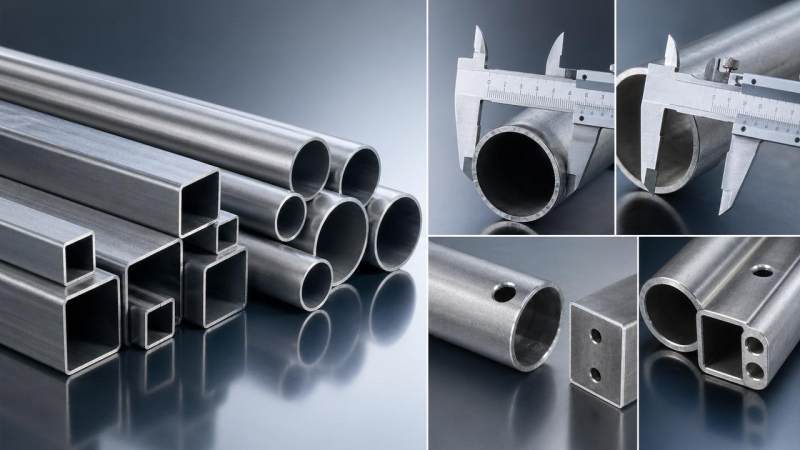
- Outside diameter or section width and height, critical for sleeves, brackets, and clamp-based connections.
- Wall thickness, which influences load capacity, weld heat input, and hole-making accuracy.
- Straightness and twist, particularly relevant for long members above 6 m to 12 m.
- End squareness, beveling, hole position, and surface condition for direct assembly.
For global buyers and site users, this is where a reliable structural steel supplier matters. Hongteng Fengda, a structural steel manufacturer and exporter from China, supports projects with angle steel, channel steel, steel beams, cold formed steel profiles, and customized structural steel components built to ASTM, EN, JIS, and GB requirements. That broad standards experience is useful when projects combine locally designed connections with imported steel materials.
The table below shows how dimensional mistakes affect common installation environments. Instead of treating steel tubing dimensions as a single purchasing item, operators can use this comparison to identify where checking effort should be concentrated before material arrives on site.
This comparison highlights an important point: delay risk is not evenly distributed. In some jobs, a 1-piece mismatch stops only one operator. In others, one incorrect batch can stall cranes, welders, inspectors, and follow-on trades for 1 to 3 days. That is why dimensional review should be linked to the site scenario from the beginning.
Three typical scenarios where operators should check steel tubing dimensions first
Most delays happen in repeatable environments. Operators who understand those patterns can reduce site adjustments and improve handover quality. The three scenarios below are among the most common across structural steel installation, industrial fabrication, and project export supply.
Scenario 1: Prefabricated structural frames and modular assembly
In prefabricated systems, steel tubing dimensions must match drawing logic exactly because the installation method assumes fast positioning and limited field modification. If columns, braces, or cross-members arrive 3 mm short or 4 mm over nominal length, the error may accumulate across multiple bays. On projects with 10 to 50 repeated frames, one early mismatch often creates a chain of alignment problems.
Operators in this scenario should pay special attention to cut length, hole location, diagonal consistency, and end squareness. These details directly affect bolted assembly speed. If end faces are not square or holes drift beyond acceptable range, crews may need to enlarge holes or force connections, which increases both labor time and fit-up risk.
A practical control point is to request dimensional verification before shipment for all members with repeated geometry. For example, on a standard modular line, checking the first 5 to 10 pieces from each production batch can help catch tooling drift before the full quantity is packed.
What to verify before unloading
- Bundle labeling matches the erection sequence and drawing revision.
- Random sample length checks confirm tolerance consistency across the batch.
- Ends, holes, and welded attachments are in the intended orientation.
- Surface damage during transport has not distorted section edges or ends.
Scenario 2: Equipment support systems, racks, and maintenance platforms
This scenario is common in factories, utility areas, and processing plants. Here, steel tubing dimensions affect attachment compatibility more than repeated frame geometry. Operators must fit clamps, saddles, handrail brackets, grating supports, and equipment anchors. Outside diameter or section width becomes the first concern, especially when supports are fabricated separately from the tubing supply.
Wall thickness matters as well because it changes drilling behavior and local load response. A thinner-than-expected wall can reduce thread engagement or create deformation around bolts and welded tabs. A thicker wall can delay field drilling and require different consumables. Even when the nominal size is correct, real-world installation may slow down if actual section dimensions vary from the connection hardware design.
In operating facilities, shutdown windows may be only 8 to 24 hours. Under those conditions, crews cannot afford trial-and-error fitting. Checking a few representative steel tubing dimensions against actual bracket components before site mobilization often saves far more time than last-minute adjustment under shutdown pressure.
Scenario 3: Heavy-duty, long-length, or water-adjacent construction work
Projects near ports, foundations, deep excavations, or temporary retaining zones introduce a different kind of dimensional risk. Here, length, straightness, and section stability become more important because lifting, driving, or staged positioning is harder to correct once work starts. Long members above 12 m, and especially those approaching 20 m or more, require tighter planning for transport, handling, and sequence control.
In the middle of such projects, buyers often combine tubular steel with retaining or deep-water products. That is where related structural products can improve project planning. For example, Steel Sheet Piles are used in deep water construction and cofferdam formation, with grades such as S275, S355, S390, S430, SY295, SY390, and ASTM A690. With production standards including EN10248, EN10249, JIS5528, JIS5523, and ASTM, and single lengths extending to over 80 m, these products show how dimensional planning becomes even more critical when installation conditions are complex.
For operators, the lesson is practical: if a project already demands long-length control for sheet piles, beams, or customized profiles, steel tubing dimensions should be reviewed with the same discipline. Straightness, length sequencing, and handling marks should never be treated as secondary details in heavy or water-adjacent jobs.
How dimensional priorities change by application, connection method, and workflow
Not every project should use the same inspection checklist. A welded assembly line focuses on different risks than a bolted site erection team. When operators understand how dimensional priorities shift, they can spend inspection time where it creates the most value instead of checking everything equally.
The biggest divide is usually connection method. Bolted systems are highly sensitive to hole position, end length, and squareness. Welded systems are more sensitive to wall thickness variation, bevel accuracy, and gap consistency. Clamp-based systems depend heavily on outside dimensions and surface condition. This means the same steel tubing dimensions can be acceptable for one workflow and unsuitable for another.
Another important factor is whether the work is done in the factory or on site. Fabrication shops can sometimes absorb small variation through controlled cutting or machining. Site teams usually have fewer tools, tighter safety restrictions, and more schedule pressure. A difference that is manageable in a workshop can become a delay once the material is lifted into place.
The following table helps compare dimensional focus areas across common workflows. It can be used as a quick decision tool during procurement review, incoming inspection, or pre-installation coordination meetings.
This comparison also supports better coordination with the supplier. A manufacturer with custom structural steel capability can adjust inspection focus, marking, and packing style if the application is clearly defined. For exported steel projects, that communication can reduce misinterpretation between workshop standards and site expectations.
Common judgment mistakes that make steel tubing dimensions look acceptable on paper but fail on site
Many installation delays are not caused by extreme errors. They are caused by acceptable-looking documents that do not reflect real assembly conditions. Operators should know where this gap usually appears, because the problem is often noticed only after unloading, sorting, or trial fitting begins.
The first mistake is checking only nominal size. A purchase order may show the correct section size, but if tolerance range, straightness expectations, or end preparation are not clearly stated, the delivered product may still create installation friction. This is common when multiple standards, local practices, or revised drawings are involved across one project cycle.
The second mistake is separating design review from field method review. A dimension may satisfy the drawing but still be difficult for the actual crew to install with available tools. On projects with limited grinding, drilling, or welding access, dimensional accuracy has a direct impact on labor hours. A 30-minute correction repeated across 40 pieces becomes a measurable schedule issue.
Frequent misjudgments to avoid
- Assuming standard length is enough without confirming exact cut length for modular or repeated assemblies.
- Treating wall thickness only as a strength issue and ignoring its effect on welding, drilling, and bracket compatibility.
- Ignoring end preparation when the connection relies on close fit-up or welding access.
- Failing to sample-check incoming materials before distributing them across multiple work fronts.
- Using one inspection checklist for all applications, even when the project includes both shop fabrication and field erection.
A practical review sequence for operators
A good field routine is to review dimensions in three stages: before production, before shipment, and after arrival. Before production, confirm application-specific dimensions and tolerances. Before shipment, verify first articles or sample reports. After arrival, inspect a controlled sample, often 3% to 10% of the batch depending on repetition and criticality. This phased approach catches issues earlier than end-stage complaint handling.
Operators should also record where rework time is actually spent. If most corrections occur at ends, hole areas, or specific section widths, that information can be fed back into the next order. Over two or three project cycles, this creates a more useful specification than relying only on generic section descriptions.
For buyers working with overseas supply, clear dimensional communication is especially important. Standard names such as ASTM, EN, JIS, and GB help establish a technical basis, but the application still determines what must be emphasized in manufacturing and inspection. The closer the supplier understands the site scenario, the lower the risk of avoidable field delay.
How to choose a supplier and prepare your next order around real installation conditions
When a project depends on accurate steel tubing dimensions, price alone is not the main decision point. Operators and project teams should ask whether the supplier can align manufacturing with the intended application, required standard, inspection focus, and delivery sequence. This is especially important for structural steel exports where transport, handling, and site assembly happen across different teams and time zones.
A capable structural steel partner should be able to support standard sections and customized components, explain how tolerances affect installation, and prepare materials in a way that reduces on-site uncertainty. Hongteng Fengda provides structural steel products and tailored solutions for global construction, industrial, and manufacturing projects, with production support for angle steel, channel steel, steel beams, cold formed profiles, and custom structural steel parts. For operators, this means one source can often coordinate multiple steel items under a consistent quality control process.
The best results usually come from early technical alignment. If the supplier receives the connection method, expected tolerance sensitivity, packaging sequence, and standard requirements before production starts, the delivered steel is more likely to fit the real installation workflow. On projects with 2 to 6 shipment lots, that planning can help reduce confusion between batches and maintain steadier progress at site.
What to confirm before placing the order
- Exact steel tubing dimensions needed for the application, not only nominal section names.
- Applicable standards, such as ASTM, EN, JIS, or GB, and any project-specific tolerance expectations.
- Whether the materials are for bolting, welding, sleeving, clamping, or mixed connection methods.
- Required cut length, end finish, hole work, marking, and packaging sequence.
- Lead time, sample support, pre-shipment inspection points, and delivery lot arrangement.
Why work with us
If your project is facing fit-up issues, repeated field modification, or uncertainty around steel tubing dimensions, we can help you review the details before they become installation delays. Our team supports parameter confirmation, product selection, customized structural steel solutions, and coordination with international standards for export supply.
You can contact us to discuss section dimensions, tolerance focus, delivery cycles, certification needs, sample support, OEM processing, or quotation planning for upcoming projects. Whether your application involves modular structures, industrial support systems, or demanding site conditions, early dimensional confirmation is one of the most effective ways to protect schedule and control total installation cost.
Share your drawings, target standards, usage scenario, and expected delivery timeline, and we can help you evaluate the most suitable steel solution for your job. Clear communication on steel tubing dimensions at the start often means fewer corrections, faster installation, and a smoother project outcome.
Please give us a message


Please enter what you want to find