Choosing the right Steel Wire for concrete reinforcement is now more important than ever.
Project standards are tightening, cost pressure is rising, and structural performance expectations continue to increase.
Yet common grade and strength mistakes still appear in reinforced concrete work.
These errors often start with unclear specifications, incomplete comparison, or confusion between tensile values and actual application needs.
This guide explains where these mistakes come from, why they matter, and how to evaluate Steel Wire for concrete reinforcement more accurately.
Why specification errors in Steel Wire for concrete reinforcement are becoming more visible
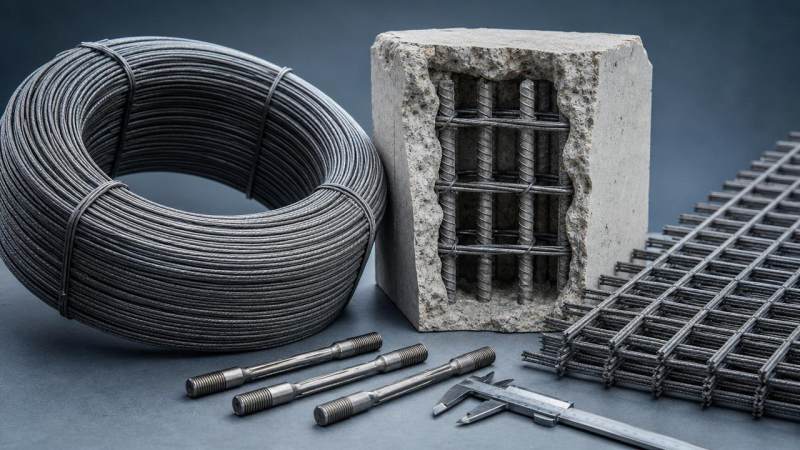
The market has changed in several ways.
Concrete structures now face higher design loads, longer service life targets, and stricter compliance reviews.
At the same time, supply chains include more cross-border sourcing.
That increases the chance of mixing standards such as ASTM, EN, JIS, and GB without proper technical alignment.
In older practice, some teams selected wire mainly by diameter or price.
Today, that shortcut is risky.
Steel Wire for concrete reinforcement must be matched to bonding behavior, ductility, welding suitability, corrosion exposure, and design code requirements.
A wire product can look acceptable on paper while still being wrong for the actual reinforced concrete condition.
The strongest trend signal: higher strength is not always better
One of the biggest misunderstandings is the belief that higher tensile strength automatically means safer reinforcement.
That assumption ignores balance.
Reinforced concrete depends on coordinated behavior between steel and concrete under load, crack development, and deformation.
If Steel Wire for concrete reinforcement is too strong but lacks ductility, it may reduce warning before failure.
If it does not fit the design assumptions, crack control and anchorage performance may also suffer.
The industry trend is clear.
Selection is moving from simple strength chasing toward performance-based evaluation.
Main factors driving this shift
- More international projects require exact compliance with named standards and test methods.
- Design teams are paying closer attention to ductility and crack control.
- Durability concerns are growing in coastal, industrial, and humid environments.
- Traceability and mill certification now affect approval speed and project risk.
- Fabrication methods such as welding and mesh forming require more consistent mechanical properties.
Common grade mistakes that create hidden project risks
Grade confusion is one of the most frequent causes of mismatch.
Different standards may use different naming systems for similar-looking products.
But similar names do not guarantee identical mechanical properties or use conditions.
Mistake 1: treating equivalent grades as identical grades
A common error is using approximate grade conversion tables without checking full specification details.
Yield behavior, elongation, chemistry, and testing basis may differ.
That matters when Steel Wire for concrete reinforcement must satisfy a specific code calculation.
Mistake 2: focusing on nominal diameter and ignoring tolerance
Diameter tolerance affects cross-sectional area and real load capacity.
A small deviation can change performance, especially in welded wire reinforcement or precast applications.
Mistake 3: overlooking surface condition
Surface condition influences bond strength and corrosion behavior.
Smooth, coated, bright, or lightly oxidized wire may behave differently inside concrete.
This is especially important where moisture or chloride exposure is expected.
Strength mistakes are often caused by incomplete reading of test data
Strength is not one number.
It includes tensile strength, yield strength, ratio values, and elongation after fracture.
When only one value is checked, decision quality drops.
For Steel Wire for concrete reinforcement, balanced data matters more than one impressive number.
A suitable product should match structural design assumptions and construction methods together.
Related material choices are also shifting toward durability and system compatibility
Reinforcement decisions rarely happen alone.
Projects increasingly compare adjacent steel products for corrosion protection, forming, and enclosure performance.
For example, in industrial and construction environments, Galv Sheeting is often used where durable galvanized steel components are needed.
Available in grades such as DX51D+Z, SGCC, and S350GD+Z, it supports thicknesses from 0.12mm to 6.00mm.
Widths range from 600mm to 1500mm, with hot galvanizing coatings up to 275g/m².
This matters because buyers now evaluate steel systems more holistically.
They look for compatible standards, traceable quality, and long service life across reinforcement and surrounding steel elements.
How these mistakes affect design, fabrication, and site execution
Errors in Steel Wire for concrete reinforcement do not stay in the purchasing stage.
They spread across the full project chain.
Design impact
Wrong strength assumptions can distort reinforcement calculations and serviceability expectations.
That may affect crack width control, anchorage length, and load redistribution behavior.
Fabrication impact
If the wire is too brittle or inconsistent, bending and welding performance may become unstable.
That increases scrap, rework, and production delays.
Site impact
Misidentified grades can trigger inspection failure, installation confusion, or replacement after delivery.
Those problems directly increase project cost and schedule uncertainty.
What deserves closer attention when selecting Steel Wire for concrete reinforcement
- Confirm the governing standard before comparing quotations.
- Check tensile strength, yield strength, and elongation together.
- Verify diameter tolerance and mass per unit length.
- Review surface condition and bond-related performance.
- Match the wire to welding, bending, and mesh processing needs.
- Request mill test certificates with traceable heat or batch information.
- Assess corrosion exposure and required durability life.
A practical way to judge future-fit wire specifications
This approach supports better decisions than comparing price alone.
It also helps identify whether a low-cost offer hides specification gaps.
The direction ahead: specification discipline will matter more than headline strength
The future of Steel Wire for concrete reinforcement is not about chasing the highest number.
It is about selecting the right grade, verified properties, and dependable consistency for the real structure.
As reinforced concrete projects become more performance-driven, specification discipline will become a competitive advantage.
Careful review of grade, strength, tolerance, and certification can prevent costly errors before they reach the site.
For better results, compare wire data against design intent, processing needs, and exposure conditions together.
That is the most reliable way to choose Steel Wire for concrete reinforcement with confidence and long-term value.
Hongteng Fengda supports global construction and industrial projects with structural steel products built to international standards.
With stable production, strict quality control, and customized solutions, it helps reduce sourcing risk and improve project efficiency.
Please give us a message


Please enter what you want to find