Does SGS certified steel automatically mean lower procurement risk? Not always. SGS certification can confirm testing results, document review, or inspection scope, but risk in steel sourcing also depends on mill capability, batch consistency, traceability, logistics control, and fitness for the intended structural load. A careful review of what SGS certified steel actually covers helps reduce hidden exposure in global steel purchasing.
Why a checklist matters when evaluating SGS certified steel
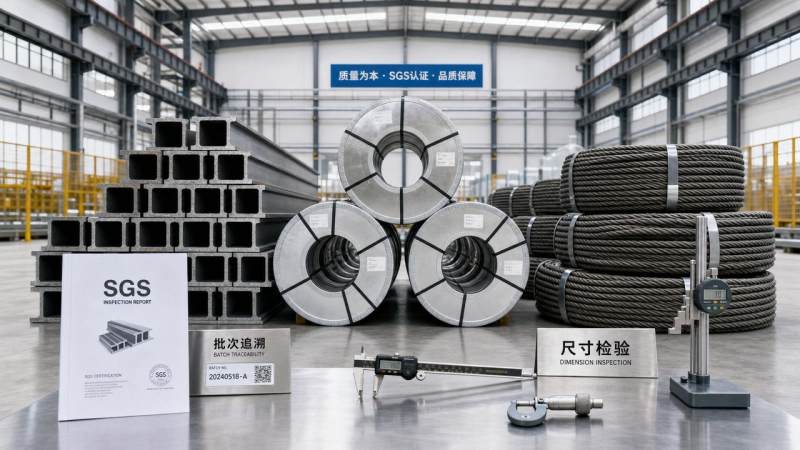
In the steel industry, paperwork can look stronger than the product itself. Many buyers see SGS certified steel as a shortcut for trust, yet certificates vary by scope, date, sample source, and inspection method.
A checklist prevents overreliance on one document. It forces verification of chemistry, mechanical properties, coating, dimensions, welding suitability, and shipment consistency before steel enters fabrication or site installation.
For structural steel exports from China, this approach is especially useful. International projects often require ASTM, EN, JIS, or GB alignment, and real risk appears when standards, tolerances, or application needs are misunderstood.
Core checklist for judging whether SGS certified steel truly lowers risk
- Confirm the certificate scope. Check whether SGS certified steel refers to mill audit, third-party testing, pre-shipment inspection, coating verification, or only a limited sample report.
- Match the report to the exact batch. Heat number, size, grade, quantity, and production date must align with packing list, mill test certificate, and marking details.
- Review the governing standard. SGS certified steel may pass one standard, but your project may require different yield strength, impact values, or corrosion performance.
- Check sampling logic. Ask whether samples were taken randomly from finished goods, prepared by the mill, or submitted from a prior production run.
- Verify production consistency. One compliant sample does not guarantee all bundles, lengths, or sections perform the same across the full shipment.
- Inspect dimensional tolerances. Straightness, thickness, flange width, camber, and length tolerance can affect fit-up, welding time, and downstream fabrication cost.
- Evaluate surface and coating condition. For galvanized or corrosion-sensitive products, zinc thickness, adhesion, and damage during handling matter as much as base steel chemistry.
- Confirm traceability controls. Good suppliers can link raw material, production line, test data, and final packing to each batch without gaps.
- Assess supply stability. SGS certified steel does not prove on-time delivery, production capacity, or repeatability over multiple purchase cycles.
- Test application suitability. Structural beams, channels, cold formed profiles, and wire rope each face different loading, fatigue, and environmental demands.
What SGS certified steel covers well, and what it does not
SGS certified steel is valuable when you need independent confirmation. It can support claims on tensile strength, chemical composition, dimensions, coating mass, or compliance with a stated specification.
However, it usually does not guarantee future production quality. It also may not cover design suitability, fabrication behavior, weldability in field conditions, or the performance of every piece shipped.
This distinction matters for both structural sections and accessory products. In corrosion-prone applications such as marine handling, cranes, or lifting systems, coating performance and operating environment require separate review.
For example, Hot dipped Galvanized Steel Wire Rope may be supplied for mining, marine industries, elevators, drilling, railways, or photovoltaic use. Even with third-party verification, the right choice depends on strand construction, diameter, tensile grade, and zinc coating group.
A rope specified at 1470Mpa to 1960Mpa, with options such as 6X19+IWR or 8x19S+FC, serves very different conditions than a structural beam. Certification helps, but application matching remains the real risk control step.
Application-specific checks for different steel purchasing scenarios
Structural frames and building support
For angle steel, channel steel, and steel beams, focus on yield strength, dimensional tolerance, and welding compatibility. SGS certified steel is useful only when the report matches the delivered heat and section size.
Also review project standard alignment. ASTM, EN, JIS, and GB grades may seem similar, but substitution without engineering confirmation can create approval delays or performance concerns.
Galvanized and corrosion-exposed applications
When steel is used outdoors, near salt, or in humid industrial environments, zinc coating data becomes critical. Ask for coating thickness range, adhesion evidence, and handling protection after inspection.
This is where SGS certified steel can mislead if the inspection was limited to a small sample. Real corrosion life depends on full-batch coating consistency and actual service conditions.
Customized fabrication and OEM components
Custom structural steel parts require tighter process control than standard stock lengths. Hole position, cutting accuracy, weld preparation, and packing protection can affect installation more than basic material certification.
A capable exporter should provide drawing review, process checkpoints, and stable production records. SGS certified steel alone does not replace manufacturing discipline.
Commonly missed risks behind SGS certified steel
One frequent mistake is assuming the certificate applies to the entire shipment. In reality, it may refer to one lot, one container, or one selected sample only.
Another missed risk is document mismatch. If the mill test certificate, invoice, bundle tags, and SGS report use inconsistent batch references, traceability becomes weak.
Buyers also overlook process capability. A supplier may pass one inspection, yet still struggle with repeat orders, thickness control, galvanizing uniformity, or delivery timing.
Logistics risk matters too. Damage during loading, moisture exposure, mixed packing, or poor container securing can reduce the practical value of SGS certified steel before it reaches site.
Finally, there is application drift. A product accepted for one use may be unsuitable for dynamic load, fatigue, lifting, or severe corrosion service without deeper technical review.
Practical execution steps before placing the order
- Request the latest SGS report together with mill test certificates, drawings, packing details, and a batch traceability summary.
- Compare standard numbers, grade names, and test items against actual project specifications, not just supplier quotations.
- Ask for photos or video of product marking, measuring, coating condition, and loading condition before shipment release.
- Define acceptance points for chemistry, mechanics, dimensions, coating, and document consistency in the purchase contract.
- Use trial orders or staged deliveries when entering a new supply relationship, especially for customized structural steel or galvanized products.
- Review whether the supplier can support repeat production with stable lead time, standard compliance, and responsive technical communication.
Reliable exporters reduce risk through more than certificates. Strong quality control, modern manufacturing facilities, and familiarity with ASTM, EN, JIS, and GB requirements make sourcing decisions more predictable over time.
For steel buyers handling structural sections, cold formed profiles, or specialized galvanized products, the best result comes from combining third-party verification with supplier capability assessment.
Conclusion and next action
SGS certified steel can lower risk, but only when its scope, batch link, and standard relevance are clearly verified. It is a useful control tool, not a complete sourcing decision by itself.
Use a checklist before every order. Verify the certificate, confirm traceability, review production consistency, and test suitability for the actual structural or industrial application.
When these steps are followed, SGS certified steel becomes part of a stronger procurement process rather than a false shortcut. That is how lower risk is achieved in real steel sourcing.
Please give us a message


Please enter what you want to find