Before cutting, welding, or installing, after-sales maintenance teams should always confirm key steel tubing dimensions to avoid fit-up issues, rework, and costly downtime. From outer diameter and wall thickness to length tolerance and end condition, each detail affects replacement accuracy and long-term performance. This guide explains which dimensions matter most before fabrication and how reliable sourcing helps maintain quality across demanding structural applications.
For after-sales maintenance personnel, the core issue is not simply knowing standard steel tubing dimensions. It is making sure the replacement tube will fit the existing assembly, perform under the same loads, and avoid unexpected delays once fabrication starts. In practical field work, even a small mismatch in diameter, wall thickness, straightness, or end preparation can turn a routine repair into a shutdown event.
That is why the most important decision before fabrication is verification, not assumption. Maintenance teams often work from old drawings, worn samples, mixed standards, or urgent replacement requests. In these situations, checking the right dimensions in the right order helps reduce installation risk, welding errors, and repeated procurement.
Which steel tubing dimensions matter most before fabrication?
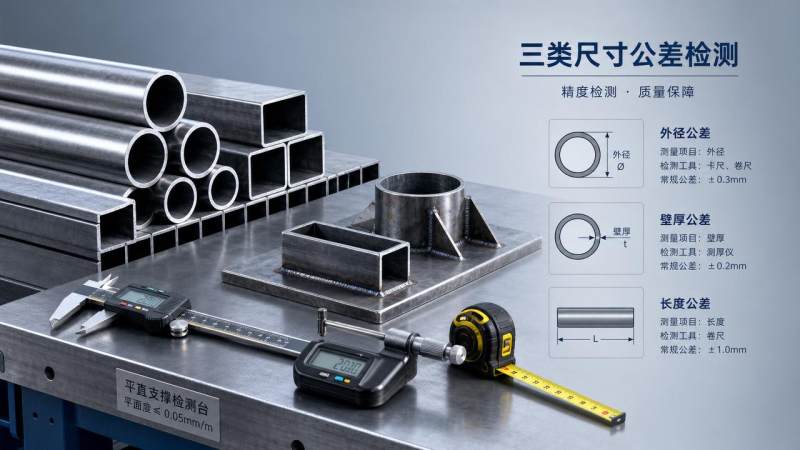
When people search for steel tubing dimensions, they usually want more than a chart. They need to know which dimensions actually affect cutting, joining, load performance, and field replacement. For maintenance work, the following items should always be verified before fabrication begins.
1. Outer diameter or outside dimensions. This is the first dimension to confirm because it affects fit-up with clamps, sleeves, flanges, couplings, brackets, and existing structural interfaces. For round tubing, outer diameter is critical. For square or rectangular tubing, outside width and height matter just as much because they determine whether the replacement section will align with the original frame.
2. Wall thickness. Wall thickness directly affects strength, weld behavior, weight, and corrosion allowance. A tube with the correct outside size but the wrong wall thickness may still fail in service or create welding problems. In maintenance environments, wall thickness also matters because many older assemblies have already lost some section due to corrosion or wear, making accurate comparison essential.
3. Inside diameter, when function requires it. Not every job needs inside diameter, but some do. If the tube carries flow, houses cables, accepts inserts, or fits over a mating part, inner clearance becomes important. In these cases, relying only on outer size is not enough, especially if wall thickness variation affects the usable internal space.
4. Length and cut tolerance. Many replacement problems happen because teams focus on section size but ignore actual cut length and tolerance. A tube that is just a few millimeters too long can create forced assembly, distortion, or misalignment at bolted and welded joints. For field replacements, overall length should be checked together with any slot, hole, notch, or end offset dimension.
5. Straightness and twist. Straightness is often overlooked until installation begins. Bent or twisted tubing is difficult to align and may require rework on site. This is especially important for long members used in frames, supports, guards, platforms, and equipment structures.
6. End condition. Ends should be checked for square cut, bevel, coping, threading, swaging, or other preparation. A correct tube size with the wrong end detail can still stop fabrication. End condition directly affects welding quality, assembly speed, and final dimensional control.
Why small dimensional errors create big maintenance problems
After-sales maintenance teams are usually measured by response time, repair quality, and equipment uptime. That means dimensional mistakes are expensive in ways that go beyond material waste. A tubing mismatch can delay restart schedules, increase labor hours, create safety concerns, and damage confidence between service teams and end users.
For example, if outer diameter is slightly oversized, the tube may not fit into an existing clamp or sleeve. If wall thickness is thinner than expected, the repair may pass visual inspection but fail under load. If the cut length is short, the gap may force field welding adjustments that weaken the connection or alter geometry. These are not theoretical issues. They are common causes of rework in maintenance fabrication.
Dimensional errors also become more serious when projects involve mixed standards such as ASTM, EN, JIS, or GB. A nominal size may look familiar on paper but differ in actual tolerance, section profile, or weight per meter. Global sourcing can be an advantage, but only when the buyer confirms dimensions against the intended application rather than relying on naming conventions alone.
How maintenance teams should verify steel tubing dimensions step by step
A practical verification workflow helps teams move faster without increasing risk. The best approach is to confirm dimensions in layers, starting with the dimensions that affect physical fit, then checking the details that influence fabrication and service life.
Start with the application. Ask what the tube does in the assembly. Is it load-bearing, protective, structural, decorative, or used as a housing? Does it connect to plates, gussets, base frames, hinges, or mechanical equipment? The function determines which dimensions are critical and which are secondary.
Check the original reference source. If you have fabrication drawings, compare them with field measurements. If you only have a sample part, inspect it for wear, corrosion, deformation, and previous repair modifications. Old tubing in service may no longer represent the original design size accurately.
Measure the major dimensions. For round tubing, confirm outer diameter, wall thickness, and length. For rectangular or square tubing, measure width, height, wall thickness, and corner condition. Use suitable tools such as calipers, ultrasonic thickness gauges, tape measures, and straightedges depending on the condition of the part.
Review tolerances. A nominal dimension alone does not tell the full story. Maintenance replacement often depends on whether actual production tolerance is acceptable for the existing structure. If a tube must mate with a fixed assembly, tolerance limits should be discussed with the supplier before fabrication.
Verify fabrication features. Confirm holes, slots, notches, coping profiles, end bevels, and welding gaps. These details can be more important than the base tube size because they determine whether the fabricated part installs smoothly without site adjustment.
Confirm material grade and standard. Dimensions should never be checked in isolation from material properties. Tubing with the right size but the wrong grade may have different yield strength, weldability, or corrosion performance. For structural and industrial repairs, dimension and grade must match the actual service requirement together.
What to check when replacing tubing in existing structures
Replacement work is different from new fabrication because the surrounding structure already exists. The maintenance team must make the new tube fit into a system that may have shifted, worn, corroded, or been modified over time. In these cases, dimensional verification should include the mating environment, not just the tube itself.
Check the spacing between supports, bolt hole centers, weld landing areas, and any connected steel components. Look for coating buildup, deformation, or accumulated tolerance from the original assembly. In older installations, the design drawing may be correct while the actual structure has moved from its nominal geometry. This is why field measurement is so important.
It is also useful to review whether the replacement part needs improved corrosion resistance. In some maintenance scenarios, tubing interfaces with sheet, plate, or protective covers exposed to outdoor or industrial environments. When these assemblies involve corrosion-prone zones, associated materials such as Steel Plate Galvanized may be specified for guards, covers, or support components. With thickness ranges from 0.12 mm to 6.00 mm, widths from 600 mm to 1500 mm, and customizable lengths from 1 m to 12 m, such materials can support structural compatibility while improving atmospheric corrosion resistance in construction, transportation, energy, and industrial applications.
For maintenance buyers, this matters because dimensional consistency is not only about tubing. It is about how the tube integrates with adjacent structural steel products, fabricated attachments, and protective elements. If plates, brackets, and covers are sourced from a supplier with controlled production and recognized standards such as ASTM, EN, JIS, and GB, dimensional coordination becomes easier across the whole repair package.
Common mistakes when interpreting steel tubing dimensions
One frequent mistake is confusing nominal size with actual measured size. This happens often when maintenance staff order replacement material quickly based on old part descriptions or informal shop language. A nominal label may not reflect the exact outer dimension, wall thickness, or standard required for the job.
Another mistake is assuming that all tubing with the same outside dimensions will perform the same way. In reality, changes in wall thickness, corner radius, grade, and manufacturing standard can affect both fabrication and service behavior. Two tubes may look similar at a glance but behave differently during welding, drilling, or load transfer.
A third issue is ignoring end condition and fabrication allowances. Tubes may be ordered in the right section size but arrive without the correct bevel, coping, or cut accuracy. Maintenance teams then lose time making adjustments that should have been specified in advance.
There is also a risk in measuring only damaged sections. If a tube has been dented, corroded, or heat-distorted, dimensions taken from the damaged area may not represent the intended size. It is better to measure multiple points and compare them with drawings, adjacent members, or undamaged reference pieces.
How reliable sourcing reduces dimensional risk
For after-sales maintenance teams, good sourcing is a technical decision, not just a purchasing task. A reliable structural steel supplier helps reduce uncertainty by providing stable manufacturing capability, consistent quality control, and support for customized dimensions when standard stock does not fully match the repair requirement.
This is especially relevant for global buyers handling cross-border projects. A manufacturer that works with international standards and exports regularly can help clarify specification differences before production. That reduces the chance of receiving tubing or structural components that are technically compliant in one market but unsuitable for the actual maintenance application.
Hongteng Fengda, as a structural steel manufacturer and exporter from China, supplies angle steel, channel steel, steel beams, cold formed steel profiles, and customized structural steel components for global construction, industrial, and manufacturing projects. For maintenance teams, the main value is not simply product range. It is the ability to combine standard specifications with OEM solutions, stable production, and quality control aligned with major standards.
When sourcing replacement steel members, buyers should ask for dimensional tolerance information, production standard confirmation, inspection records, and support for custom fabrication details where needed. This is often what separates a smooth replacement process from repeated field correction.
A simple pre-fabrication checklist for maintenance teams
Before releasing tubing for cutting or welding, use a short checklist to confirm the essentials:
Confirm tube shape: round, square, or rectangular.
Confirm actual outside dimensions, not only nominal size.
Confirm wall thickness at multiple points if wear or corrosion is present.
Confirm required inside clearance if the tube mates with inserts or carries flow.
Confirm cut length and allowable tolerance.
Confirm straightness, twist, and visual damage.
Confirm end preparation: square cut, bevel, cope, thread, or special detail.
Confirm hole positions, slots, brackets, and welded attachments.
Confirm material grade, standard, and coating requirement.
Confirm fit with the existing structure using field measurements where possible.
This checklist is simple, but it addresses the issues that most often cause maintenance rework. It also helps teams communicate more clearly with fabricators and suppliers, especially when replacement parts are urgent.
Conclusion
For after-sales maintenance personnel, verifying steel tubing dimensions before fabrication is one of the most effective ways to prevent installation problems, control repair costs, and protect uptime. The dimensions that matter most are the ones that affect real fit and service performance: outer size, wall thickness, length, tolerance, straightness, and end condition.
The key takeaway is straightforward. Do not treat steel tubing dimensions as a simple catalog reference. Treat them as a fit-for-purpose verification process tied to the actual structure, the fabrication method, and the operating environment. When maintenance teams combine careful measurement with reliable sourcing and clear specification review, they reduce risk and improve the quality of every replacement job.
In demanding structural applications, the best results come from checking critical dimensions early, clarifying tolerances before production, and working with suppliers that understand international standards and customized steel requirements. That approach saves time in the shop, avoids surprises in the field, and supports longer-lasting repairs.
Please give us a message


Please enter what you want to find