Even small tolerance deviations in ss sheet plate can lead to poor final fit, rework, safety risks, and costly delays in structural and industrial projects. For quality control and safety managers, understanding how thickness, flatness, width, and length variations affect assembly is essential to maintaining compliance and preventing on-site issues. This article explains the key tolerance factors and how to manage them effectively.
Why ss sheet plate tolerance matters
In steel fabrication, tolerance is not just a drawing note. It defines whether a plate can be cut, drilled, welded, and assembled without forcing the structure out of alignment. When an ss sheet plate arrives outside the expected limits, even by a small amount, the impact can spread across an entire production line. Parts may not line up, weld gaps may change, and installed components can create stress points that reduce reliability.
For quality control teams, the challenge is to separate acceptable variation from risk-driving deviation. For safety managers, the concern is more direct: misfit can weaken load transfer, distort protective systems, and increase the chance of field modification. That is why tolerance control should be treated as part of project safety, not only as a purchasing requirement.
Key tolerance factors that affect final fit
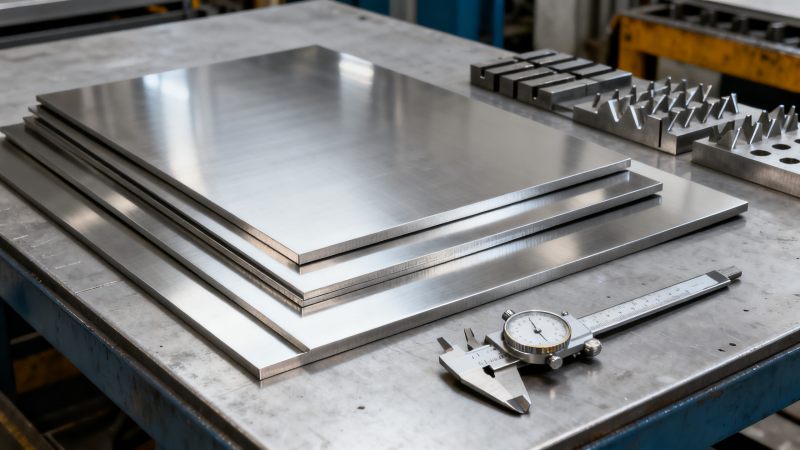
The main tolerance issues usually involve thickness, flatness, width, length, and edge condition. Thickness variation affects hole alignment, fastener performance, and weld preparation. Flatness deviation can cause gaps during assembly or create uneven contact surfaces that are difficult to correct after cutting. Width and length errors may seem minor, but they can become critical when parts are nested, framed, or installed in modular systems.
In many projects, tolerance is also influenced by surface condition and processing history. Cold working, cutting, polishing, and forming can change how a sheet behaves during fabrication. This is one reason buyers and inspectors often compare delivery inspection data with the original specification rather than relying on appearance alone.
Industry background and why standards are used
Structural and industrial buyers usually source materials under recognized standards such as ASTM, AISI, JIS, GB, DIN, and EN. Standards help define acceptable limits for size, mechanical properties, and surface condition, making it easier to match one supplier’s product with another’s engineering assumption. For ss sheet plate, this matters especially in projects with strict inspection records, safety certification, or repeatable assembly requirements.
While the term ss sheet plate is often used broadly in procurement and fabrication discussions, the actual material form may be linked with related stainless steel products used in supporting structures, frames, and precision parts. For example, 316L Stainless Square steel rod is selected in many sectors where corrosion resistance, form stability, and dependable dimensional control are important. In kitchenware, medical instruments, shipbuilding, automotive parts, and outdoor decoration engineering, close dimensional control supports smoother assembly and longer service life.
A material with balanced mechanical performance, such as tensile strength, yield strength, elongation, and hardness, can still create fit issues if its processed dimensions are inconsistent. That is why inspection should cover both performance data and dimensional tolerance. A product may meet nominal strength requirements and still fail at installation if the thickness or edge accuracy falls outside the project’s needs.
Typical application focus for quality and safety teams
Different industries place different pressure on tolerance control. In manufacturing and heavy equipment work, fit affects machine accuracy and maintenance access. In shipbuilding and defense-related applications, dimensional stability is essential because corrective work after assembly is expensive and often restricted. In urban decoration or outdoor engineering, visible distortion can also become a quality complaint, not only a technical defect.
- Precision fabrication: tight fit-up and weld consistency.
- Structural installation: hole alignment and load transfer.
- Safety-related assemblies: stable geometry and reliable closure.
- Repeat production: predictable nesting, cutting, and scrap control.
From a practical standpoint, quality control personnel should pay attention to the interaction between tolerance and downstream operations. A plate that is slightly oversized may still be usable after trimming, but repeated trimming raises labor cost and may damage the intended geometry. A plate that is undersized may be unusable for critical parts, especially when the design leaves little allowance for correction.
Practical methods to reduce fit problems
A strong tolerance management system begins with clear technical communication. Buyers should specify required dimensions, reference standards, inspection points, and acceptance criteria before production starts. Suppliers should confirm whether thickness, flatness, and edge finish can be controlled to the needed level, and whether any processing steps may influence final geometry.
Incoming inspection should use calibrated tools and documented sampling rules. For critical projects, it is useful to verify not only nominal size but also variation across the full sheet or component. This helps identify warping, taper, and localized distortion that may not be obvious during a quick visual check. When a deviation is found early, the team can decide whether to rework, replace, or adjust the assembly sequence.
Another useful practice is to connect tolerance data with actual use conditions. For example, a component destined for outdoor decoration engineering may tolerate a slightly different correction strategy than one intended for medical instruments or safety equipment. The best control plan is not only about meeting a number; it is about confirming that the material can perform reliably in the final environment.
Conclusion and next steps
For ss sheet plate, tolerance issues can create hidden risk long before a project reaches installation. Thickness, flatness, width, and length all affect whether parts fit as designed, whether rework is needed, and whether the final structure remains safe and efficient. Quality control and safety managers should therefore evaluate tolerance as part of a full material control strategy, not as a minor inspection detail.
If your project depends on stable dimensions, consistent processing, and standards-based supply, work with a supplier that understands both fabrication demands and inspection discipline. Clear specifications, reliable production, and documented quality checks are the most effective ways to reduce fit problems and protect project outcomes.
Please give us a message


Please enter what you want to find