In structural fabrication, steel angle bending directly affects fit-up accuracy, load performance, and on-site safety.
Understanding bending limits, tolerances, and common errors helps reduce rework, scrap, delays, and compliance risks.
This guide explains how steel angle bending works, what limits shape quality, and which practical checks improve consistency.
It also highlights prevention methods that support reliable fabrication for construction, industrial, and manufacturing applications.
What does steel angle bending mean in structural fabrication?
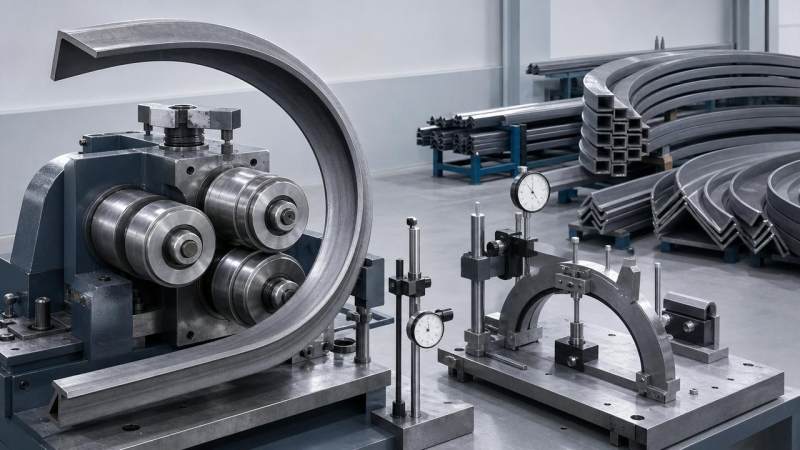
Steel angle bending is the controlled forming of angle sections into a required radius or geometry without losing functional strength.
The process is common in frames, supports, brackets, architectural trims, walkways, equipment bases, and curved structural details.
Unlike flat sheet bending, angle sections contain two legs and a corner root.
That shape creates uneven stress distribution during forming, especially when one leg resists deformation more than the other.
As a result, steel angle bending must consider section size, leg thickness, bend direction, tooling pressure, and target radius.
The quality objective is not only visual accuracy.
It also includes dimensional repeatability, stable load transfer, correct hole alignment, and predictable assembly on site.
Why is it more challenging than straight cutting?
Straight cutting removes material with limited shape distortion.
Steel angle bending changes geometry and internal stress at the same time.
Even a small setup error may cause twisting, leg spread, local buckling, or springback beyond tolerance.
What limits the minimum bend radius in steel angle bending?
The minimum bend radius depends on material ductility, thickness, section geometry, forming method, and the final service requirement.
Low-carbon structural steel usually bends more easily than high-strength grades.
Thicker angles generally require a larger radius to avoid cracking or severe distortion.
The root area is critical because strain concentrates there during steel angle bending.
Key factors that define bending limits
- Material grade and elongation capacity
- Angle leg width, thickness, and corner radius
- Hot bending versus cold bending process
- Rolling, press bending, or stretch forming method
- Presence of holes, notches, welds, or cutouts near the bend zone
If the target radius is too tight, the outer fibers may crack while the inner side compresses and wrinkles.
When the radius is too loose, the part may not fit the design envelope.
That mismatch often causes connection stress or field modification.
How should bending limits be verified?
The most reliable method is trial forming on the actual grade and section.
Drawings alone cannot fully predict springback and distortion behavior in every steel angle bending job.
For outdoor or corrosive environments, related materials also need compatible durability.
In cladding or accessory systems, AZ50 Galvalume Steel Coil is often selected for corrosion resistance, weldability, and stable performance.
Which tolerances matter most for steel angle bending quality?
Tolerances determine whether the bent part can be installed without forcing, shimming, slotting, or extra welding.
In practice, steel angle bending quality is judged by more than overall radius.
Several dimensions influence assembly success.
Critical tolerance checkpoints
- Inside or centerline bend radius
- Arc length and developed length
- Sweep consistency across the full section
- Twist along the bent member
- Leg angle opening or closing after forming
- End squareness and hole position retention
Twist is one of the most damaging issues.
A part can meet radius tolerance but still fail installation because the legs rotate out of plane.
Leg spread is another frequent hidden problem.
It changes the connection geometry and can interfere with bolted fit-up.
Recommended inspection approach
Use templates, radius gauges, string lines, and calibrated dimensional checks.
For repeat production, define first-article approval before the full batch begins.
Measurement points should be fixed on drawings and inspection records.
What are the most common steel angle bending errors?
Most steel angle bending failures come from controllable process mistakes rather than unusual material defects.
Recognizing the error patterns early prevents repeated scrap and unstable quality.
1. Underestimating springback
After load release, the steel partially returns toward its original shape.
If compensation is too small, the final radius becomes larger than specified.
2. Applying uneven force
Poor roller alignment or bad clamping can push one leg more than the other.
That causes twist, asymmetric curvature, or edge marking.
3. Ignoring section orientation
Bending with the wrong leg orientation changes stiffness and deformation response.
The same angle can behave differently depending on how it enters the machine.
4. Bending too close to holes or welds
Discontinuities act as stress raisers.
Cracks, elongation, and hole distortion become more likely near the bend line.
5. Using unsuitable material condition
Excessively hard or inconsistent stock increases the risk of fracture and tolerance drift.
Material certification and mechanical property review are important before production.
How can steel angle bending errors be prevented in production?
Prevention starts with process planning, not end-of-line correction.
A stable steel angle bending workflow combines tooling control, material review, and disciplined inspection.
Practical prevention steps
- Confirm material grade, thickness, and heat lot before bending.
- Review drawings for minimum radius and nearby features.
- Perform sample bends and record springback compensation.
- Set roller or die alignment using standard references.
- Inspect first pieces for radius, twist, and leg angle.
- Monitor repeated batches to catch drift before full output.
Surface protection must also be considered.
In projects requiring corrosion-resistant accessories or formed sheet components, another option is AZ50 Galvalume Steel Coil.
Its aluminum-zinc-silicon coating supports exterior, structural, and industrial applications where durability matters.
Typical thickness ranges from 0.12mm to 6.00mm, with widths from 600mm to 1500mm.
How do cost, lead time, and quality connect in steel angle bending?
Steel angle bending becomes expensive when errors are discovered after welding, coating, or shipment.
A low quoted bending price may hide higher total project cost.
The real cost includes trial work, scrap rate, inspection effort, schedule impact, and field correction.
Where delays usually appear
- Unverified bend radius assumptions
- Late discovery of twist or hole mismatch
- Tooling changes during batch production
- Rework after galvanizing, painting, or assembly
Early technical review shortens lead time more effectively than rushed correction later.
Reliable structural steel suppliers reduce risk through stable production capacity, controlled processes, and international standard compliance.
Quick FAQ table for steel angle bending decisions
Steel angle bending quality depends on understanding limits, controlling tolerances, and preventing predictable errors before production scales up.
With proper trials, tooling checks, and inspection standards, bent angles can achieve reliable fit, appearance, and structural performance.
For projects needing dependable structural steel supply and customized solutions, a capable partner can help control sourcing risk, cost, and delivery consistency.
Please give us a message


Please enter what you want to find