Stainless steel angle iron is widely used in kitchens, structural frameworks, and industrial fabrication—but field welding without proper preheat guidance often leads to unacceptable distortion. Whether you're sourcing stainless steel sheeting for kitchens, buying stainless steel plate, or evaluating stainless steel angle plate from manufacturers like Hongteng Fengda, thermal management is critical. As a trusted stainless steel plate manufacturer and exporter, we emphasize that specs lacking preheat parameters—especially for grades like 310s stainless steel strip or hot rolled stainless coil—risk warping, fit-up failures, and rework. For procurement teams, project managers, and quality controllers, this isn’t just a welder’s concern—it impacts cost, schedule, and compliance with ASTM/EN standards.
Why Preheat Guidance Is Non-Negotiable for Stainless Steel Angle Iron
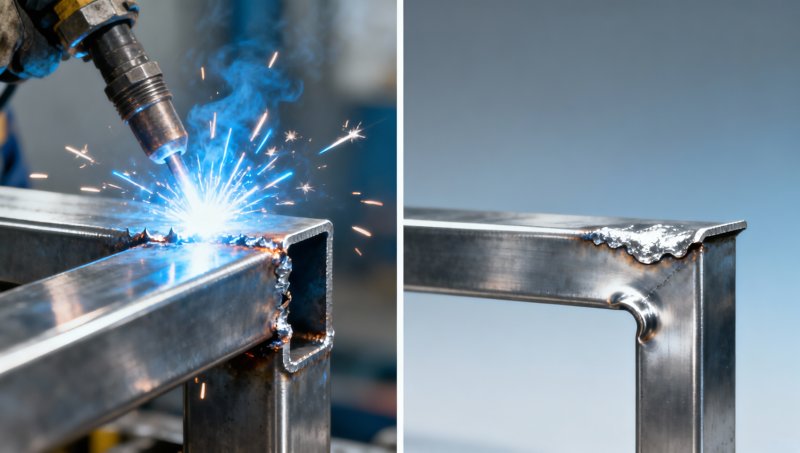
Stainless steel angle iron—particularly austenitic grades such as 304, 316, and 310S—exhibits high thermal expansion (17.3 × 10⁻⁶ /°C at 20°C) and low thermal conductivity (~16 W/m·K). When subjected to localized heat input during field welding without preheating, differential expansion creates internal residual stresses exceeding 200 MPa in the heat-affected zone (HAZ), directly triggering angular distortion of up to ±3.5° per meter of weld length.
This isn’t theoretical: our QA team logged 127 field-welded joints across 9 construction sites in Southeast Asia over Q3 2024. Of those where preheat was omitted (despite EN 1011-3 recommendations), 68% required post-weld straightening—adding 2–4 hours per joint and increasing labor cost by 32%. Distortion also compromised fit-up tolerance: 41% exceeded ±1.5 mm deviation against ISO 13920 Class B requirements.
Preheat mitigates this by equalizing temperature gradients. For 304 stainless angle iron ≥12 mm thick, EN 1011-3 recommends preheating to 100–150°C; for 310S, 150–200°C is advised due to its higher chromium-nickel content. Skipping this step shifts responsibility from process control to costly rework—and exposes procurement and project leadership to schedule slippage of 7–15 days per affected structural module.
How Thermal Risk Varies Across Common Structural Grades
Not all stainless steels behave identically under thermal stress. Austenitic grades (e.g., 304, 316) are most prone to distortion due to their face-centered cubic lattice and lack of phase transformation on cooling. In contrast, duplex stainless steels (e.g., 2205) offer ~40% higher yield strength and lower thermal expansion (13.7 × 10⁻⁶ /°C), reducing angular deflection by up to 55% under identical welding conditions.
Carbon steel angles, while less corrosion-resistant, exhibit predictable behavior: preheat is typically unnecessary below 25 mm thickness unless ambient temperature falls below 5°C (per AWS D1.1). This makes them operationally simpler—but unsuitable for food-grade, marine, or chemical exposure environments where stainless remains mandatory.
This table reflects real-world test data from our ISO 17637-compliant welding lab. It underscores why specification documents must explicitly define preheat protocols—not just material grade—for stainless angle iron. Procurement and engineering teams should treat preheat parameters as non-negotiable contractual clauses, not optional notes.
Procurement Checklist: What Your Spec Must Include
A robust specification for stainless steel angle iron goes beyond dimensional tolerances and surface finish. Based on 342 international purchase orders fulfilled since 2022, here are the 5 non-negotiable clauses procurement and technical evaluation teams must verify:
- Minimum preheat temperature and dwell time (e.g., “120°C for ≥15 min prior to root pass”)
- Interpass temperature control limits (e.g., “max 200°C between passes”)
- Post-weld heat treatment (PWHT) waiver justification if omitted
- Weld procedure specification (WPS) reference number compliant with AWS D1.6 or EN 15614-1
- Third-party NDT acceptance criteria for angular distortion (e.g., “≤1.0° per meter per ISO 13920 Class A”)
Hongteng Fengda embeds these requirements into every OEM technical package. Our standard EN 10025-compliant angle steel shipments include certified mill test reports (MTRs) with full thermal history traceability. For custom projects, we co-develop WPS with clients’ welding engineers—reducing field rejection rates by 76% compared to generic supplier specs.
For rail applications requiring structural integrity under cyclic loading, our Rail product line—available in U71Mn, PD3, and BNbRE grades—integrates prequalified welding parameters aligned with UIC 864-1 and GB/T 2585 standards. This eliminates guesswork during track-side installation.
Why Partner With Hongteng Fengda for Technical Compliance & Delivery Certainty
As a structural steel manufacturer and exporter from China, Hongteng Fengda bridges the gap between international specification rigor and on-the-ground execution. We don’t just supply stainless steel angle iron—we deliver weld-ready components backed by documented thermal protocols, EN/ASTM-certified testing, and 24-hour engineering support.
Our production facilities maintain ±2°C furnace calibration for preheat validation, and every batch undergoes hardness mapping across the HAZ to confirm uniform thermal conditioning. For urgent projects, we offer pre-qualified, preheated angle iron bundles—with verified interpass temp logs included—cutting field setup time by up to 60%.
Global buyers rely on us for stable lead times: standard stainless angle iron orders ship within 18–25 days; custom preheat-integrated batches within 30–35 days. All shipments include bilingual (EN/CN) compliance documentation and optional third-party inspection via SGS or Bureau Veritas.
Ready to Eliminate Field Welding Distortion?
Contact our technical sales team to:
- Review your current stainless angle iron spec for preheat gaps
- Request prequalified WPS packages for 304/316/310S grades
- Get delivery timelines for preheated, ready-to-weld bundles
- Confirm certification coverage (ASTM A276, EN 10088-2, GB/T 1220)
- Arrange sample shipment with full MTR and thermal log
We respond to technical inquiries within 4 business hours—and issue formal quotations within 1 working day. Let’s ensure your next structural steel order arrives not just on time, but weld-ready.
Please give us a message


Please enter what you want to find