For after-sales maintenance teams, the service life of Stainless Steel Welded Mesh directly affects safety, replacement cycles, and total project cost. Factors such as material grade, welding quality, surface condition, installation environment, and daily maintenance all play a critical role. Understanding these key influences helps identify risks early, extend product lifespan, and ensure more reliable performance in demanding industrial and construction applications. In steel-related projects, long-term performance is rarely determined by one single variable. Instead, the durability of Stainless Steel Welded Mesh depends on how material selection, fabrication standards, structural loading, corrosion exposure, and maintenance practice work together over time.
Basic Overview of Stainless Steel Welded Mesh Service Life
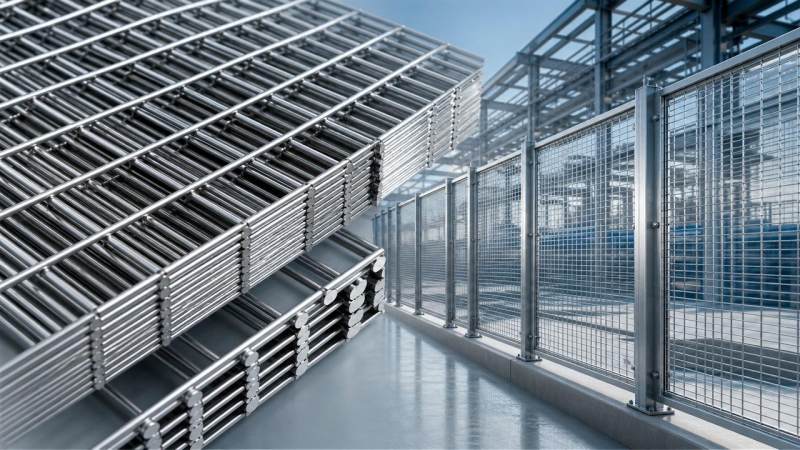
Stainless Steel Welded Mesh is widely used in construction, industrial guarding, infrastructure reinforcement, filtration support, enclosures, and equipment protection. It consists of longitudinal and transverse stainless steel wires resistance-welded at each intersection to form a stable grid. Compared with woven mesh, welded mesh offers higher rigidity, more consistent openings, and easier panel installation. Its service life refers to the period during which the mesh continues to meet mechanical, dimensional, and corrosion-resistance requirements under actual operating conditions.
In practice, expected life may range from a few years in highly corrosive or mechanically aggressive locations to decades in controlled environments. That is why evaluating Stainless Steel Welded Mesh only by purchase price is not enough. A lower-cost mesh with poor weld consistency or an unsuitable steel grade may create repeated maintenance, unexpected shutdowns, or safety exposure later. For steel systems, durability is part of structural value, not just a material feature.
Main Factors That Affect Service Life Most
Among all variables, five factors usually have the strongest influence on the service life of Stainless Steel Welded Mesh: steel grade, welding quality, surface condition, exposure environment, and maintenance discipline. These are also the areas where early assessment can most effectively reduce lifecycle cost.
1. Material grade and alloy composition
The corrosion resistance of Stainless Steel Welded Mesh begins with alloy selection. Grades such as 201 or 202 may be suitable for dry indoor environments with limited corrosive exposure, while 304 is often selected for general outdoor and industrial use. In chloride-rich areas, chemical processing zones, coastal installations, or washdown conditions, 316 usually performs better because of its higher resistance to pitting and crevice corrosion. If the grade does not match the environment, even well-made mesh may fail early.
2. Welding quality at each intersection
Weld integrity directly affects strength retention and crack resistance. Poor heat control can cause weak joints, burn-through, or excessive heat-affected zones. In service, these defects become starting points for fracture, localized corrosion, or dimensional instability. Consistent resistance welding parameters, clean wire surfaces, and proper post-production inspection are essential. For Stainless Steel Welded Mesh used in safety barriers or machine guarding, weld quality is often the difference between stable long-term use and repeated repair.
3. Surface condition and contamination control
A stainless surface must remain clean and intact to maintain its passive protective layer. Iron contamination from handling tools, carbon steel contact, grinding debris, or transport damage can trigger rust staining and reduce corrosion performance. Surface scratches, rough edges, or unremoved welding discoloration also increase risk. A properly finished Stainless Steel Welded Mesh panel generally lasts longer because it is less likely to trap corrosive deposits and easier to inspect and clean.
4. Installation stress and structural support
Even high-quality mesh can lose life if it is overstressed during installation. Excessive tensioning, poor fastening spacing, unsupported spans, or forced alignment around frames may place constant stress on wires and welds. Over time, vibration, impact, and cyclic loading intensify these weaknesses. Good support design, compatible connectors, and correct edge treatment help Stainless Steel Welded Mesh maintain shape and load performance much longer.
5. Daily maintenance and inspection frequency
Service life is strongly affected by what happens after installation. Dust, salt, chemical residue, standing moisture, and debris accumulation can change the local corrosion environment around the mesh. Routine cleaning, scheduled inspection, and timely replacement of damaged fasteners prevent minor defects from becoming system failures. In many facilities, poor maintenance shortens the life of Stainless Steel Welded Mesh more quickly than normal aging does.
Industry Background and Current Durability Focus
Across construction, manufacturing, utility, and infrastructure projects, durability has become a more important decision factor than simple initial cost. Material traceability, international standards compliance, and fit-for-environment selection now receive more attention because steel components are expected to perform with fewer interruptions and lower maintenance burden.
This is where support members also matter. In many guard, partition, walkway, and enclosure systems, mesh performance depends on the framing steel around it. For projects needing stable support sections, Channel In Steel can be integrated into structural assemblies for construction, wall beam support, brackets, lightweight roof frames, and steel structure purlin applications. Available in grades including Q195, Q235, Q345B, Duplex, and 201/202/304/316, with thickness from 1.5mm to 25mm and standards such as ASTM, JIS, DIN, and GB/T, it offers high strength, good weld ability, and anti-corrosion performance for systems where the mesh and support frame must work together reliably.
Application Value in Steel and Construction Projects
The value of Stainless Steel Welded Mesh is not limited to corrosion resistance. When selected and maintained correctly, it improves operational continuity, reduces repair frequency, and supports safer working environments. In construction and industrial steel systems, the most durable mesh installations usually share three characteristics: the correct stainless grade, stable support structure, and a maintenance plan matched to site conditions.
For exporters and global project suppliers, service life also affects sourcing confidence. Buyers often compare not only specification sheets but also consistency in production, compliance with ASTM, EN, JIS, or GB-related requirements, and the ability to customize steel components that fit real installation conditions. A reliable structural steel partner helps reduce mismatch risk between mesh panels, support channels, fastening hardware, and field environment.
Typical Service Environments and Risk Levels
Not all applications expose Stainless Steel Welded Mesh to the same aging pattern. The environment should guide both grade selection and maintenance intervals.
Practical Recommendations to Extend Service Life
- Match stainless grade to the actual environment rather than choosing by initial cost alone.
- Check weld uniformity, opening consistency, and visible heat damage before installation.
- Avoid direct contamination from carbon steel tools, racks, and grinding operations.
- Use proper framing members, support spacing, and compatible fasteners to reduce stress concentration.
- Establish routine cleaning intervals in areas exposed to salt, chemicals, or trapped debris.
- Inspect impact zones, cut edges, and weld points regularly for early signs of damage or corrosion.
If replacement decisions are made only after visible failure appears, lifecycle cost is usually already rising. Earlier intervention based on inspection records is more effective. In projects supported by structural sections, selecting well-controlled steel components from experienced suppliers can further improve long-term assembly performance. Companies with stable production capacity, export experience, and compliance with major standards are better positioned to support durable steel systems across global construction and industrial applications.
Next-Step Evaluation for Better Long-Term Performance
The service life of Stainless Steel Welded Mesh is affected most by the combination of grade suitability, weld quality, surface protection, environment, and maintenance. When these factors are reviewed together, the mesh performs more safely and predictably, and replacement planning becomes easier. For upcoming steel projects, the practical next step is to compare application conditions against mesh grade, support structure, fastening design, and inspection frequency before final selection. A system-level review delivers far better durability than evaluating Stainless Steel Welded Mesh as an isolated item.
For applications that also require dependable structural steel support, customized sections, and internationally compliant supply, working with an experienced China-based structural steel manufacturer and exporter can help reduce sourcing risk, improve consistency, and support efficient project execution from specification to installation.
Please give us a message


Please enter what you want to find