Is cheap steel from China reliable for long-term use? For many end consumers, the answer depends on more than price alone. Product standards, manufacturing control, and supplier credibility all play a major role in durability and safety. Understanding how Chinese structural steel is produced and evaluated can help buyers make smarter decisions and avoid costly risks over time.
When Is Cheap Steel From China Reliable in Real Projects?
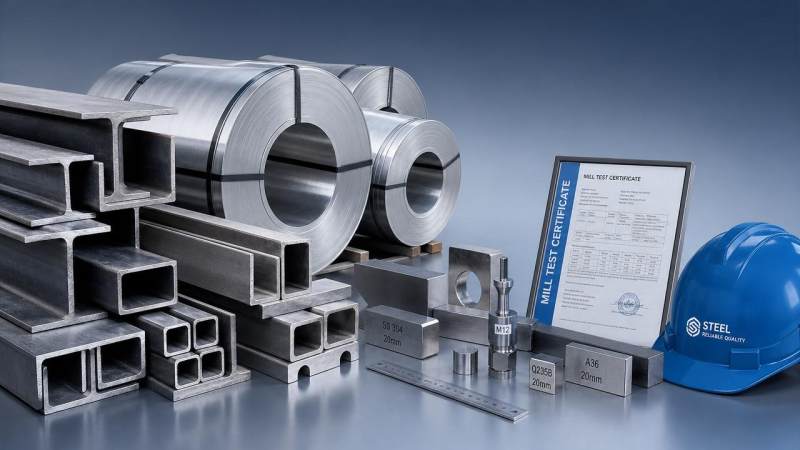
The question “is cheap steel from China reliable” cannot be answered with a simple yes or no. Reliability depends on where the steel will be used, how long it must perform, what standards it must meet, and whether the supplier can maintain consistent quality over repeated orders. In structural, industrial, and fabrication work, low price only creates value when the material remains dimensionally stable, mechanically compliant, and suitable for the intended service environment.
Chinese steel covers a wide spectrum. Some products are made for price-sensitive, short-cycle applications, while others are produced under strict ASTM, EN, JIS, or GB controls for long-term construction and manufacturing use. That means the real issue is not whether low-cost Chinese steel exists, but whether the specific grade, process route, inspection record, and export service are aligned with the actual project conditions.
Why Different Use Scenarios Change the Reliability Answer
A warehouse frame, a machine support, an outdoor decorative panel, and a transport component do not ask the same thing from steel. Some applications prioritize tensile strength and yield strength. Others care more about corrosion behavior, surface finish, flatness tolerance, weldability, or forming performance. This is why asking “is cheap steel from China reliable” without naming the end use often leads to poor decisions.
For example, structural sections used in buildings need dependable mechanical properties, traceable chemistry, and stable dimensional tolerance. By contrast, stainless coil for decorative or fabricated parts may be judged more heavily by surface condition, flexibility, hardness range, and finish consistency. In both cases, long-term reliability comes from matching steel characteristics to service demands rather than selecting the lowest quotation.
Typical Scenarios Where Buyers Ask: Is Cheap Steel From China Reliable?
Construction frames and load-bearing steelwork
In construction, cheap steel from China can be reliable if it is produced by a qualified supplier with controlled rolling, proper testing, and clear compliance documents. Long-term performance in beams, channels, angle steel, and customized structural components depends on load capacity, weld integrity, coating suitability, and resistance to deformation over time. Even a small deviation in thickness or chemistry can affect fabrication and safety margins.
This is where experienced structural steel exporters stand out. A supplier with modern facilities, export experience, and stable lead times can reduce hidden project risk by providing consistent batches, third-party inspection options, and products aligned with ASTM, EN, JIS, and GB standards. In long-life construction use, reliability is less about the country of origin and more about manufacturing discipline.
Industrial equipment, fabrication, and formed parts
Fabricated products often require a balance between strength and formability. In these cases, cheap steel from China may still be a reliable choice when process requirements are clearly defined before ordering. Buyers should confirm bending performance, weld response, hardness range, and surface finish before mass production. If a coil or section is inexpensive but creates cracking, springback issues, or excessive scrap, the apparent cost advantage disappears.
A useful example is 430 Stainless Steel Coil, which is commonly used in tabletops, countertops, kitchenware, medical instruments, automotive parts, conveyor belts, screens, bolts, nuts, and decorative engineering. Available in finishes such as BA, 2B, NO.1, NO.4, HL, and 8K, it can suit applications where appearance, formability, and controlled strength matter. Typical technical values include tensile strength of at least 520MPa, yield strength of at least 275MPa, elongation of about 55% to 60%, hardness up to 183HB or 100HRB, and thickness options from 2.5mm to 10.0mm. In the right fabrication scenario, a competitively priced stainless coil with verified ASTM, JIS, EN, ISO, SGS, or BV compliance can absolutely support long-term use.
Outdoor use and corrosion-sensitive environments
Outdoor structures and exposed fabricated parts present a stricter test. Here, the answer to “is cheap steel from China reliable” depends heavily on corrosion resistance strategy. Carbon structural steel may need galvanizing, painting, or another protective system. Stainless steel grades must be matched to actual exposure conditions, not simply selected by price. Humidity, chloride presence, industrial pollution, and maintenance intervals all affect service life.
A low-cost product may perform well indoors yet fail early outdoors if coating adhesion, finish quality, or material selection is poor. Long-term reliability in this scenario requires review of the base material, protective treatment, installation details, and expected maintenance cycle.
How Reliability Requirements Differ by Scenario
Practical Checks Before Deciding if Cheap Steel From China Is Reliable
To judge whether cheap steel from China is reliable for long-term use, several checkpoints matter more than headline price:
- Confirm the exact grade, standard, and intended application.
- Request mill test certificates with chemistry and mechanical property data.
- Check tolerance control for thickness, width, length, and straightness.
- Review surface finish and coating requirements for the service environment.
- Evaluate supplier export experience, packaging quality, and lead-time stability.
- Use third-party inspection when the project carries high safety or compliance risk.
Reliable Chinese steel sourcing often comes from suppliers that combine production capacity with documentation discipline. Companies focused on structural steel manufacturing and export are typically better prepared to support standard sections, custom components, OEM requirements, and repeat quality control for global markets.
Best-Fit Sourcing Advice for Different Project Conditions
- For long-life structural projects: prioritize standard compliance, stable mechanical properties, and traceable production over the lowest unit cost.
- For forming and fabrication: ask for sample testing to verify bending, stamping, and welding behavior before confirming bulk orders.
- For decorative or exposed applications: focus on finish quality, corrosion suitability, and maintenance expectations.
- For custom components: choose a supplier able to handle drawings, OEM specifications, and dimensional consistency across batches.
This is where a capable Chinese structural steel partner adds value beyond supply. With modern manufacturing facilities, strict quality control, and experience serving North America, Europe, the Middle East, and Southeast Asia, consistent exporters can help reduce sourcing risk while keeping cost efficiency realistic.
Common Misjudgments That Cause Long-Term Problems
One common mistake is assuming all low-cost steel products from China are the same. In reality, process control, raw material selection, finishing, inspection frequency, and export packaging can vary widely. Another mistake is comparing quotations without aligning grade, tolerance, finish, and testing scope. A lower offer may exclude critical quality steps.
It is also risky to judge reliability only from initial appearance. Steel that looks acceptable on arrival may still perform poorly in welding, bending, or outdoor exposure if the underlying specification is mismatched. Long-term use depends on verified performance data and realistic service-condition planning.
Final Answer: Is Cheap Steel From China Reliable for Long-Term Use?
Yes, cheap steel from China can be reliable for long-term use, but only when the product is matched to the application, produced under recognized standards, and supplied by a manufacturer with dependable quality control. The better question is not simply “is cheap steel from China reliable,” but “is this specific steel, from this specific supplier, reliable for this specific scenario?”
If the project requires structural sections, cold formed profiles, stainless coil, or customized steel components, the next practical step is to review the grade, standards, drawings, and expected service conditions before ordering. A qualified Chinese exporter can then recommend the right specification, provide supporting certificates, and help balance cost with long-term performance.
For projects that need stable production capacity, international standard compliance, and customized structural steel support, detailed technical communication before purchase is the safest way to turn a low price into real long-term value.
Please give us a message


Please enter what you want to find