Even minor surface defects in an ss tube can speed up corrosion, weaken structural performance, and lead to unexpected maintenance issues.
For after-sales maintenance work, early recognition helps extend service life, reduce downtime, and avoid costly replacement cycles.
This article explains common ss tube surface problems, their causes, practical evaluation methods, and maintenance priorities in real steel service conditions.
Surface Defects in an SS Tube: Basic Overview
An ss tube usually works under load, pressure, vibration, moisture, chemicals, or outdoor exposure.
Its surface condition often provides the earliest visible warning of hidden deterioration.
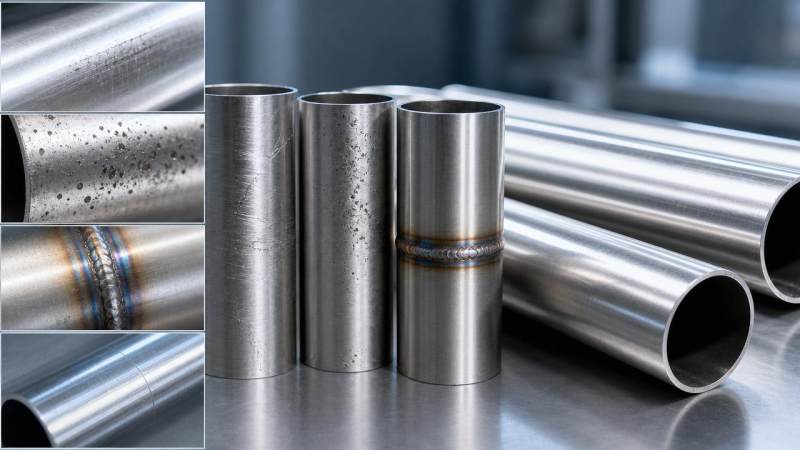
Surface defects are visible or measurable irregularities formed during production, handling, welding, storage, or service.
Some defects only affect appearance, but others create stress concentration, coating failure, or accelerated localized corrosion.
For any ss tube, defect severity depends on depth, length, location, environment, and whether the tube carries structural or process duties.
Common surface defect types
- Scratches and scoring from transport, cutting, or abrasive contact.
- Pitting caused by chlorides, trapped moisture, or coating damage.
- Scale, oxide film, and heat tint from welding or poor heat treatment.
- Dents and flattening that reduce section stability.
- Laps, seams, and rolled-in inclusions from manufacturing.
- Cracks near welds, bends, or heavily stressed zones.
- Rust staining or contamination from carbon steel contact.
Current Industry Attention Around SS Tube Surface Quality
In steel applications, surface quality receives greater attention because operating environments are becoming harsher and maintenance windows shorter.
Small defects on an ss tube can now create larger lifecycle costs than many teams expected before.
These issues matter across construction, industrial structures, support systems, and fabricated steel assemblies exposed to weather or process media.
How Surface Defects Shorten SS Tube Service Life
A surface defect does not remain isolated.
It often becomes the starting point for corrosion growth, fatigue initiation, coating breakdown, or dimensional instability.
Main damage pathways
- Rough surfaces retain moisture and contaminants longer.
- Deep scratches remove passive or protective layers.
- Pits act as local corrosion cells and deepen rapidly.
- Cracks intensify stress under vibration or pressure cycles.
- Dents change wall behavior and may affect fit-up or alignment.
For a structural ss tube, loss of section thickness can reduce reliability long before total failure becomes visible.
For process or support applications, local damage may trigger leakage, clamp loosening, or difficult field repair.
Typical Defect Categories and Practical Evaluation
A useful inspection approach separates defects by risk level rather than by appearance alone.
Inspection should combine visual review with thickness checks, weld examination, and operating history.
A single photo is not enough to classify risk for an ss tube in demanding service.
Application Value in Steel Structures and Industrial Use
Better defect recognition improves maintenance planning, spare allocation, and shutdown timing.
It also supports more accurate repair decisions instead of unnecessary full replacement.
Where surface condition has high operational impact
- Outdoor support frames exposed to rain, dust, and temperature cycling.
- Fabricated steel assemblies near coastal or chemical environments.
- Welded structural members where local discoloration may indicate weak spots.
- Storage and transfer systems affected by abrasion and impact.
- Retrofit projects where old and new steel components interact.
In these settings, managing ss tube condition helps protect both safety margins and total steel lifecycle value.
Practical Inspection and Maintenance Recommendations
A repeatable field process gives the best results.
It keeps judgments consistent across different exposure conditions and service periods.
Recommended practice steps
- Clean the surface before inspection to remove false indications.
- Mark defect position, size, orientation, and surrounding conditions.
- Compare affected areas with nearby sound surface zones.
- Check whether the defect crosses welds, bends, or support points.
- Record trend data, not just one-time appearance.
- Prioritize pits, cracks, and deep mechanical damage for immediate review.
Important cautions
- Do not polish away evidence before measuring defect depth.
- Do not mix stainless-contact tools with contaminated carbon steel tools.
- Do not ignore recurring stains around brackets, clamps, or weld toes.
- Do not treat all discoloration as cosmetic without environmental review.
When replacement is necessary, consistent material quality and proper surface processing remain critical to long-term performance.
Next-Step Focus for Longer Tube Service Life
The most effective approach is early detection, correct classification, and timely intervention.
A well-documented ss tube inspection routine reduces uncertainty and supports better maintenance budgeting.
For steel projects that also require stable base materials for fabrication, forming, and structural components, material selection should align with service conditions and quality control needs.
As part of broader steel supply planning, Cold Rolled Steel Coil can support construction and steel structure applications with clean surface condition, broad thickness options, and compliance with standards such as ASTM, EN, JIS, DIN, AISI, and GB.
Available grades include Q355, Q345B, Q390, Q420, Q460, Q500, Q550, Q620, Q690, Q890C, 16Mo3, 16MnR, and related specifications.
With length from 4m to 12m, width from 0.6m to 3m, and thickness from 0.1mm to 300mm, it fits varied fabrication requirements.
Reliable steel sourcing, careful defect control, and disciplined maintenance together create longer service life across demanding structural steel systems.
Please give us a message


Please enter what you want to find