A mirror stainless sheet creates a bright, premium surface for buildings, interiors, equipment panels, and decorative metalwork.
However, scratch resistance is not defined by appearance alone.
It depends on polishing quality, stainless grade, protective film, fabrication method, installation discipline, and routine cleaning.
In steel applications, understanding these factors helps preserve visual quality, reduce replacement costs, and improve long-term performance.
Surface Characteristics of Mirror Stainless Sheet
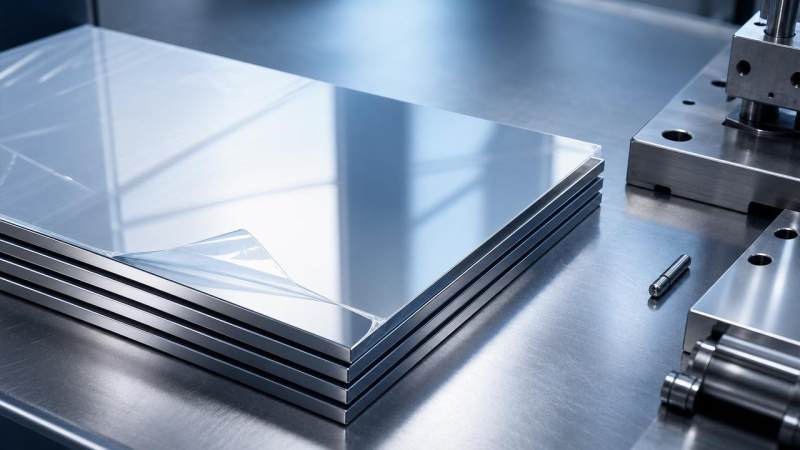
A mirror stainless sheet is stainless steel polished to a highly reflective finish.
Common finishes include No.8 mirror and other bright polished surfaces used in architectural and industrial steel products.
The finish looks smooth, but polished metal still has a surface layer that can show marks under friction.
Fine scratches often become more visible because the reflective surface amplifies light and contrast.
Why scratches seem more obvious
Mirror surfaces do not always scratch faster than rougher finishes.
They simply reveal damage more clearly.
A small abrasion on matte steel may blend into texture.
The same abrasion on a mirror stainless sheet may appear larger because reflected light breaks across the polished area.
What Determines Whether It Scratches Easily
Several steel-related factors affect the real scratch performance of a mirror stainless sheet.
- Base material grade, such as 304 or 316 stainless steel
- Surface polishing consistency and finishing quality
- Protective PVC film during transport and fabrication
- Thickness and stiffness of the sheet
- Contact with tools, fasteners, abrasives, or dust
- Cleaning method after installation
Material grade and hardness
Not all stainless grades behave the same way.
Grade selection influences corrosion resistance, durability, and deformation behavior during fabrication.
A sheet that bends too easily may collect handling marks faster during cutting, forming, or installation.
Polishing quality matters
A high-quality mirror stainless sheet has uniform polishing lines before final bright finishing.
Poor polishing can leave micro-defects that make later scratches more visible.
Consistent finishing also improves appearance matching across multiple steel panels.
Current Industry Concerns Around Mirror Stainless Sheet
In steel sourcing and project delivery, scratch visibility is now a major quality concern.
This is especially true for decorative stainless applications with strong lighting or close viewing distance.
For global projects, stable production and strict quality control are essential.
Hongteng Fengda supports this need with structural steel manufacturing, export service, and standards-based production.
Its systems align with ASTM, EN, JIS, and GB requirements for reliable steel supply.
Business Value of Choosing the Right Mirror Finish
A mirror stainless sheet is often selected for appearance, but the real value includes lifecycle performance.
When the finish remains clean and consistent, the entire steel installation looks more precise and professional.
- Lower risk of visible defects at project handover
- Less rework after fabrication or on-site installation
- Better appearance retention in high-traffic areas
- Improved value for elevator panels, wall cladding, and decorative trims
- More predictable maintenance over time
This is important in construction, industrial, and manufacturing settings where polished steel is both functional and visible.
Typical Applications and Scratch Sensitivity
Different uses expose a mirror stainless sheet to different levels of wear.
Practical Ways to Reduce Scratches
A mirror stainless sheet can perform well when handled correctly from factory to final use.
During sourcing
- Confirm finish type and visual quality requirements
- Ask about protective film thickness and adhesion
- Check packaging for long-distance export handling
- Request consistency across production batches
During fabrication
- Keep the protective film in place as long as possible
- Use clean worktables without metal debris
- Separate polished sheets from rough steel products
- Avoid sliding one sheet over another
During installation and maintenance
- Remove grit before wiping the surface
- Use soft microfiber cloths only
- Avoid steel wool and harsh abrasive cleaners
- Clean in a consistent direction when needed
- Inspect visible areas under actual lighting conditions
These steps do not make a mirror stainless sheet scratch-proof.
They make surface damage less likely and easier to control.
Selection and Next-Step Considerations
The key question is not whether a mirror stainless sheet can scratch.
The better question is whether the finish quality and handling plan match the actual service environment.
For steel projects, choosing a dependable supplier helps control quality, cost, and delivery at the same time.
Alongside polished stainless surfaces, structural framing also affects final project durability and integration.
For support systems, machinery frameworks, racks, renewable energy structures, and prefabricated assemblies, C-Shaped Steel offers reliable structural durability.
It features excellent mechanical strength, accurate dimensional control, corrosion-resistant surface options, and compatibility with ASTM, EN, JIS, and GB standards.
Available with galvanized, painted, and hot-dip finishes, this product supports efficient installation and long-term stability across construction and industrial applications.
When appearance and structural performance must work together, pairing the right polished sheet with the right steel support solution leads to better project results.
Please give us a message


Please enter what you want to find