Understanding the ss pipe 2 inch price starts with more than a simple quote.
Size tolerance, wall thickness, material grade, surface finish, and order volume all affect the final cost.
For buyers comparing options, this guide explains the key price differences clearly.
It helps you evaluate specifications, reduce sourcing risks, and match pipe value with actual industrial or structural use.
What does ss pipe 2 inch price usually include?
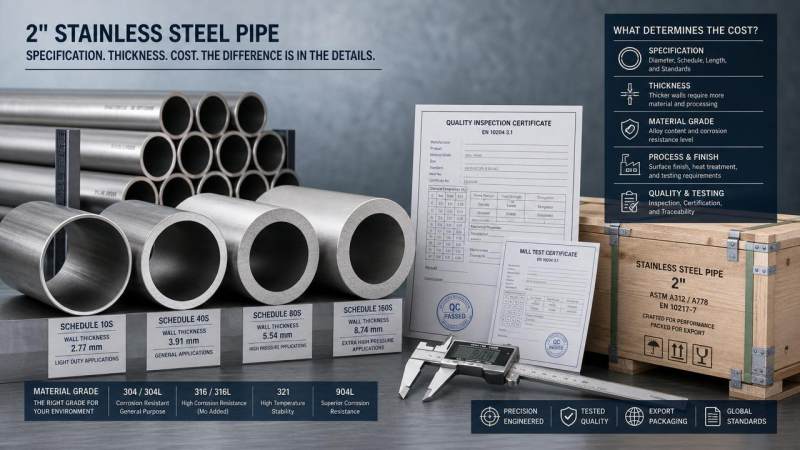
The ss pipe 2 inch price normally covers the pipe material, forming process, finishing, and basic packing.
However, different quotations may use different bases, so direct comparison can be misleading.
Some prices are based on theoretical weight.
Others are based on actual weight after production and final inspection.
A quote may also include ASTM, EN, or JIS compliance costs.
These certification and testing details often explain why similar pipes show different prices.
When checking ss pipe 2 inch price, confirm these points first:
- Outside diameter standard and tolerance
- Wall thickness and schedule
- Stainless steel grade, such as 201, 304, 316, or 316L
- Welded or seamless production method
- Surface finish, including pickled, polished, or brushed
- Pipe length, end treatment, and packing method
Without these details, a low offer may become expensive after adjustment.
How do size and thickness change the ss pipe 2 inch price?
Although “2 inch” sounds simple, pipe pricing changes greatly with thickness.
A 2 inch stainless steel pipe with thin wall uses less metal.
A heavier schedule uses more raw material and increases processing demand.
That is why wall thickness often drives the largest cost difference.
For example, Schedule 10, Schedule 40, and Schedule 80 pipes may share the same outside diameter.
Yet their weight per meter differs significantly.
Since stainless steel cost is closely tied to weight, thicker pipes usually mean higher total price.
Tolerance also matters.
Tighter thickness control can increase manufacturing cost but improve installation consistency and welding quality.
This is especially important in pressure systems and precision fabrication.
Quick comparison of price factors
Which stainless steel grades create the biggest cost differences?
The ss pipe 2 inch price changes sharply when the material grade changes.
Grade 201 is usually more affordable, but corrosion resistance is more limited.
Grade 304 is widely used because it balances durability, workability, and cost.
Grade 316 and 316L usually cost more because they offer better resistance in chloride or marine environments.
Choosing the wrong grade can increase life-cycle cost, even if the initial pipe price looks lower.
In structural steel projects, material matching is important beyond the pipe itself.
Support members, roof framing, and light structural components should align with load and environment requirements.
For related framing systems, Z-beam solutions are often used in purlins, wall beams, brackets, and lightweight roofs.
Available in Q235B, Q345B, S275, S355, A36, and other grades, they support customized lengths from 2 to 12 meters.
Options such as perforated or galvanized coated profiles can help coordinate structural assemblies efficiently.
Is welded or seamless better when comparing ss pipe 2 inch price?
This is one of the most common sourcing questions.
Welded stainless steel pipe is often more economical for many structural and fluid transfer uses.
Modern welded pipe can also provide reliable dimensional consistency and a clean surface.
Seamless pipe usually costs more.
Its process is more complex, and it is commonly selected for high pressure, high temperature, or critical service conditions.
The better option depends on application, not on price alone.
If the project requires standard mechanical strength and corrosion resistance, welded pipe may offer better value.
If the application includes severe conditions, seamless pipe may justify the higher ss pipe 2 inch price.
A simple decision guide
- Choose welded pipe for general construction, decoration, and standard industrial systems.
- Choose seamless pipe for demanding pressure service or critical technical specifications.
- Always compare test reports, tolerances, and compliance before judging value.
What hidden costs can affect the final ss pipe 2 inch price?
The quoted unit price is only one part of total procurement cost.
Several hidden items can change the real landed cost.
Cut-to-length service may increase processing charges.
Special packaging for export can add cost but reduce damage risk.
Third-party inspection, mill test certificates, and custom markings may also appear separately.
Freight matters too.
A cheaper pipe from a distant source may end up costing more after transportation, duties, and local handling.
Lead time is another hidden factor.
Delayed supply can interrupt fabrication and raise project costs far beyond the pipe value itself.
A reliable supplier should clarify these cost items early.
How can you judge whether the ss pipe 2 inch price is reasonable?
A reasonable ss pipe 2 inch price should align with specification, quality level, and service scope.
Start by comparing offers on the same technical basis.
Check grade, wall thickness, production method, and standard carefully.
Then review delivery terms, inspection documents, and packaging details.
Do not focus only on the lowest number.
Low prices may hide thinner actual walls, weaker alloy content, or inconsistent quality control.
A better method is to ask for a detailed quotation sheet.
That makes supplier comparison easier and reduces misunderstanding.
FAQ summary table
The ss pipe 2 inch price is never just a material number.
It reflects thickness, grade, process, quality control, and delivery conditions together.
A smart comparison focuses on fitness for use, compliance, and total landed cost.
For steel sourcing, clear technical data and stable supply support better results than chasing the cheapest quote.
If you are evaluating stainless pipe together with structural steel components, choose a supplier that can explain specifications clearly and support customized project needs.
Please give us a message


Please enter what you want to find