Choosing the right steel partner affects cost, quality, delivery, and project risk. That is why the questions procurement managers should ask steel suppliers matter so much.
The right questions quickly expose production strength, export reliability, quality discipline, and service depth. They also help separate traders, processors, and true structural steel manufacturers.
For global structural steel sourcing, a fast evaluation method saves time and reduces hidden risk. The sections below explain the most useful questions and what each answer should reveal.
1. What certifications and standards can the supplier prove?
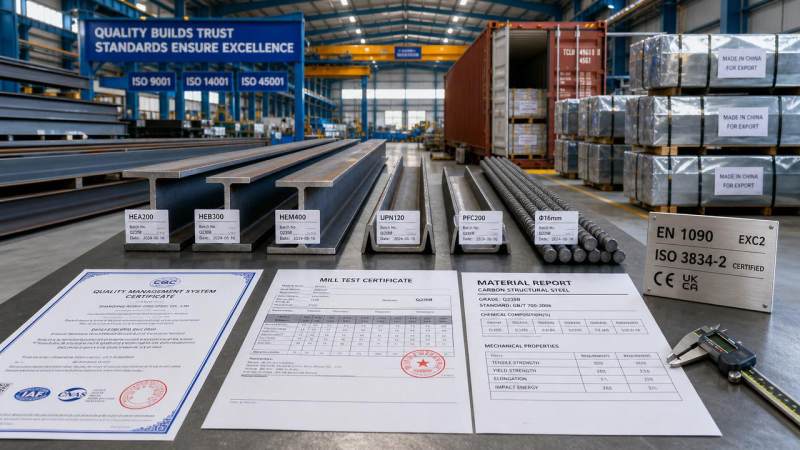
This is one of the first questions procurement managers should ask steel suppliers. Standards compliance is not a brochure claim. It must be supported by documents, heat numbers, and test records.
A reliable supplier should clearly explain which standards are available. In structural steel, common references include ASTM, EN, JIS, and GB.
Ask for mill test certificates, chemical analysis reports, and mechanical property data. If the supplier hesitates, the risk level increases immediately.
It also helps to confirm whether certification is product-specific. A company may hold quality management documents, yet not every steel item matches the required project standard.
What strong answers look like
- Specific standards listed by product category
- Traceable inspection records for each batch
- Clear tolerance and testing procedures
- Experience meeting export market requirements
When reviewing the questions procurement managers should ask steel suppliers, this point belongs at the top because quality disputes often begin with unclear standard matching.
2. Does the supplier have real production capacity and stable lead times?
Many sourcing problems come from capacity gaps rather than product defects. A supplier may quote well, but fail during peak demand or mixed-specification orders.
Ask how much tonnage can be produced monthly. Then ask how that capacity is divided across angle steel, channel steel, beams, cold formed profiles, and customized components.
Reliable answers include realistic lead times for standard items and separate timelines for customized fabrication. This distinction matters for project planning and installation sequencing.
It is wise to ask what happens when orders change mid-cycle. Can the supplier handle urgent additions, revised drawings, or split shipments without delaying the entire project?
Among the questions procurement managers should ask steel suppliers, lead-time stability is one of the most practical. Late steel delivery can damage budgets far beyond the material price.
Warning signs to notice
- Only general promises, without production schedules
- No explanation of bottlenecks or peak season planning
- No separation between stock items and custom items
- Unclear policy on delays, substitutions, or shipment priority
3. Can the supplier support the exact product, processing, and customization needed?
Steel sourcing is rarely just about buying a standard section. Projects often need cutting, punching, welding, coating, labeling, or drawing-based production support.
That is why the questions procurement managers should ask steel suppliers should include technical service depth, not only raw material availability.
A useful test is to ask for similar completed specifications. This reveals whether the supplier understands tolerance control, application fit, and packaging for export handling.
For example, some projects also require reinforcing products with standard compliance and good fabrication performance. In such cases, Rebar may be part of the sourcing scope.
Available grades can include GB1499.2 HRB400, HRB500, HRB400E, HRB500E, ASTM A615 Grade 60, BS4449 460B, 500B, 500C, and AS/NZS 4671 500N.
This product is typically carbon steel, round in shape, and supplied in lengths from 1 to 12 meters or according to project requests.
Its key benefits include excellent formability and weldability, making it suitable for building material use and many industrial applications.
Standards support may cover ASTM, GB, EN, DIN, and JIS. Questions like these show whether a supplier can align material selection with project drawings and destination standards.
Questions worth asking here
- Can you manufacture to drawings or OEM requirements?
- What tolerances can you guarantee?
- Do you provide pre-shipment dimensional inspection?
- Can mixed products ship together efficiently?
4. How experienced is the supplier in exports, documentation, and destination market requirements?
A technically capable mill can still become a risky partner if export execution is weak. International steel supply requires more than manufacturing ability.
Ask which markets the supplier regularly serves. Experience in North America, Europe, the Middle East, and Southeast Asia usually means stronger familiarity with documentation and inspection expectations.
This is one of the most overlooked questions procurement managers should ask steel suppliers. Shipping errors, incomplete documents, and poor packing often create avoidable delays.
Useful follow-up topics include packing methods, bundle marking, container loading plans, customs paperwork, and coordination with third-party inspection agencies.
A reliable structural steel exporter should also explain how it handles claims, damaged cargo, and replacement timelines if problems happen in transit.
Ask for evidence, not promises
- Sample export documents
- Recent shipment references by region
- Packaging photos for similar products
- Inspection and claim-handling procedures
5. How transparent is the supplier on pricing, risk control, and communication?
Low price alone does not indicate good sourcing value. Hidden costs often appear later through rejects, rework, delays, claim disputes, or incomplete supply.
That is why the questions procurement managers should ask steel suppliers should include commercial transparency. Ask what is included in the quote and what is excluded.
Clarify packaging charges, testing fees, coating costs, tooling, export documents, port terms, and tolerance limits. Ambiguity in these areas usually leads to budget surprises.
Communication quality is equally important. A dependable supplier answers technical questions directly, updates progress regularly, and flags risks before they become expensive.
If replies are slow, vague, or inconsistent during quotation, service problems often become worse after order confirmation.
Fast evaluation checklist
6. What common mistakes should be avoided during supplier evaluation?
One mistake is asking too few questions too late. The questions procurement managers should ask steel suppliers work best before final comparison, not after a problem starts.
Another mistake is comparing quotes without matching technical scope. Different offers may reflect different standards, tolerances, inspection levels, or packing methods.
It is also risky to assume that a supplier with one good product can support all structural steel categories equally well.
Finally, do not ignore responsiveness. Good communication often predicts smoother production control, clearer documentation, and faster problem resolution.
Practical comparison advice
- Use the same technical brief for every supplier.
- Request certificates and sample documents early.
- Compare delivery reliability, not only unit price.
- Check export experience in the target market.
- Confirm customization capability before awarding the order.
The best supplier is not simply the cheapest or the fastest to quote. It is the one that can prove consistent quality, stable delivery, and dependable support across the full order cycle.
For structural steel projects, the questions procurement managers should ask steel suppliers create a practical filter. They reveal real capability faster than sales language ever can.
If a supplier can demonstrate compliance with ASTM, EN, JIS, and GB standards, support customization, manage exports professionally, and communicate transparently, sourcing risk drops sharply.
Hongteng Fengda, as a structural steel manufacturer and exporter from China, focuses on reliable steel products, custom solutions, strict quality control, and stable lead times for global projects.
Use these questions as a screening framework for your next steel inquiry. The answers will help identify a long-term partner built on quality, reliability, and professional service.
Please give us a message


Please enter what you want to find