Understanding JIS steel equivalents is essential when comparing Japanese grades with ASTM, EN, or GB standards for sourcing and project planning.
This guide explains common JIS steel matching tips, major comparison factors, and practical checks that help reduce specification errors.
It also highlights how to review mechanical properties, chemical composition, and application requirements before confirming an equivalent grade.
What does JIS steel equivalent really mean?
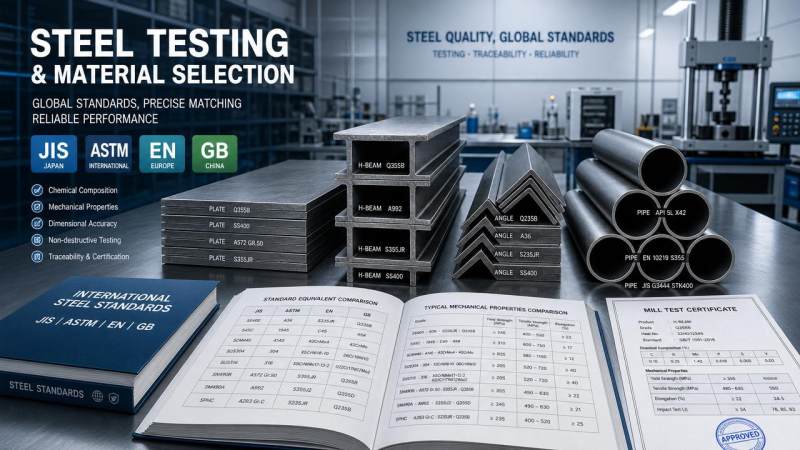
A JIS steel equivalent is not always an exact one-to-one replacement.
In many cases, it means a grade with similar strength, chemistry, formability, or service performance under another standard.
JIS steel is widely used in construction, fabrication, machinery, and infrastructure projects connected to global supply chains.
When drawings mention SS400, SM490, or other Japanese grades, buyers often need to compare them with ASTM, EN, or GB alternatives.
That comparison should never rely only on grade names.
Different standards define yield strength, tensile range, impact testing, and tolerances in different ways.
A useful JIS steel equivalent must therefore match the real engineering need, not just the label on a mill certificate.
Which factors matter most when matching JIS steel grades?
The safest approach is to compare several technical points together.
Using only one property can create hidden risks during fabrication or service.
1. Mechanical properties
Start with yield strength, tensile strength, and elongation.
These values strongly affect load-bearing performance, welding behavior, and forming results.
2. Chemical composition
Carbon, manganese, phosphorus, sulfur, and alloying elements influence weldability and toughness.
A similar strength level does not guarantee similar fabrication performance.
3. Product form
Plate, sheet, angle, beam, channel, and pipe standards often differ even under the same grade family.
Always confirm that the equivalent applies to the same product category.
4. Delivery condition and testing
Some projects require normalized material, impact toughness, or traceable inspection records.
Those requirements may be outside a basic grade comparison table.
5. End-use environment
Marine exposure, low temperature service, seismic design, and heavy welding all affect grade suitability.
A common JIS steel alternative for buildings may not suit offshore or pressure-related applications.
What are common JIS steel grade matching examples?
Many search queries focus on familiar structural grades.
Still, these examples should be treated as reference points, not automatic substitutions.
For structural sections, shape availability is as important as grade equivalence.
An equivalent material that cannot meet section size or tolerance needs may still fail the project.
In practical supply, standard-compliant sections such as Q195 angle steel are often reviewed together with JIS steel comparisons.
They are commonly used in building structures, bridges, transmission towers, warehouse shelves, and cable trench supports.
Typical options include equal and unequal angles, with thickness from 3-24mm and width from 20mm-200mm.
Material references may include A36, A53, Q235, and Q345, depending on the structural design target.
Certified production under ASTM, AISI, EN, DIN, JIS, and GB supports easier cross-standard sourcing discussions.
How can JIS steel be compared with ASTM, EN, and GB more accurately?
A more accurate comparison follows a clear review sequence.
- Identify the exact JIS steel grade and product form.
- Check required thickness, dimensions, and tolerances.
- Compare minimum mechanical properties at the same thickness range.
- Review chemistry limits and carbon equivalent.
- Confirm weldability, toughness, and heat treatment condition.
- Verify testing documents and standard edition.
This method is especially useful for fabricated steel parts and exported structural components.
Projects involving channels, beams, angles, and cold formed profiles often require this cross-check process.
It helps avoid choosing a JIS steel equivalent that looks acceptable in theory but creates production delays later.
What mistakes cause the biggest risks in JIS steel substitution?
Several common mistakes appear repeatedly in international steel sourcing.
- Assuming all online grade charts are exact and current.
- Ignoring thickness-dependent strength requirements.
- Matching only chemistry while neglecting toughness.
- Overlooking dimensional tolerance differences.
- Using a plate equivalent for a structural section.
- Skipping mill test certificate review before production.
Another major risk is treating lower-cost steel as interchangeable without technical confirmation.
A cheaper option may increase welding repairs, coating failures, or approval delays.
For sections serving as connectors between components, stable dimensions and predictable stress performance are critical.
That is why section products like Q195 angle steel must be checked beyond appearance or nominal size.
How do lead time, cost, and supplier capability affect JIS steel decisions?
Even when a JIS steel equivalent is technically valid, supply conditions still matter.
Availability varies by region, mill schedule, coating requirement, and section complexity.
A practical grade match should support both engineering compliance and delivery reliability.
When reviewing suppliers, check these points:
A supplier with broad standard knowledge can simplify JIS steel comparison work.
That is especially valuable for global construction and industrial projects requiring customized structural steel solutions.
What is the best way to confirm a JIS steel equivalent before ordering?
Use a short approval checklist before finalizing any replacement.
- Match grade, product type, and standard edition.
- Review mechanical properties against project requirements.
- Check chemical composition and weldability limits.
- Confirm dimensions, tolerances, and available lengths.
- Request mill certificates and testing details.
- Verify surface condition, finish, and any fabrication needs.
For structural steel exports, this final check prevents costly misunderstandings after fabrication starts.
It also helps align technical expectations between design documents and actual mill supply.
JIS steel equivalents are most useful when they are verified through properties, standards, dimensions, and application conditions together.
A careful comparison can reduce sourcing risk, improve schedule control, and support better structural steel performance.
If a project involves international grade conversion, customized sections, or multi-standard compliance, the next step is a detailed technical review with a reliable structural steel supplier.
Please give us a message


Please enter what you want to find