When color coated steel begins to blister, fade, peel, or corrode too early, after-sales maintenance teams need to identify the real cause fast. From poor surface preparation to harsh environments and improper installation, coating failure often results from multiple factors. This guide explains the most common reasons behind color coated steel coating problems and how to reduce future maintenance risks.
For maintenance personnel, the challenge is rarely just spotting the defect. The real task is separating surface symptoms from root causes, then deciding whether the problem came from substrate quality, coating design, transport damage, installation error, or service environment.
In construction, industrial buildings, roofing systems, wall panels, and fabricated steel components, even a small coating defect can spread over 3 to 12 months if moisture, chlorides, or UV exposure remain uncontrolled. That is why a structured inspection method matters.
Understanding How Color Coated Steel Fails in Service
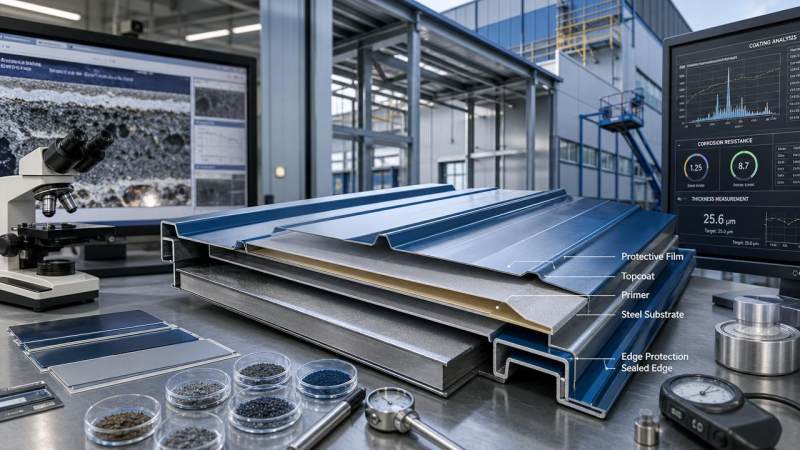
Color coated steel is designed as a layered system. It usually includes the steel base, metallic coating such as galvanized iron or aluminum-zinc steel, chemical pretreatment, primer, and topcoat. Failure at any one layer can reduce the performance of the whole system.
For after-sales teams, the first 24 to 72 hours after receiving a complaint are critical. Early checks should record defect location, exposure conditions, installation date, nearby corrosive sources, and whether the damage appears on edges, flat areas, bends, overlaps, or fastener points.
Typical coating failure symptoms
- Blistering caused by trapped moisture, contamination, or osmotic pressure
- Peeling or delamination linked to poor adhesion between primer, topcoat, and substrate
- Premature fading or chalking under strong UV exposure after 1 to 5 years
- Rust staining at cut edges, scratches, overlaps, or damaged areas
- Cracking near bends when forming radius is too tight for coating flexibility
Why visual diagnosis alone is not enough
Two panels may show similar peeling, but one may result from pretreatment failure while the other comes from water ingress at an exposed screw line. If the root cause is misread, repairs may only last 6 to 18 months before the defect returns.
The table below helps maintenance teams connect common field symptoms with the most likely failure mechanism and the first action to take on site.
A quick symptom map improves response speed, but field teams should still verify substrate condition, coating thickness, and environmental exposure before approving any repair plan or replacement recommendation.
The Most Common Root Causes of Coating Failure
Most color coated steel failures are not caused by a single issue. In practice, 2 to 4 factors often overlap. A moderate coating defect can become severe when poor installation meets a high-humidity site or when edge damage is left unsealed in coastal air.
1. Inadequate surface preparation before coating
If oil, rolling residue, dust, or oxidation remain on the metallic coated steel before primer application, coating adhesion can drop sharply. Even when the topcoat looks uniform at delivery, blistering or peeling may appear after repeated wet-dry cycles.
Pretreatment consistency matters especially for galvanized iron and aluminum-zinc steel. Uneven chemical conversion layers can create weak zones, and those zones often fail first near formed sections, corners, and drainage paths.
2. Wrong paint system for the environment
Not every paint system suits every project. PE may perform well in mild inland applications, while SMP, HDP, or PVDF may be more suitable where UV radiation, temperature swings, or industrial fallout are stronger. Choosing the wrong system can shorten visual life and corrosion protection.
In hot roofs, dark colors may raise surface temperature significantly, sometimes above 60°C in direct sun. In coastal areas, chloride deposition increases the risk of edge corrosion and underfilm attack, especially when washing frequency is low.
3. Coating thickness outside the practical range
A topcoat that is too thin may lose barrier performance early. A film that is too thick may reduce flexibility and increase cracking risk during forming. For many prepainted products, coating thickness must stay controlled layer by layer rather than judged by appearance alone.
When maintenance teams investigate repeated failures, they should compare site condition with original product parameters. For example, some prepainted sheets use top coating in the range of 11-35μm and back coating in the range of 5-14μm, and that difference affects exposure performance.
4. Mechanical damage during transport, storage, or installation
Scratches, edge knocks, coil pressure marks, and abrasion between sheets can break coating continuity before the material even reaches service. Once the metallic layer is exposed, moisture and debris can initiate corrosion at the damaged point within weeks.
Common site mistakes include dragging sheets across each other, stacking on uneven supports, leaving protective packaging wet for more than 48 hours, and cutting with tools that leave hot metal particles on painted surfaces.
5. Poor installation detailing
Many color coated steel complaints start at overlaps, fasteners, cut edges, and water traps. If roof pitch, drainage path, sealant use, or thermal movement allowance is wrong, moisture remains on the surface longer and coating breakdown accelerates.
Fastener over-tightening can also crack washers or damage the coating around holes. On wall panels and roofing, trapped water around joints is often more dangerous than open exposure because drying becomes slower and contamination concentrates locally.
6. Harsh service conditions and poor maintenance frequency
Industrial fumes, animal housing emissions, fertilizer storage, cement dust, and marine salts all shorten coating life. In these environments, cleaning only once per year may be insufficient. Quarterly checks or washing every 3 to 6 months may be necessary.
In agricultural or coastal projects, even high-quality color coated steel can deteriorate early if debris remains in valleys, under flashings, or behind rooftop equipment. Service life depends not only on product quality but also on exposure management.
When replacement or specification review is required, maintenance teams often compare paint systems, dimensions, and end-use suitability. A practical reference is PPGI Steel Sheet, which is commonly used in construction, manufacturing, roofing, wall panels, door frames, appliance housings, agricultural projects, and public buildings.
Typical options in this category include thickness from 0.2mm to 1.2mm, width from 600mm to 1250mm, and finishes such as PE, SMP, HDP, and PVDF. Primer systems may include epoxy, polyester, water-soluble acrylic, or polyurethane, depending on service demands and fabrication needs.
How After-Sales Maintenance Teams Should Inspect the Problem
A reliable inspection process reduces repeated site visits and avoids disputes about whether failure came from supply, fabrication, or service conditions. In most cases, a 5-step routine is enough to classify the issue before laboratory testing is considered.
Step-by-step field inspection routine
- Record the defect type, affected area, orientation, and estimated spread rate.
- Check whether failure is concentrated at edges, bends, laps, or fixing points.
- Review installation date, storage condition, cleaning interval, and nearby corrosive sources.
- Measure dry film thickness if possible and compare both failed and sound areas.
- Decide whether touch-up, part replacement, or full specification review is required.
Key questions to ask on site
- Did the defect appear within 6 months, 1 to 2 years, or after long-term service?
- Is the damaged area exposed to standing water, shade, or chemical residue?
- Were sheets cut, bent, drilled, or fastened after delivery?
- Are there signs of packaging moisture, white rust, or back-to-back abrasion?
The following table can be used as a maintenance-side decision tool when evaluating whether the coating issue is mainly material-related, handling-related, or environment-related.
Using a documented checklist helps suppliers and buyers discuss the issue with evidence. It also supports more practical decisions, such as local repair for isolated damage or material upgrade when the full environment exceeds the original specification.
How to Reduce Future Coating Failures
The best way to reduce coating claims is to treat color coated steel as a system decision, not just a painted sheet purchase. Product selection, fabrication practice, installation detail, and maintenance schedule all need to match the actual project environment.
Match the paint system to the real exposure level
For mild residential or commercial exposure, PE may be acceptable in many cases. For stronger UV, long design life, or more corrosive sites, SMP, HDP, or PVDF may offer better retention of color, gloss, and film integrity over longer periods.
Control storage and handling before installation
Sheets should be stored dry, ventilated, and slightly inclined for drainage if temporary outdoor storage cannot be avoided. Protective packaging should not remain waterlogged, and wet-packed material should be separated and dried as quickly as possible, ideally within the same day.
Improve site detailing and edge protection
Design out water traps where possible. Use clean cutting methods, remove metal swarf, protect exposed edges when required, and avoid dissimilar metal contact that can trigger galvanic effects. These small details often determine whether color coated steel performs for 5 years or more than 20 years.
Set a realistic maintenance schedule
In low-pollution inland projects, inspection every 12 months may be enough. In coastal, agricultural, or industrial applications, 3 to 6 months is often safer, especially for roofing, wall panels, flashings, and low-drainage zones.
Practical prevention checklist
- Confirm substrate type: galvanized iron or aluminum-zinc steel
- Verify paint and primer combination for the environment
- Review coating thickness range before production approval
- Check bending radius and post-forming requirements
- Plan cleaning frequency based on dust, salt, and chemical exposure
- Document installation and maintenance for future claim analysis
For projects needing a balance of corrosion resistance, appearance, and fabrication flexibility, PPGI Steel Sheet can be specified in strips, plain sheets, or corrugated sheets, with glossy or matte finishes and RAL-based color options for different architectural and industrial uses.
For global buyers, working with a structural steel manufacturer that understands standards such as ASTM, EN, JIS, and GB can also reduce mismatch risk between expected service conditions and delivered material specification. This is especially valuable when projects involve OEM processing or multiple climate zones.
Supplier Support and Long-Term Risk Control
After-sales success depends not only on repair ability but also on technical communication before shipment. Maintenance teams benefit when suppliers provide clear material descriptions, paint system details, dimensional tolerances, handling guidance, and installation recommendations from the start.
Hongteng Fengda, as a structural steel manufacturer and exporter from China, supports global construction, industrial, and manufacturing projects with stable production capacity, customized structural steel solutions, and quality control aligned with major international standards. That supply-side discipline helps reduce sourcing uncertainty and downstream maintenance pressure.
When coating complaints occur, faster resolution usually comes from sharing 4 types of information early: defect photos, project environment, installation timing, and processing history. This shortens the time needed to determine whether local repair, replacement, or specification adjustment is the most economical path.
Coating failure in color coated steel is usually traceable when the inspection process is disciplined. The most common causes are weak surface preparation, mismatched paint selection, insufficient or unsuitable coating structure, mechanical damage, poor detailing, and harsh exposure combined with low maintenance frequency.
For after-sales maintenance teams, the priority is to diagnose by location, pattern, timing, and environment rather than by appearance alone. For buyers and project managers, better product matching and field control can significantly lower repeat maintenance costs and reduce premature replacement.
If you need support in selecting prepainted steel, structural steel components, or customized supply solutions for demanding service environments, contact Hongteng Fengda to get tailored recommendations, review product details, and explore more reliable steel solutions for your project.
Please give us a message


Please enter what you want to find