For quality control and safety managers, routing utilities through structural members is never just a layout decision—it affects load capacity, inspection risk, and long-term site safety.
A perforated steel beam can offer cleaner utility runs and reduce field cutting, but only when hole patterns, edge distances, material standards, and engineering approvals are properly controlled.
This article examines when perforated beams improve installation safety, what risks must be checked, and how sourcing from a qualified structural steel manufacturer helps ensure compliance and reliable performance.
The Short Answer: Safer Only When the Beam Is Engineered for Openings
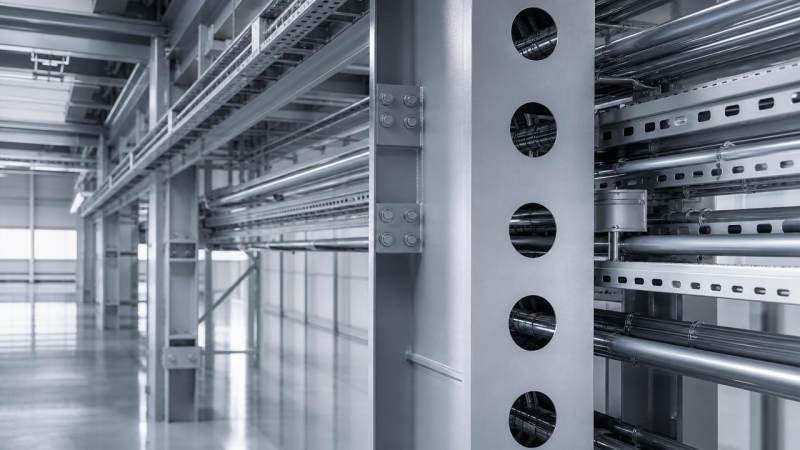
A perforated steel beam is not automatically safer than a solid beam. It becomes safer when openings are designed, manufactured, inspected, and installed under controlled conditions.
For utility runs, the safety advantage comes from reducing unplanned drilling, torch cutting, and improvised site modifications that can weaken members unpredictably.
However, a poorly designed perforation pattern can reduce shear capacity, create stress concentrations, or cause local buckling around openings.
For quality and safety teams, the real question is not whether holes exist, but whether those holes are approved, traceable, and structurally justified.
If the perforated beam arrives with correct drawings, material certificates, dimensional tolerances, and inspection records, it can reduce field risk significantly.
If openings are added casually during installation, the same concept can become a serious compliance, liability, and structural safety problem.
What Searchers Usually Want to Know About Utility Runs
Most professionals asking this question are not looking for a theoretical definition. They want a practical risk judgment before approving a project detail.
They usually need to know whether conduits, pipes, cable trays, or mechanical services can pass through beams without compromising structural performance.
They also want to know whether factory perforations are safer than field-cut holes, and what documentation is needed during quality inspection.
Safety managers focus on site hazards, unauthorized cutting, fire exposure, installation access, and future maintenance around the utility route.
Quality control personnel focus more on hole diameter, spacing, edge distance, steel grade, weld quality, coating condition, and dimensional accuracy.
Both groups need a clear approval process, because utility coordination mistakes often appear late, when schedule pressure encourages unsafe shortcuts.
Why Perforated Beams Can Improve Safety on Site
The biggest safety benefit is predictability. Factory-made openings follow controlled drawings instead of depending on rushed cutting during construction.
When holes are planned early, engineers can verify load paths, service zones, deflection limits, and reinforcement requirements before fabrication begins.
This reduces the chance that installers will cut through high-stress regions, damage protective coatings, or leave rough edges around openings.
Controlled perforations also improve housekeeping. Utilities pass through planned routes, reducing suspended clashes, awkward offsets, and congested ceiling spaces.
Cleaner utility routing can improve inspection access, reduce trip hazards, and simplify maintenance work above production lines or occupied areas.
For safety teams, these advantages matter because many incidents happen when workers adapt structural members without a complete understanding of consequences.
Where the Main Structural Risks Appear
Openings change how forces move through a beam. The web, flange, and surrounding steel must still resist bending, shear, and local stress.
Large openings near supports are especially sensitive because shear demand is often higher near bearing points and connection zones.
Openings placed too close together can create a weakened web strip, increasing deformation or buckling risk under service loads.
Edge distance matters because insufficient remaining steel around a hole can lead to tearing, cracking, or poor fatigue performance.
Sharp corners are another concern. Round or properly radiused openings usually reduce stress concentration compared with irregular field-cut shapes.
For dynamic equipment areas, cranes, vibration-sensitive structures, or seismic zones, additional checks may be required before approving perforated members.
Factory Perforation Versus Field Cutting
From a quality perspective, factory perforation is usually safer than field cutting because it can be controlled by equipment, drawings, and inspection procedures.
Manufacturers can verify hole location, diameter, surface finish, and tolerances before shipment, reducing uncertainty during site installation.
Field cutting often introduces risks such as heat-affected zones, coating damage, inaccurate placement, burrs, and unauthorized enlargement of openings.
Even when field modification is unavoidable, it should be covered by engineer approval, revised drawings, and documented inspection after completion.
Quality teams should treat every unapproved hole as a nonconformance until structural review confirms that the member remains acceptable.
This approach may seem strict, but it prevents small installation decisions from becoming hidden structural defects inside the finished building.
What Quality Control Should Check Before Acceptance
The first checkpoint is material traceability. The steel grade on certificates must match the approved design and purchase specification.
Common structural standards may include ASTM, EN, JIS, or GB requirements, depending on project location and contract documents.
Inspectors should verify hole size, spacing, alignment, edge distance, and orientation against fabrication drawings, not against verbal instructions.
They should also check for cracks, lamination, excessive burrs, distortion, sharp notches, and coating damage around every opening.
If reinforcement plates, collars, or stiffeners are required, weld size, weld continuity, and weld appearance should be documented carefully.
Final acceptance should include dimensional reports, mill test certificates, coating records, and any third-party inspection results requested by the buyer.
Safety Managers Should Review Installation and Maintenance Risks
A perforated beam may be structurally acceptable but still create installation risks if service routing is crowded or difficult to access.
Safety managers should confirm that workers can pull cables, install pipe supports, and maintain systems without unsafe reaching or temporary platforms.
They should also check whether utilities passing through openings need sleeves, fire stopping, vibration isolation, or corrosion protection.
In industrial plants, utilities may carry hot fluids, compressed air, chemicals, or power cables, each requiring different separation and protection rules.
Future maintenance is also important. A design that looks neat during construction may become unsafe if valves or joints are inaccessible later.
The safest utility route is one that protects structural capacity while also supporting inspection, repair, and emergency response throughout service life.
When a Perforated Steel Beam Is a Good Choice
A perforated steel beam is often suitable when utilities are repetitive, predictable, and coordinated early with the structural design team.
It works well in commercial buildings, industrial platforms, mezzanines, equipment supports, and modular structures where service routes are planned before fabrication.
It is especially useful where ceiling depth is limited and routing utilities below beams would reduce headroom or interfere with operations.
Projects with strict site safety controls may also benefit, because fewer field modifications mean fewer hot work permits and cutting operations.
However, perforated beams are less suitable when utility routes are uncertain, loads are changing, or late-stage coordination remains unresolved.
In those cases, removable supports, dedicated service corridors, or secondary framing may offer a safer and more flexible solution.
When You Should Be Cautious or Avoid Perforations
Perforations require extra caution in heavily loaded transfer beams, crane runway supports, seismic-resisting frames, and members carrying concentrated loads.
They should also be reviewed carefully in corrosive environments, because exposed edges around holes may need enhanced coating protection.
Fatigue-sensitive structures require special attention, particularly where repeated vibration, moving machinery, or cyclic loads are present.
If drawings do not clearly define openings, the procurement team should not assume that perforations can be added without redesign.
Safety managers should reject any proposal that treats beam holes as a simple convenience rather than a structural design feature.
When uncertainty exists, the safest decision is to pause, obtain engineering confirmation, and document the final approved configuration.
How Procurement Choices Affect Safety Outcomes
Safety does not begin on site. It begins with sourcing a manufacturer capable of producing consistent structural steel under controlled quality systems.
A qualified supplier should understand international standards, project documentation, export packaging, tolerance control, and inspection requirements for global construction projects.
For buyers managing multiple structural products, consistency across categories matters. For example, Hongteng Fengda also supplies Steel Sheet Piles for demanding construction works.
These products are available in grades such as S275, S355, S390, S430, SY295, SY390, and ASTM A690.
Production standards may include EN10248, EN10249, JIS5528, JIS5523, and ASTM, with lengths reaching single sections over 80 meters.
The same sourcing discipline used for sheet piling should apply to perforated beams: clear specifications, verified materials, and documented inspection before shipment.
What Documentation Should Buyers Request
Quality control teams should request approved fabrication drawings showing every opening, including dimensions, centerlines, tolerances, and reference points.
They should also ask for material test certificates, heat numbers, steel grade confirmation, production standard references, and inspection reports.
If coatings are applied, surface preparation grade, coating thickness, repair procedures, and inspection records should be included.
For critical structures, third-party inspection or witness points may be specified before production, during fabrication, and before loading.
Packaging and marking should also be controlled, because damaged edges or mixed members can create problems during installation.
A complete documentation package allows safety and quality personnel to verify compliance without relying only on visual judgment at the site.
Practical Approval Checklist for Utility Runs
Before approving a perforated beam, confirm that the utility route is coordinated with structural, mechanical, electrical, and fire protection drawings.
Check whether openings are located away from critical supports, connection zones, concentrated load points, and areas of high shear demand.
Verify minimum edge distances, spacing between holes, web slenderness, reinforcement needs, and compatibility with the selected steel grade.
Confirm that penetrations will not trap water, damage coatings, or expose unprotected steel in corrosive or humid environments.
Review whether workers can install and maintain the utility safely, including access, lifting, pulling force, and future replacement requirements.
Finally, make sure any deviation from approved drawings triggers formal review, rather than informal acceptance under schedule pressure.
Common Mistakes That Create Hidden Risk
One common mistake is approving a hole pattern based only on utility convenience, without checking actual structural demand along the beam.
Another mistake is assuming that small holes are always harmless. Multiple small openings can still weaken a web if poorly spaced.
Some projects also overlook coating repair. Bare steel around openings can become an early corrosion point, especially outdoors or near chemicals.
Late coordination is another major issue. When utilities are routed after steel installation, teams may cut openings without proper engineering review.
Finally, insufficient documentation creates long-term risk. Future inspectors may not know whether openings were original, approved, or added later.
These mistakes are avoidable when project teams treat perforations as controlled structural features instead of field conveniences.
How a Manufacturer Can Support Safer Outcomes
A professional structural steel manufacturer can help translate design intent into accurate production details, reducing ambiguity before fabrication starts.
Manufacturing support may include drawing review, tolerance discussion, steel grade selection, cutting method control, and inspection planning.
Modern facilities can produce angle steel, channel steel, beams, cold formed profiles, and customized components under consistent quality procedures.
For export projects, reliable lead times and stable production capacity are also safety factors, because delays often pressure teams into compromises.
Suppliers familiar with ASTM, EN, JIS, and GB standards can help buyers align product requirements with local project expectations.
Hongteng Fengda focuses on dependable structural steel manufacturing and customized solutions for construction, industrial, and manufacturing projects worldwide.
Final Judgment: Is It Safer?
A perforated steel beam can be safer for utility runs when it replaces uncontrolled field cutting with engineered, documented, and inspected openings.
Its safety value depends on hole design, load verification, material compliance, production accuracy, coating protection, and installation discipline.
For quality control managers, the key is traceability: every opening should match approved drawings and be supported by proper records.
For safety managers, the key is risk prevention: the utility route must remain accessible, maintainable, and safe throughout the structure’s life.
If those conditions are met, perforated beams can improve coordination, reduce site hazards, and support cleaner construction outcomes.
If those conditions are missing, a perforated beam may introduce hidden structural and compliance risks that are harder to correct later.
Conclusion
The safest answer is not a simple yes or no. A perforated steel beam is safer only when engineering control comes before convenience.
For utility runs, planned openings can reduce field modification, improve routing discipline, and simplify inspection when produced by a qualified manufacturer.
Quality and safety teams should demand approved drawings, verified materials, controlled tolerances, coating protection, and clear nonconformance procedures.
With the right supplier and review process, perforated beams become a practical safety improvement rather than an uncertain construction shortcut.
Please give us a message


Please enter what you want to find