Why ss pipe for water supply matters in long-term home and building use
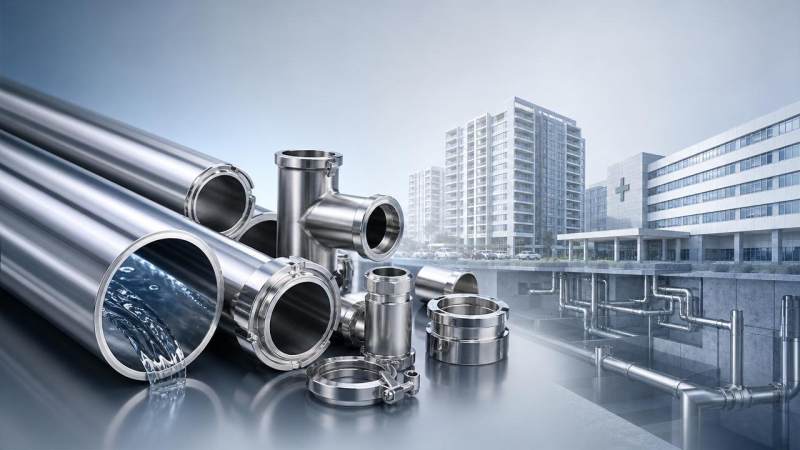
Choosing ss pipe for water supply is an important decision for homeowners and end users who care about health, durability, and long-term value.
Stainless steel pipes are widely known for corrosion resistance and clean water performance. Still, long-term safety depends on grade, installation, water quality, and maintenance.
In steel-related construction projects, water systems must balance hygiene, pressure strength, service life, and repair cost. That is why this topic deserves a practical, scenario-based review.
For most normal potable systems, ss pipe for water supply is considered safe for long-term use when the right stainless grade and proper joining method are selected.
Which water supply scenarios require different safety judgments
Not every water system faces the same risk. A villa, apartment tower, hospital, factory, and coastal building can expose stainless steel to very different conditions.
The safety of ss pipe for water supply changes with chloride level, temperature, flow speed, stagnation time, welding quality, and dissimilar metal contact.
This means buyers should not ask only whether stainless steel is safe. They should ask whether it is safe in their actual operating environment.
Typical residential scenarios where ss pipe for water supply performs well
Urban apartments and houses with stable municipal water
This is the most common and suitable case. Municipal water usually has controlled chemistry, moderate pressure, and predictable daily flow.
In these conditions, ss pipe for water supply can deliver clean water, low scaling, and a long service life with limited maintenance.
High-end homes focused on drinking water quality
Many people choose stainless steel because it does not add taste easily and supports a cleaner inner surface than some traditional alternatives.
For visible indoor installations, stainless steel also offers a modern appearance and strong resistance to aging under normal service conditions.
Commercial and special-use scenarios that need closer evaluation
Hotels, hospitals, and schools
These sites value hygiene and stable delivery. Stainless systems can be a strong option because they resist internal rust and support consistent water cleanliness.
However, intermittent use during holidays or low occupancy can create water stagnation. That raises the importance of flushing and system design.
Coastal buildings and chloride-heavy environments
Coastal air and water conditions can increase chloride exposure. In such places, lower stainless grades may face pitting corrosion over time.
Here, the answer to whether ss pipe for water supply is safe becomes grade-specific. Material selection must match the environment carefully.
Industrial buildings with mixed water demands
Some facilities use the same site for drinking water, cleaning water, and process water. Not all streams have the same chemistry or temperature.
A segmented piping plan often works better than one material for every line. Safety depends on identifying where stainless truly fits.
What makes stainless steel safe for long-term water contact
The key advantage is the passive oxide layer on stainless steel. This thin film protects the surface and helps resist corrosion in many water systems.
When the correct grade is used, ss pipe for water supply offers several long-term benefits:
- Strong corrosion resistance in normal potable water
- Low risk of red rust contamination
- Smooth inner wall that supports steady flow
- High mechanical strength and pressure resistance
- Long service life when installation is correct
These qualities make stainless steel a trusted material in many steel-based construction and infrastructure systems around the world.
Where long-term safety concerns can appear
Stainless steel is not automatically risk-free. Problems usually come from the wrong grade, poor fabrication, or unsuitable water chemistry.
Common concerns include:
- Pitting from high chloride water
- Crevice corrosion at poorly designed joints
- Weld area issues without proper treatment
- Galvanic corrosion when connected to unlike metals
- Stagnant water in low-use pipe sections
So, is ss pipe for water supply safe? Yes, but only when engineering details are taken seriously from the start.
A practical comparison of different water supply scenarios
How steel project experience supports better material decisions
Reliable water supply choices often come from broader project discipline. Material traceability, dimensional control, and standard compliance all matter.
Hongteng Fengda, a structural steel manufacturer and exporter from China, supports global construction and industrial projects with stable quality and customized steel solutions.
Its experience covers angle steel, channel steel, steel beams, cold formed profiles, and OEM structural components under ASTM, EN, JIS, and GB standards.
In many projects, water systems are part of a larger steel environment that also includes transport and access structures such as Rail.
This product is available in grades such as U74, U71Mn, Q235, 55Q, and 45Mn, with lengths from 12m to 30m and thickness from 3mm to 24mm.
Applications include railway systems, bridge railings, and deck handrails, with ISO9001-2008 and ISO14001:2004 support for controlled production.
How to choose ss pipe for water supply by actual need
A practical selection process reduces risk and avoids overspending. Focus on environment, grade, connection method, and expected service conditions.
- Test or review water chemistry, especially chloride level.
- Choose a stainless grade suited to potable water exposure.
- Confirm welding, pressing, or threading quality.
- Avoid unnecessary dead legs and stagnant branches.
- Use compatible fittings to limit galvanic effects.
- Request standards, certificates, and dimensional consistency.
If these points are checked, ss pipe for water supply usually becomes a dependable long-term solution rather than a maintenance burden.
Common mistakes that weaken long-term safety
Several avoidable mistakes lead to poor results even when stainless steel should have worked well.
- Selecting by price only, without checking water conditions
- Using low-grade material in coastal or saline regions
- Ignoring post-weld cleaning requirements
- Mixing metals without insulation planning
- Leaving systems unused for long periods
These issues do not mean ss pipe for water supply is unsafe by nature. They show that safe performance depends on proper system thinking.
Final answer and next step for a reliable water supply choice
Yes, ss pipe for water supply is generally safe for long-term use in residential, commercial, and many institutional settings.
The best results come when the stainless grade matches the environment, fabrication is controlled, and the system avoids stagnant or chloride-heavy risk points.
Before ordering, review water quality, installation conditions, and project standards. Then compare life-cycle value instead of initial price alone.
That approach makes ss pipe for water supply a practical, healthy, and durable option for long-term water delivery in steel-related construction projects.
Please give us a message


Please enter what you want to find