Before production begins, verifying JIS steel is essential for quality control teams and safety managers who need to prevent material mismatches, compliance risks, and costly project delays.
From checking mill test certificates and dimensional tolerances to confirming chemical composition, mechanical properties, and traceability, each step protects structural performance.
This guide explains practical verification points to help confirm JIS steel before fabrication, shipment, or site installation.
Why JIS Steel Verification Must Start Before Production
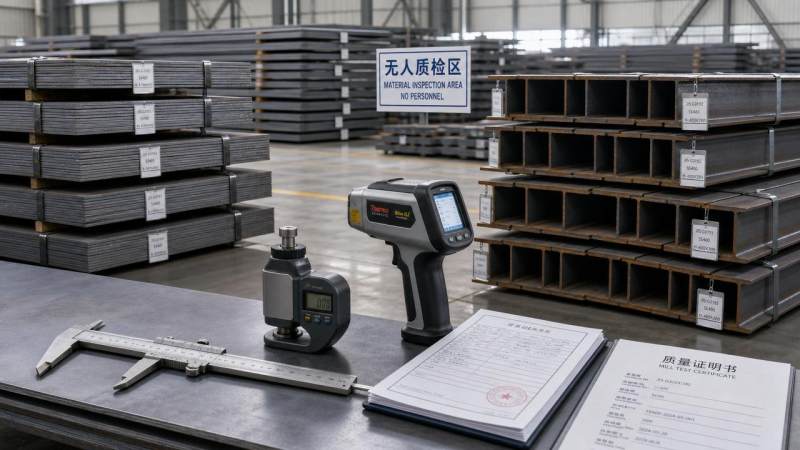
JIS steel is commonly used in structural frames, machinery, shipbuilding, industrial platforms, and infrastructure projects requiring defined Japanese Industrial Standards.
Once cutting, drilling, welding, or forming begins, a wrong grade becomes expensive to correct.
Early verification reduces rework, rejected inspections, unsafe substitutions, and disputes between drawings, purchase orders, and delivered steel.
A checklist also creates repeatable control. It helps compare documents, markings, test results, and physical steel before value-added processing starts.
Core Checklist to Verify JIS Steel Before Release
Use the following checklist before accepting JIS steel into production. Each item should be recorded with evidence and inspector confirmation.
- Confirm the JIS standard number, grade, delivery condition, and product form against the purchase order, drawing notes, and project specification.
- Check the mill test certificate for heat number, manufacturer name, grade, size, chemical composition, mechanical properties, and approval signature.
- Match heat numbers on bundles, tags, plates, bars, or beams with certificate data before unloading or internal transfer.
- Verify chemical composition values for carbon, manganese, phosphorus, sulfur, silicon, and alloying elements against the applicable JIS steel grade.
- Review tensile strength, yield strength, elongation, impact values, and test temperature where toughness is required by the project.
- Measure thickness, width, length, flange size, web size, straightness, and squareness using calibrated tools before fabrication release.
- Inspect surface condition for lamination, heavy scale, cracks, edge defects, corrosion, dents, and coating damage that may affect processing.
- Confirm welding suitability, preheat needs, carbon equivalent, and supplementary requirements when JIS steel will enter welded structures.
- Separate accepted, pending, and rejected materials physically, and update status labels before production teams access the steel.
Document Review: Certificates, Standards, and Traceability
Document control is the first gate for JIS steel verification. Do not rely only on packing lists or commercial invoices.
The mill test certificate should identify the producing mill, standard, grade, heat number, batch quantity, dimensions, and test results.
Check whether the certificate references the correct JIS steel standard. Common structural standards differ from standards for pressure, plate, pipe, or sheet products.
Traceability must remain intact after unpacking. If tags are removed, transfer heat numbers to durable labels, stencils, or barcoded records.
For imported material, confirm whether third-party inspection, origin documents, or customer-specific declarations are required before production approval.
Key Certificate Points to Compare
- Compare grade names exactly, including suffixes, delivery condition symbols, and any normalized or controlled-rolled requirements.
- Check whether test samples were taken in the required direction and from the correct product thickness range.
- Confirm that all ordered dimensions are covered by the certificate, not only a similar size from the same shipment.
- Review customer purchase notes for extra impact testing, ultrasonic testing, coating, marking, or packaging requirements.
Dimensional and Visual Checks for JIS Steel
Dimensional verification prevents hidden production waste. A certified grade may still be unsuitable if size tolerances are outside project limits.
Use calibrated measuring tools and record actual readings. Avoid approving JIS steel only by nominal dimensions printed on bundle tags.
For plates and sheets, measure thickness at multiple points. Check edge condition if nesting, laser cutting, or tight welding fit-up is planned.
For beams, channels, and angles, inspect flange width, web thickness, leg length, straightness, camber, twist, and end cut condition.
Chemical and Mechanical Confirmation
JIS steel performance depends on both chemistry and mechanical properties. Both must meet the declared grade and design requirement.
Chemical limits influence weldability, hardness, corrosion behavior, toughness, and forming response. Even small deviations may affect fabrication reliability.
Mechanical values prove whether the steel can carry load, deform safely, and resist fracture under specified conditions.
When project risk is high, use third-party laboratory testing. Portable PMI may support screening, but laboratory tests provide stronger evidence.
Practical Test Review Actions
- Review carbon equivalent before welding heavy sections, restrained joints, low-temperature parts, or fatigue-sensitive structural connections.
- Confirm impact test temperature and absorbed energy when JIS steel will be used outdoors, offshore, or in cold environments.
- Check elongation values when bending, forming, rolling, or punching will be performed before final assembly.
- Request retesting if certificate values are missing, unclear, inconsistent, or outside the required thickness category.
Mid-Process Material Selection and Supply Control
Material verification should also consider whether the selected product form fits the fabrication route, not only the written standard.
For projects requiring plate or sheet supply, Carbon Sheet Steel can support construction, shipbuilding, petroleum, chemical, machinery, and boiler heat exchanger applications.
Available references include Q245R, Q345R, Q370R, 16MnDR, 09MnNiDR, 15CrMoR, 14Cr1MoR, and related pressure or low-temperature grades.
Typical thickness ranges from 1mm to 100mm. Widths may include 1010, 1219, 1250, 1500, 1800, and 2500mm.
Lengths can be supplied as 1000, 2000, 2440, 3000, 5800, 6000mm, or customized project sizes.
When matching such materials with JIS steel requirements, confirm standard equivalency, inspection scope, and allowable substitution in writing.
Application Scenarios That Need Extra Attention
Structural Fabrication
Structural frames require reliable yield strength, dimensional accuracy, and welding performance. JIS steel used in columns, beams, and bracing must be traceable.
Before production, confirm cutting drawings match actual stock sizes. This reduces splice changes, bolt-hole errors, and late engineering revisions.
Shipbuilding and Marine Components
Marine use may require toughness, corrosion allowance, and additional inspection. JIS steel should be checked against class or project-specific rules.
Surface defects are especially important because coatings and weld seams must perform in aggressive service environments.
Machinery and Industrial Equipment
Machinery parts often require stable machining, flatness, and consistent mechanical behavior. Small variations may cause assembly or tolerance problems.
Check hardness expectations, plate flatness, and internal quality before machining high-value components from JIS steel.
Commonly Overlooked Risks in JIS Steel Verification
Assuming equivalent grades are automatically accepted. Similar chemistry does not always mean identical mechanical values, test methods, or delivery conditions.
Ignoring heat number breaks after cutting. Once full-length material is divided, each piece must keep traceability through marking or digital records.
Approving damaged packaging without inspection. Wet bundles, torn covers, or broken straps can hide corrosion, edge damage, or mixed materials.
Skipping tolerance checks on urgent orders. Fast schedules increase risk. JIS steel should still pass measurement checks before entering machines.
Accepting incomplete certificates. Missing test values, unclear grade names, or unsigned documents should trigger clarification before production starts.
Practical Execution Steps Before Production Release
- Create a receiving checklist that links purchase order requirements, JIS steel standard clauses, inspection points, and acceptance criteria.
- Assign responsibility for certificate review, dimensional inspection, visual inspection, and final material release.
- Use calibrated tools and keep calibration records available for audit or customer inspection.
- Photograph bundle tags, heat numbers, surface condition, and any nonconformity before material movement.
- Quarantine doubtful JIS steel immediately, and prevent cutting or welding until disposition is approved.
- Record all approvals in a material control log, including inspector name, date, batch, size, and release status.
For repeat orders, keep a supplier performance file. Track certificate accuracy, dimensional consistency, surface quality, packaging, and delivery reliability.
This history helps reduce sourcing risk and supports faster decisions when future JIS steel shipments arrive.
Summary and Next Action
Verifying JIS steel before production is not a paperwork formality. It is a practical control that protects safety, schedule, cost, and compliance.
Start with the standard, grade, certificate, heat number, dimensions, surface condition, chemistry, mechanical properties, and traceability.
Then document the result clearly, isolate uncertain material, and release only confirmed steel into fabrication.
For international structural steel sourcing, work with suppliers that understand ASTM, EN, JIS, and GB requirements.
A disciplined checklist turns JIS steel verification into a repeatable production safeguard, rather than a last-minute inspection problem.
Please give us a message


Please enter what you want to find