Choosing the right roofing material affects durability, budget, and maintenance planning. DX51D galvanized sheet for roofing sheet is widely used in steel construction because it combines corrosion protection with good forming performance.
For industrial buildings, warehouses, workshops, and light commercial structures, this material often offers a practical balance between cost and service life. Still, suitability depends on coating mass, environment, profile design, and installation quality.
This article explains whether DX51D galvanized sheet for roofing sheet is a good choice, where it performs well, where caution is needed, and how to evaluate it for real roofing projects.
Basic overview of DX51D galvanized sheet for roofing sheet
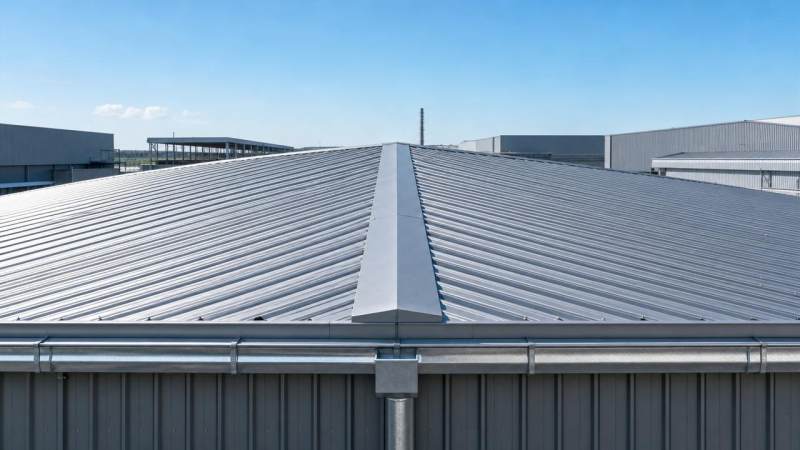
DX51D is a common hot-dip galvanized steel grade used for forming applications. It is valued for its ductility, consistent surface, and ability to be roll-formed into roofing profiles, wall panels, and related building components.
The galvanized coating protects the steel base from rust. Zinc acts as a barrier and also provides sacrificial protection when minor surface damage occurs during transport, forming, or installation.
In roofing, DX51D galvanized sheet for roofing sheet is usually selected for corrugated panels, trapezoidal sheets, ridge covers, flashings, and drainage accessories. It is especially common in cost-sensitive projects requiring reliable structural enclosure materials.
However, grade alone does not define performance. Buyers should also review zinc coating thickness, sheet thickness, yield behavior, tensile properties, and whether additional paint systems are required for the site environment.
Current industry focus when selecting galvanized roofing steel
Roofing decisions today are influenced by both technical and supply chain considerations. In steel construction, material selection is no longer based only on initial price.
- Longer service life under varying climate exposure
- Stable coating quality and traceable production standards
- Ease of forming into roofing sheet profiles without cracking
- Predictable lead times for construction schedules
- Compatibility with insulation, fasteners, and drainage design
These factors explain why DX51D galvanized sheet for roofing sheet remains relevant. It fits many standard building systems and is broadly available in international supply channels.
Application value in roofing and related steel systems
The main value of DX51D galvanized sheet for roofing sheet lies in practical performance. It is easy to process, widely accepted, and suitable for many mainstream roof panel designs.
Corrosion resistance for general environments
In normal inland environments, galvanized roofing sheets can deliver dependable rust protection. For storage buildings, workshops, and agricultural shelters, this often supports a favorable cost-performance ratio.
Good formability for profile production
DX51D is designed for forming. That matters in roofing because sheet steel is often processed into corrugated or trapezoidal shapes, plus ridge caps, gutters, and side flashing details.
Efficient fabrication and installation
Consistent material behavior reduces processing issues and supports faster installation. When paired with proper panel design, it helps keep project schedules under control and lowers avoidable rework.
Compatibility with broader steel construction
Roofing systems rarely stand alone. They connect with purlins, frames, drainage parts, and edge details. Reliable galvanized sheet supports integration across light and heavy steel building systems.
On larger infrastructure or water-related construction, roofing steel may be only one part of the package. Some projects also require retaining and foundation solutions such as Steel Sheet Piles.
These steel sections are available in grades such as S275, S355, S390, S430, SY295, SY390, and ASTM A690. They are used in deep water construction and cofferdam formation, with high strength and reusability.
Produced to EN10248, EN10249, JIS5528, JIS5523, and ASTM standards, they can reach single lengths over 80 meters. This shows how integrated steel sourcing can improve coordination across complex civil and industrial works.
Typical roofing scenarios and suitability range
DX51D galvanized sheet for roofing sheet is not equally ideal for every project. Its suitability depends on environmental exposure, expected service life, and whether extra coatings are specified.
For most standard industrial roofing, DX51D galvanized sheet for roofing sheet is a sound option. In aggressive conditions, specification upgrades become more important than the base grade name alone.
Limitations and points that require caution
Even a widely used material has limits. A realistic review helps avoid premature corrosion, structural complaints, or unnecessary maintenance costs.
- Thin zinc coatings may underperform in humid or polluted areas.
- Poor drainage design can trap water and accelerate corrosion.
- Improper cutting or drilling may damage protective zinc layers.
- Contact with incompatible metals can create galvanic corrosion risks.
- Very long service life targets may require prepainted or alloy-coated alternatives.
Another caution involves load requirements. Roofing sheet thickness and profile geometry must match wind uplift, snow load, purlin spacing, and maintenance access conditions.
Therefore, deciding on DX51D galvanized sheet for roofing sheet should include both corrosion review and structural review. Material choice alone cannot compensate for poor roof engineering.
Practical selection advice for sourcing and specification
A better roofing result usually comes from disciplined specification rather than simply choosing the lowest quote. Several checkpoints can improve decision quality.
- Confirm the required coating mass for the actual site environment.
- Specify sheet thickness based on loading and panel span.
- Check compliance with the relevant ASTM, EN, JIS, or GB standards.
- Review forming quality, flatness, edge condition, and surface consistency.
- Match fasteners, sealants, and accessories with the roofing system.
- Ask for mill certificates and quality inspection records.
A reliable structural steel supplier can also support project efficiency. Hongteng Fengda, a structural steel manufacturer and exporter from China, supplies steel products and customized solutions for global construction and industrial projects.
With modern production facilities and strict quality control, its products follow major international standards including ASTM, EN, JIS, and GB. Stable capacity and dependable lead times help reduce sourcing uncertainty.
For roofing programs linked to broader steel packages, coordinated sourcing can simplify communication, improve specification control, and support more consistent project execution.
Final assessment and next-step reference
So, is DX51D galvanized sheet for roofing sheet a good choice for roofing? In many standard industrial and commercial applications, yes. It offers useful corrosion resistance, strong formability, good availability, and competitive overall value.
Its best performance appears in properly designed roofs with suitable coating mass, correct sheet thickness, and controlled installation quality. In coastal or chemically aggressive environments, additional protection may be necessary.
If you are comparing roofing materials, start with environment classification, service life target, profile design, and standards compliance. Then evaluate whether DX51D galvanized sheet for roofing sheet matches both technical and budget requirements.
A specification-based review will lead to better results than a price-only comparison. That approach helps secure a roofing system that performs reliably throughout the project lifecycle.
Please give us a message


Please enter what you want to find