For project managers evaluating material performance, 304 stainless steel coil tubing for construction offers a practical balance of corrosion resistance, formability, and cost efficiency. But is it the right choice for every structural or support application? Understanding its strengths, limits, and compliance with project requirements is essential before sourcing. This article explores where 304 coil tubing fits in modern construction projects and how reliable steel suppliers can help reduce risk and improve outcomes.
Is 304 Coil Tubing Actually Suitable for Construction Use?
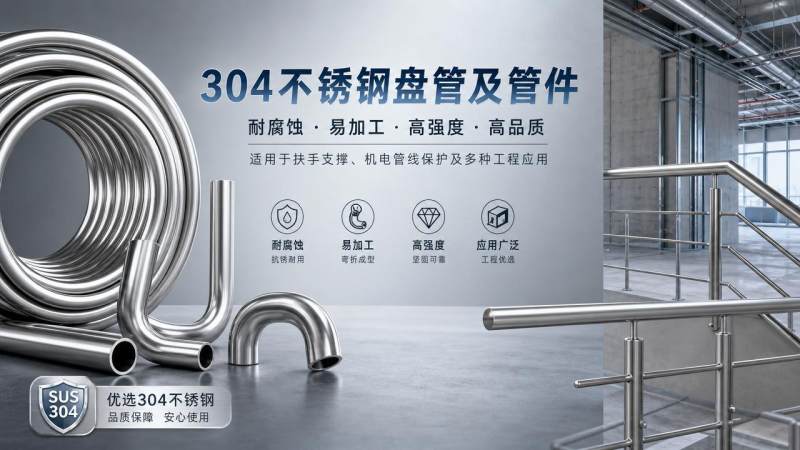
Yes, 304 stainless steel coil tubing is suitable for many construction uses, but it is not a universal solution for every project condition.
For project managers, the key question is not whether 304 can be used in construction, but where it performs reliably and where another grade may be safer.
In most indoor, commercial, architectural, and light industrial environments, 304 stainless steel coil tubing for construction is a dependable choice.
It combines corrosion resistance, clean appearance, good fabrication performance, and broad availability, which helps teams control procurement and installation risk.
However, it is less ideal in chloride-rich coastal zones, marine structures, highly aggressive chemical settings, and applications requiring high structural load capacity.
That means material selection should be tied to service environment, design loads, code requirements, fabrication method, and life-cycle maintenance expectations.
What Project Managers Are Really Trying to Decide
When buyers search for 304 stainless steel coil tubing for construction, they are usually comparing risk, cost, and durability rather than only reviewing material properties.
They want to know whether the tubing will last in the actual project environment without creating corrosion claims, rework, or unexpected replacement costs.
They also need to judge whether 304 supports efficient fabrication, especially for bending, welding, routing, handrails, frames, trims, conduits, and support assemblies.
Another practical concern is compliance. Project managers often need confidence that supplied tubing meets ASTM, EN, JIS, or other specified standards.
Lead time consistency matters too. Even a technically suitable material becomes a procurement problem if dimensions, tolerances, or surface finish vary between batches.
So the evaluation is usually commercial and operational, not just metallurgical. The best material is the one that fits project exposure, budget, and execution schedule.
Where 304 Stainless Steel Coil Tubing Performs Well in Construction
304 is widely used in applications where moderate corrosion resistance and good formability are more important than maximum structural strength.
Common construction uses include architectural trims, decorative framing, equipment enclosures, HVAC components, cable protection, light supports, and exposed interior metalwork.
It is also a practical option for tubing systems that need clean surfaces, attractive appearance, and easier maintenance in public or commercial buildings.
In hospitals, retail spaces, transport terminals, and office developments, 304 often works well because the environment is controlled and contamination levels are limited.
For fabricated assemblies, its forming characteristics help manufacturers produce coils, bends, curves, and custom profiles with relatively efficient processing.
This can reduce complexity when projects require nonstandard geometry, especially for OEM parts or prefabricated construction components sourced at scale.
Its Main Strengths: Why 304 Remains a Popular Choice
The first major advantage is corrosion resistance. 304 performs well in humid indoor conditions and many urban outdoor settings without requiring protective coating.
That reduces maintenance planning compared with carbon steel, especially for visible installations where coating damage would affect both durability and appearance.
The second strength is fabrication flexibility. 304 can be formed, welded, and finished in ways that support custom construction detailing.
This matters for project teams balancing design freedom with manufacturability. A material that is easier to process can shorten fabrication timelines and reduce reject rates.
The third advantage is supply chain familiarity. Because 304 is one of the most common stainless grades globally, buyers usually benefit from broader availability.
That often translates into more stable pricing, easier replacement sourcing, and fewer delays when projects span multiple regions or involve phased delivery schedules.
Its clean, modern appearance is another benefit. In exposed applications, 304 can support both function and architectural presentation without additional surface treatments.
Its Limits: When 304 Is Not the Best Construction Material
304 stainless steel coil tubing should not be treated as the automatic answer for all outdoor or structural applications.
Its biggest limitation is chloride sensitivity. In coastal locations, marine atmospheres, deicing salt exposure, or splash zones, 304 may develop pitting or crevice corrosion.
In those conditions, project managers often compare 304 with 316 or other more corrosion-resistant grades before approving final material selection.
Another limitation is structural role. Coil tubing is not always intended for primary load-bearing functions, particularly where high strength or code-certified performance is required.
Even if the alloy itself is reliable, tubing geometry, wall thickness, and forming history affect actual mechanical performance in service.
That means engineers must verify load conditions, deflection limits, joining methods, and applicable design standards rather than relying on grade name alone.
Surface contamination during fabrication is also a concern. Poor handling, iron contamination, or low-quality welding can reduce corrosion performance significantly.
How to Judge Whether 304 Fits Your Specific Project
A practical review starts with the service environment. Is the tubing installed indoors, outdoors, near seawater, near chemicals, or in a high-humidity processing area?
Next, define the function clearly. Will the tubing serve as protection, enclosure, trim, routing support, or part of a structural frame?
Then review fabrication requirements. Tight-radius bending, repeated welding, polished finishes, and custom dimensions all affect sourcing and manufacturing feasibility.
Project managers should also confirm cleaning and maintenance expectations. A material that performs well in theory may still underperform if maintenance is neglected.
Compliance review is equally important. Check the requested standards, inspection documents, mechanical properties, and finish requirements before purchase order release.
Finally, compare life-cycle cost instead of focusing only on initial price. A cheaper material may create higher replacement, maintenance, or appearance-restoration costs later.
What Specifications Should Be Verified Before Sourcing?
Before buying 304 coil tubing, confirm grade designation, outer diameter, wall thickness, coil length, surface finish, and dimensional tolerances.
Ask whether the product is produced to the specific ASTM, EN, JIS, or GB standard required by the project documentation.
Mill test certificates should be available and traceable. This is especially important for projects involving consultants, third-party inspection, or owner approval procedures.
Weld quality, passivation condition, and packaging method should also be discussed, particularly for export orders or long-distance sea transport.
If the tubing will be cut, bent, or welded after delivery, clarify fabrication compatibility in advance to avoid site-level surprises.
Experienced suppliers can also support value engineering by recommending dimension adjustments that preserve performance while improving yield or freight efficiency.
Balancing 304 Coil Tubing with Other Stainless Options in One Project
Construction projects rarely depend on one stainless product alone. Different components may require different grades, forms, and finishes depending on exposure and function.
For example, tubing may be selected for routing or framed elements, while plates are required for brackets, covers, machine guards, or fabricated support details.
In some cost-sensitive, less aggressive environments, ferritic stainless products may also be considered for noncritical parts where design requirements allow.
One example is 430 Stainless Steel Plate, which offers good corrosion resistance, formability, and useful mechanical properties for selected industrial and fabricated applications.
With tensile strength of at least 520 and yield strength of at least 275, it can suit components such as trims, electrical parts, conveyor-related fabrications, kitchen equipment, and certain transport uses.
Available in thicknesses from 0.3 mm to 200 mm and multiple finishes such as BA, 2B, NO.1, NO.4, HL, and 8K, it gives procurement teams flexibility where 304 tubing is not the right product form.
The point is not to substitute one grade blindly for another, but to align each material choice with environment, fabrication route, and commercial target.
How a Reliable Structural Steel Supplier Reduces Project Risk
For project managers, supplier capability is almost as important as material grade. Even the right specification can fail if execution is inconsistent.
A qualified manufacturer should provide stable production, dimensional control, traceable quality documents, and responsiveness during technical clarification stages.
Export experience matters as well. Packaging, marking, lead time planning, and standard interpretation can all affect delivery success in international construction supply chains.
Hongteng Fengda supports global buyers with structural steel manufacturing and customized supply solutions across construction, industrial, and manufacturing projects.
With experience serving North America, Europe, the Middle East, and Southeast Asia, the company helps buyers manage sourcing risk through consistent quality and dependable schedules.
For project teams, this kind of support is especially valuable when orders include mixed steel categories, custom dimensions, or standard-specific compliance requirements.
Common Mistakes to Avoid When Approving 304 for Construction
One common mistake is specifying 304 only because it is stainless, without reviewing actual corrosion exposure on site.
Another is treating decorative success as proof of structural suitability. Appearance and load performance are different engineering questions.
Some teams also overlook fabrication quality. Poor welding procedure or contamination can cause field failures that are blamed on the grade unfairly.
Over-standardizing is another risk. Using 304 everywhere may seem simple, but it can waste budget in low-risk areas and underperform in harsh environments.
Finally, do not separate procurement from technical review. Material grade, dimensions, finish, and application should be approved as one integrated decision.
Final Verdict for Project Managers
304 coil tubing is suitable for construction use in many common applications, especially where corrosion resistance, formability, appearance, and cost balance are important.
It is a strong choice for architectural, commercial, and light industrial uses that do not involve severe chloride exposure or primary heavy structural demand.
But suitability depends on project conditions, not just popularity. The right decision comes from matching environment, function, compliance, and life-cycle expectations.
If your project needs stainless tubing that is practical to fabricate, widely available, and reliable in moderate conditions, 304 is often a smart specification.
If exposure is more aggressive or the component has critical structural duty, a deeper engineering and sourcing review is necessary before approval.
For the best result, work with suppliers who understand standards, fabrication realities, and international project delivery, so material choice supports both performance and execution.
Please give us a message


Please enter what you want to find