Is 1x19 Stainless Steel Aircraft Cable 5/32 Inch Flexible?
If you are considering 1x19 stainless steel aircraft cable 5/32 inch for a railing, support, or light structural application, flexibility is one of the first questions to ask.
This cable construction is known for high strength, clean appearance, and excellent corrosion resistance, but it behaves differently from more flexible cable types.
Understanding how stiff it feels, where it performs best, and when another construction may be more suitable can help you choose the right stainless steel cable.
What Does 1x19 Construction Mean?
The term 1x19 means the cable has one strand made from nineteen individual stainless steel wires.
These wires are laid together in a compact pattern, creating a smooth, strong, and relatively rigid cable.
Compared with 7x7 or 7x19 cable, 1x19 stainless steel aircraft cable 5/32 inch has much less internal movement.
That reduced movement is the main reason it feels stiff when bent by hand.
The 5/32 inch diameter is small enough for railing systems, architectural lines, and tensioned supports.
However, diameter alone does not define flexibility. Cable construction is often more important than size.
Short Answer: Is It Flexible?
No, 1x19 stainless steel aircraft cable 5/32 inch is not considered a flexible cable.
It can bend gradually, but it should not be forced around tight corners or small pulleys.
It is better described as semi-rigid, high-tension stainless steel wire rope.
This stiffness is useful when a straight, clean, low-stretch line is required.
Where Does 1x19 Stainless Steel Aircraft Cable 5/32 Inch Perform Best?
1x19 stainless steel aircraft cable 5/32 inch performs best in straight-line tension applications.
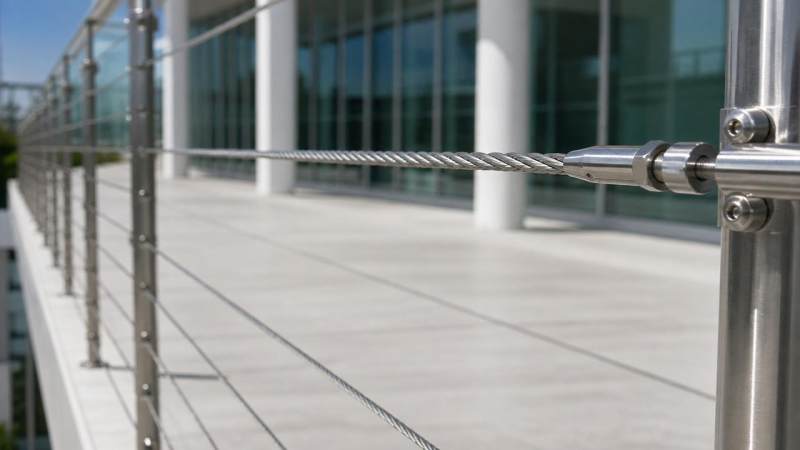
It is commonly selected for cable railing, balustrades, guardrails, shade supports, and architectural bracing.
Its polished appearance also makes it suitable for visible steel and metalwork projects.
In railing systems, stiffness helps the cable stay straight between posts after proper tensioning.
Low stretch is another benefit. It reduces the need for repeated adjustment after installation.
- Straight cable railing runs
- Marine and outdoor architectural details
- Light structural tension members
- Decorative stainless steel barriers
- Support lines requiring minimal sag
For these uses, 1x19 stainless steel aircraft cable 5/32 inch is often a practical and visually refined choice.
When Is This Cable Too Stiff?
This cable may be too stiff when the design requires frequent bending, coiling, or movement.
It is not ideal for winches, control cables, garage door systems, or repeated pulley operation.
If the cable must pass around sheaves, 7x19 cable is usually more appropriate.
If moderate flexibility is needed, 7x7 construction may offer a balanced compromise.
Using 1x19 stainless steel aircraft cable 5/32 inch in a tight bend can create stress concentration.
That stress can reduce service life, damage fittings, or create uneven load distribution.
Practical Bend Guidance
Always follow the cable supplier’s minimum bend radius recommendation.
As a general rule, larger bend radii protect wire rope from fatigue and distortion.
Avoid sharp corners, undersized holes, and fittings that pinch the cable body.
How Does It Compare With 7x7 and 7x19 Cable?
The main difference is the number of strands and wires inside the cable.
More strands usually mean more flexibility, but often with more stretch and less clean linear stiffness.
For clean railing lines, 1x19 stainless steel aircraft cable 5/32 inch usually looks straighter than 7x7 or 7x19.
For moving assemblies, that same stiffness becomes a disadvantage.
What Should Be Checked Before Choosing It?
Before selecting 1x19 stainless steel aircraft cable 5/32 inch, review load, environment, fittings, and installation method.
Stainless steel grade matters. Type 316 is often preferred for coastal or chloride-rich environments.
Type 304 may be suitable for many indoor or mild outdoor conditions.
The end fittings should match the cable construction and diameter.
Swage fittings, turnbuckles, terminals, and anchors must be installed according to manufacturer instructions.
In structural steel projects, cable performance also depends on surrounding components.
Posts, brackets, plates, and beams must resist the cable’s tension without excessive deflection.
For related corrosion-resistant steel components, Steel Plate Galvanized can support construction, transportation, energy, and industrial applications.
Available thickness ranges include 0.12mm-6.00mm, with widths from 600mm-1500mm and customizable lengths from 1m-12m.
Grades include DX51D, DX52D, SGCC, S350GD, and S550GD, following standards such as ASTM, EN, JIS, and GB.
Selection Checklist
- Confirm the cable must run mostly straight.
- Check minimum breaking strength and working load limits.
- Choose 304 or 316 stainless steel based on exposure.
- Use fittings designed for 5/32 inch 1x19 cable.
- Avoid tight bends during installation and service.
Common Mistakes With 1x19 Stainless Steel Aircraft Cable 5/32 Inch
One common mistake is assuming every aircraft cable is flexible.
Aircraft cable is a broad term, and construction changes performance significantly.
Another mistake is selecting cable only by diameter.
A 5/32 inch cable can be stiff or flexible depending on whether it is 1x19, 7x7, or 7x19.
Over-tensioning is also risky. It can deform posts, stress anchors, or damage threads.
Under-tensioning creates sag, especially on longer railing spans.
How Should It Be Installed for Better Service Life?
Install 1x19 stainless steel aircraft cable 5/32 inch with careful alignment and controlled tension.
Posts should be firmly fixed before tensioning begins.
Holes should be smooth, properly sized, and free from burrs.
Sharp edges can scratch stainless steel and create future corrosion points.
Use proper cutting tools to avoid frayed ends or distorted cable geometry.
After installation, inspect tension, alignment, and terminal seating.
Outdoor systems should be cleaned periodically, especially near salt, chemicals, or industrial pollution.
Maintenance Tips
- Wash deposits from the cable surface.
- Check fittings for loosening or discoloration.
- Retension only when the system design allows it.
- Replace cable showing broken wires or kinks.
Final Recommendation
1x19 stainless steel aircraft cable 5/32 inch is strong, attractive, and corrosion resistant, but it is not a flexible cable.
It is a smart choice for straight cable railing, architectural tension lines, and stable support applications.
If the project needs tight bending, coiling, or pulley movement, compare 7x7 or 7x19 before ordering.
For safer selection, confirm cable grade, fittings, tension requirements, bend radius, and surrounding steel structure capacity.
When these details match the application, 1x19 stainless steel aircraft cable 5/32 inch can deliver reliable long-term performance.
For steel components, custom structural profiles, or corrosion-resistant project materials, request specifications, drawings, and load requirements before final sourcing.
Please give us a message


Please enter what you want to find