Choosing the correct pipe size can directly affect flow performance, installation efficiency, and long-term reliability.
If you are wondering whether 1 stainless pipe is the right fit for your line, the answer depends on pressure, media type, application environment, and connection requirements.
Understanding these factors helps avoid costly mistakes and supports a stainless steel solution with strength, corrosion resistance, and stable performance.
What does 1 stainless pipe actually mean?
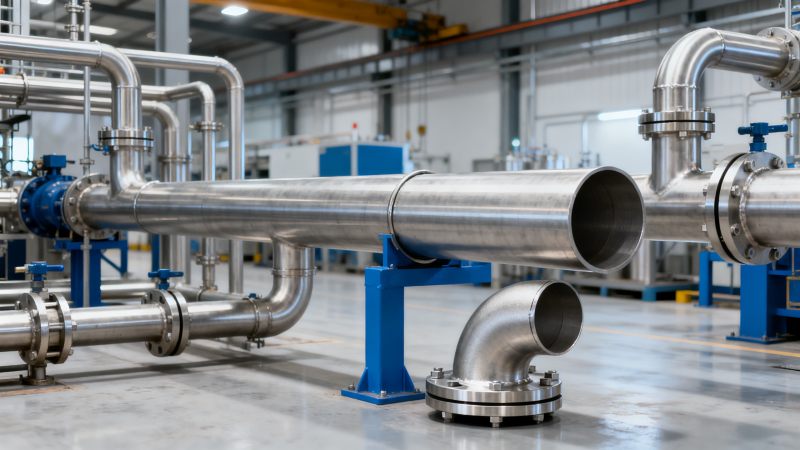
The term 1 stainless pipe usually refers to a nominal pipe size of 1 inch.
Nominal size is not the same as exact outside diameter or inside diameter.
That difference matters because wall thickness changes the internal flow area.
For example, a 1 stainless pipe in Schedule 10 and Schedule 40 will not carry exactly the same flow.
The outside diameter remains standardized, while the wall thickness changes.
This affects pressure rating, weight, welding behavior, and cost.
In steel projects, correct size interpretation prevents mismatch with fittings, flanges, and supports.
It also helps when checking ASTM, EN, JIS, or GB requirements.
When is 1 stainless pipe the right choice for a line?
A 1 stainless pipe is often suitable for moderate flow lines.
It appears in water transfer, compressed air, light chemical service, and equipment connection sections.
It can also work in food processing and general industrial systems where corrosion resistance is important.
The size is practical when space is limited but strength is still required.
It is also common in branch lines rather than large main lines.
However, suitability depends on design flow rate and acceptable pressure loss.
If the fluid must move quickly over long distances, 1 stainless pipe may be too small.
If the line is short and flow demand is controlled, it can be an efficient option.
Typical applications where this size works well
- Process equipment connections
- Cooling water branch lines
- Compressed air distribution
- Light-duty chemical transfer
- Drainage or return lines
How do flow, pressure, and wall thickness affect the decision?
This is the most important sizing question.
A 1 stainless pipe may look adequate, but poor hydraulic performance can appear after startup.
Smaller internal diameter increases velocity and friction loss.
Higher velocity can create noise, vibration, and wear in some systems.
At the same time, thicker walls improve pressure capacity but reduce internal area.
That means schedule selection is part of the sizing decision.
Check these technical points before confirming 1 stainless pipe
- Required flow rate per hour
- Operating and peak pressure
- Fluid temperature range
- Total pipe length and fitting count
- Acceptable pressure drop
- Connection type and maintenance access
If any of these values are uncertain, the line can be undersized or oversized.
Undersizing raises operating resistance.
Oversizing increases material and support cost without real benefit.
Good steel sourcing is not only about material grade.
It is also about matching dimensions to working conditions.
How does 1 stainless pipe compare with other steel line options?
Stainless pipe is selected mainly for corrosion resistance, hygiene, and service life.
Compared with carbon steel, it usually needs less protective maintenance in wet or aggressive conditions.
Compared with plastic lines, it offers better strength and temperature tolerance.
For support structures and related assemblies, other steel products may also be used nearby.
In those cases, corrosion control across the whole project becomes important.
A useful example is Galvanized Round Steel.
This product suits towers, highways, marine components, building structures, pipe joints, screws, nuts, and many industrial parts.
Its galvanized surface is glossy, durable, and designed for long anti-corrosion life.
Available diameters range from 16-250mm or customized, with tensile strength of 570-820 MPa.
It follows standards such as ASTM, EN, JIS, GB, BS, and AS.
In mixed steel projects, selecting stainless pipe for fluid service and galvanized round steel for supports can improve durability.
What mistakes happen when selecting 1 stainless pipe?
A common mistake is choosing by habit instead of calculation.
Another mistake is focusing only on nominal size and ignoring schedule.
Some lines fail early because the medium was more corrosive than expected.
Others become expensive because oversized pipe and fittings were installed everywhere.
Watch for these practical risks
- Ignoring pressure drop in long runs
- Using the wrong stainless grade for chloride exposure
- Mismatching pipe with fittings or valves
- Underestimating thermal expansion
- Selecting size before confirming future capacity
These issues can be avoided with a simple review of operating data, standards, and installation conditions.
Reliable steel suppliers usually help verify dimensions, tolerances, and compliance before production.
How can you judge quickly whether 1 stainless pipe fits your project?
A quick decision framework helps narrow the answer.
This table is not a substitute for engineering calculation.
Still, it helps screen the basic suitability of 1 stainless pipe early.
What should be confirmed before ordering?
Before placing an order, confirm more than the nominal size.
Material grade, schedule, length, end finish, surface condition, and test requirements all matter.
It is also useful to verify standards and documentation.
Projects involving structural steel and line components benefit from consistent sourcing and quality control.
Hongteng Fengda supports global steel supply with stable production, customized solutions, and compliance with major international standards.
That helps reduce sourcing risk and keeps delivery planning more predictable.
Final checklist
- Confirm actual flow and pressure data
- Match grade to medium and environment
- Select proper wall thickness
- Verify fittings, valves, and connection standards
- Review support and corrosion strategy
So, is 1 stainless pipe the right size for your line?
It can be the right solution when flow demand, pressure drop, environment, and connection needs are all aligned.
The safest path is to compare operating data with pipe dimensions before purchase.
If project requirements include both piping and structural steel, integrated specification review can improve durability and cost control.
Please give us a message


Please enter what you want to find