Rebar for concrete reinforcement is essential in most structures, but it is not always enough to meet the demands of complex loads, harsh environments, or long-span designs. For project managers and engineering leaders, understanding when reinforced concrete needs additional structural steel support can reduce risk, improve performance, and keep projects on schedule and within budget.
In practical construction planning, the question is not whether rebar is important, but where its role reaches a limit. When floor spans exceed common ranges, when vibration cycles are high, or when corrosion exposure shortens service life, relying on reinforced concrete alone can create avoidable design and procurement risks.
For project managers, this decision affects 4 critical targets at once: structural safety, fabrication lead time, installation sequencing, and total lifecycle cost. It also influences whether a project should introduce steel beams, channels, plate components, or custom structural assemblies early in the design stage rather than as a late corrective measure.
Where Rebar for Concrete Reinforcement Reaches Its Limits
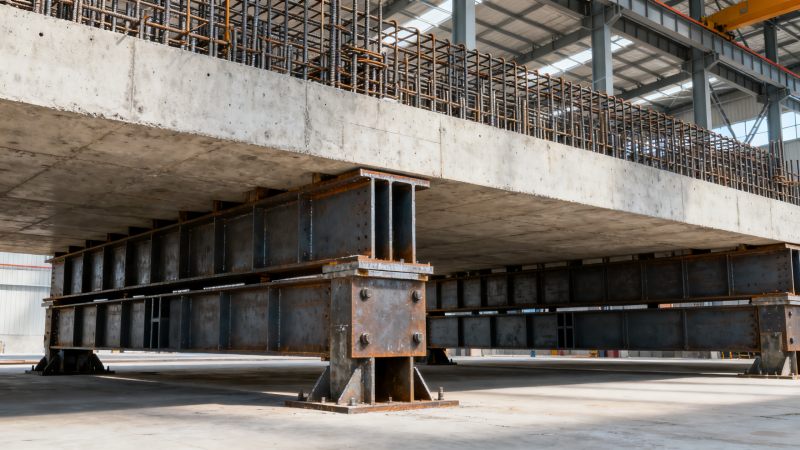
Rebar for concrete reinforcement performs extremely well in tension control inside concrete members, especially in beams, slabs, columns, and foundations under standard building loads. However, once project conditions move beyond routine residential or low-rise commercial requirements, additional structural steel often becomes necessary.
Load Intensity and Span Length
A common warning sign is span length. In many routine floor systems, reinforced concrete can remain efficient at spans of roughly 6–9 meters. Beyond that range, section depth increases quickly, self-weight rises, and deflection control becomes more difficult. In industrial halls, logistics facilities, and equipment platforms, project teams often shift to composite or steel-supported systems at 10–18 meters or more.
Heavy point loads are another trigger. Machinery bases, crane runway supports, mining equipment areas, and transfer stations can introduce concentrated loads that produce local stress conditions not solved by simply adding more bars. In such cases, steel beams, bearing plates, stiffeners, and fabricated sections distribute force more efficiently than oversized concrete members.
Harsh Environments and Durability Risks
Rebar for concrete reinforcement also becomes less sufficient where the environment is aggressive. Chlorides, repeated wet-dry cycling, industrial chemicals, and freeze-thaw exposure can accelerate cracking and reduce the effective protection concrete provides to embedded steel. Coastal facilities, wastewater works, mining plants, and process industries face these conditions regularly.
Even with proper cover, once cracking exceeds serviceability expectations, corrosion risk rises. In many projects, specifying supplementary structural steel outside the concrete section can improve inspectability, simplify replacement planning, and reduce shutdown risks over a 15–30 year operating horizon.
Dynamic Loads and Fatigue
Structures exposed to repeated vibration need special attention. Examples include crushers, conveyors, drill rigs, power shovel support zones, and heavy truck service areas. Under thousands or even millions of stress cycles, reinforced concrete may face fatigue-sensitive cracking, especially around openings, anchors, and discontinuities.
For these projects, structural steel framing can absorb, transfer, or isolate dynamic effects more predictably. Project teams frequently combine concrete for mass and stability with fabricated steel for load path control, maintenance access, and future equipment replacement.
The table below helps identify typical situations where reinforced concrete alone may not be the most efficient choice.
The key takeaway is that rebar for concrete reinforcement is strongest when working inside a stable and serviceable concrete system. Once geometry, environment, or loading conditions become more demanding, adding structural steel is often a design optimization rather than an unnecessary upgrade.
How Project Managers Should Evaluate Reinforced Concrete vs. Structural Steel Support
Project managers rarely make this decision based on material theory alone. The real evaluation combines 5 factors: load case, schedule, fabrication complexity, transport constraints, and future maintenance. A system that looks cheaper in early design may become slower and more expensive once formwork, curing, rework, and access restrictions are included.
1. Check Whether More Rebar Solves the Real Problem
A common mistake is assuming that if a member is underperforming, the answer is simply more rebar for concrete reinforcement. In reality, additional bars may increase congestion, complicate concrete placement, reduce compaction quality, and create hidden defects. Once bar spacing becomes tight, installation errors and inspection delays become more likely.
If the issue is excessive span, localized bearing stress, equipment anchoring, or stiffness demand, steel beams or plate components may provide a cleaner solution with fewer site variables. This is especially relevant when the schedule allows only 7–14 days for installation before mechanical works begin.
2. Compare Construction Sequence and Site Productivity
Concrete systems require formwork, bar fixing, embedding, pouring, curing, and often a waiting period before full loading. Structural steel components can often be fabricated in parallel with civil works and installed in shorter windows. For fast-track industrial projects, that overlap can save 2–4 weeks in critical areas.
This is one reason many global contractors use a hybrid strategy: reinforced concrete for foundations and mass elements, plus steel framing for spans, equipment support, mezzanines, stairs, and retrofit zones. The decision is driven not only by strength but by sequence efficiency.
Procurement Questions to Ask Early
- Will additional rebar create congestion at beam-column joints or anchor zones?
- Can structural steel be fabricated off-site while civil works continue on-site?
- Is the target handover date sensitive to curing time or weather delays?
- Will future equipment upgrades require cutting, drilling, or strengthening?
- Are ASTM, EN, JIS, or GB compliant steel sections required for export or multinational projects?
3. Consider Plate Steel for Local Reinforcement and Fabricated Components
In many industrial and heavy-duty applications, plate steel is introduced not to replace rebar for concrete reinforcement, but to solve local performance problems. Base plates, gussets, wear zones, equipment supports, and connection details often depend on plate material with reliable strength, weldability, and dimensional consistency.
A practical example is Carbon Steel Sheet Plate in Q345A(16Mn), which is widely used in construction, engineering machinery, manufacturing plants, mining and drilling rig structures, cranes, excavators, loaders, bulldozers, and coal mine hydraulic support systems. Its available size range of 3000–11880 mm in length, 1500–4000 mm in width, and 6–700 mm in thickness gives project teams flexibility for both standard and custom fabricated parts.
For project managers, the value lies in specification clarity. Q345A(16Mn) typically includes carbon content of 0.15–0.19, manganese 1.20–1.50, silicon 0.20–0.50, with phosphorus and sulfur each controlled at ≤0.020. When plate products also align with standards such as GB1591, GB/T1591, JIS G 3106, DIN17100, ASTM, and EN10025, they are easier to integrate into multinational procurement packages.
This type of steel is especially useful where reinforced concrete needs external steel assistance for machinery interfaces, support brackets, general building components, or fabricated assemblies exposed to high local stress. It gives engineering teams another option between fully cast-in reinforcement and full steel framing.
The comparison below shows how project teams can decide whether rebar, structural sections, or plate components should lead the solution.
This comparison shows that rebar for concrete reinforcement remains indispensable, but it does not answer every structural challenge. The best-performing projects usually assign each steel product to the role it handles most efficiently.
Typical Scenarios Where Additional Structural Steel Is the Better Choice
For engineering leaders, decisions become easier when tied to real scenarios. Several project types repeatedly show where reinforced concrete benefits from added steel sections, fabricated profiles, or plate assemblies.
Industrial Buildings and Equipment Platforms
Manufacturing plants and heavy equipment workshops often require clear spans of 12–24 meters, overhead cranes, equipment pits, and elevated access platforms. In these layouts, concrete alone can become bulky and slower to build. Steel beams, channels, and custom components reduce structural depth and simplify later modifications.
Mining, Drilling, and Material Handling Facilities
Mining trucks, loaders, drilling rigs, crushers, and conveyors create repeated impact and abrasion conditions. These facilities often need robust support frames, machine seats, wear plates, and replaceable steel details. Rebar for concrete reinforcement supports the mass concrete portions, but the working interfaces often rely on structural steel for durability and maintainability.
Retrofit and Expansion Projects
When an operating plant needs a capacity increase, adding more concrete and rebar is not always practical. Existing sections may have limited reserve capacity, and shutdown periods may be restricted to 48–72 hours. Steel strengthening, external framing, or bolted plate systems can be installed faster and with less disruption.
Three Signs a Hybrid Steel Strategy Should Be Reviewed
- Concrete member depth interferes with process lines, headroom, or service routes.
- Connection zones are too congested for reliable rebar fixing and concrete placement.
- Future maintenance or equipment replacement will require accessible steel interfaces.
Supplier Selection, Standards, and Risk Control in Global Steel Procurement
Once the project confirms that rebar for concrete reinforcement is not enough on its own, supplier capability becomes critical. A project manager needs more than price comparison. The supplier must support specification alignment, consistent production, quality control, and dependable export delivery.
What to Verify Before Issuing the Purchase Order
For structural steel, angle steel, channel steel, steel beams, cold formed profiles, and custom fabricated parts, 6 checks are especially important: material grade, dimensional tolerance, applicable standard, weld preparation, surface condition, and delivery batching. If custom components are involved, drawing review and approval sequence should be fixed before production begins.
For international projects, mixed standard environments are common. A reliable manufacturer should be able to supply products aligned with ASTM, EN, JIS, or GB depending on the contract package. This reduces re-approval cycles and helps procurement teams avoid substitution disputes during inspection.
Why Manufacturing Stability Matters
On large projects, inconsistency is often more expensive than headline unit price. A 1–2 week delay in steel delivery can interrupt civil, mechanical, and installation teams at the same time. Manufacturers with modern production facilities, stable capacity, and strict quality control help project owners reduce this chain reaction risk.
Hongteng Fengda focuses on structural steel manufacturing and export from China, supplying angle steel, channel steel, steel beams, cold formed steel profiles, and customized structural components for global construction, industrial, and manufacturing projects. For buyers in North America, Europe, the Middle East, and Southeast Asia, this kind of support is valuable when balancing compliance, lead time, and cost control.
Practical Risk-Control Checklist
- Confirm steel grade, standard, and test expectations before production release.
- Separate standard items from OEM items to avoid procurement bottlenecks.
- Review shipment lots against installation sequence, not only total tonnage.
- Allow time for document review, especially where multiple standards apply.
- Use suppliers able to support both standard sections and custom structural parts.
Rebar for concrete reinforcement remains the backbone of many structural systems, but it is not always enough when projects involve long spans, high local stresses, repeated vibration, aggressive environments, or fast-track construction schedules. In these cases, structural steel sections, fabricated components, and plate products provide the extra performance, flexibility, and installation efficiency that reinforced concrete alone may not deliver.
For project managers and engineering leaders, the best results usually come from early material coordination rather than late-stage correction. If your project needs angle steel, channels, beams, cold formed profiles, plate components, or custom structural steel solutions that align with ASTM, EN, JIS, or GB requirements, now is the right time to review the load path, fabrication plan, and procurement schedule together.
Contact Hongteng Fengda to discuss your structural steel requirements, request a tailored solution, or learn more about product options that can strengthen project performance while controlling sourcing risk and delivery pressure.
Please give us a message


Please enter what you want to find