Reading an I beam weight chart correctly is essential for safe design, accurate costing, and efficient material sourcing. Whether you are comparing I beam weight per foot for fabrication, checking rebar for beam support, or selecting steel angle for construction, this guide helps you avoid common mistakes and make confident decisions from specification review to project execution.
For buyers, engineers, project managers, fabricators, and quality teams, a beam weight chart is more than a reference sheet. It affects freight planning, lifting method selection, welding preparation, load calculations, storage layout, and total purchase cost. A small reading error can lead to a large variance when the order quantity reaches 20 tons, 50 tons, or more.
In structural steel sourcing, the most common mistakes come from unit confusion, section misidentification, and mixing theoretical weight with actual delivered weight. Understanding how charts are organized, what each column means, and how standards differ can help reduce risk before procurement, fabrication, and site installation begin.
Understand what an I beam weight chart is really showing
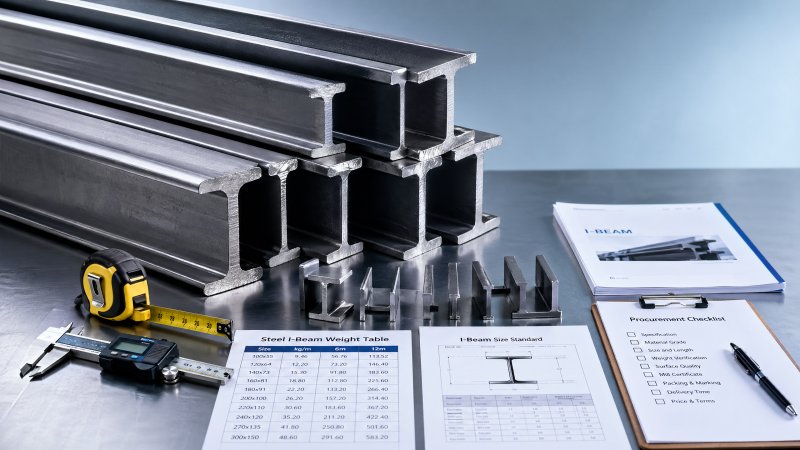
An I beam weight chart usually lists section designation, depth, flange width, web thickness, flange thickness, section area, and weight per meter or weight per foot. In many charts, weight is theoretical, which means it is calculated from nominal dimensions and steel density rather than measured from each beam after rolling.
This matters because two beams that look similar may differ significantly in mass. For example, a heavier section may have a thicker web or wider flange, increasing both load capacity and shipping cost. A difference of 5 kg/m over a 12 m beam means 60 kg more per piece, which becomes substantial across 100 pieces.
Another key point is terminology. In global trade, buyers may ask for I beams, H beams, universal beams, or wide flange beams. Some charts separate these categories, while others combine them. Technical evaluation teams should always verify whether the chart follows ASTM, EN, JIS, or GB conventions before comparing weights across suppliers.
The most common columns in a beam chart
If you understand the standard columns, the chart becomes much easier to use. Instead of reading only the beam designation, review the full row. Weight alone never tells the full structural story, because section geometry determines stiffness, connection detailing, and fabrication difficulty.
When reviewing a quotation or drawing, match at least 4 data points: section designation, standard, length, and unit weight. This 4-point check helps prevent ordering a section that has the right name but the wrong mass or geometry.
Why theoretical weight and actual weight may differ
Steel rolling tolerances, length tolerances, and coating condition can create small differences between theoretical and actual piece weight. For procurement and freight estimation, theoretical weight is standard practice. For final packing, container loading, and crane planning, however, actual bundled weight may be the more practical reference.
Most project teams accept a reasonable variance when it falls within the relevant product standard. The important thing is not to mix chart weight, weighbridge weight, and invoiced commercial weight without understanding the basis for each number.
How to avoid the reading mistakes that cause cost and safety problems
The fastest way to make mistakes is to assume that every chart uses the same units. Some use kg/m, others use lb/ft, and some list sectional area in cm² while others use in². A unit error can distort total tonnage by more than 2.2 times when kilograms and pounds are confused.
Another frequent issue is reading the designation only and skipping the standard source. An IPE 200, a W8 section, and a JIS 200 section are not interchangeable by name alone. Even when nominal depth looks similar, flange width and thickness can vary enough to affect bolting, welding, and structural performance.
Fabrication teams should also check whether the listed beam length is cut length or stock length. For example, a project may require 11.8 m finished length, but the mill may supply 12 m standard lengths. That 0.2 m difference influences waste, cutting plan, and yield rate across large volumes.
Five checks before you trust the chart
A practical review method is to verify the chart in a fixed sequence. This is especially useful for procurement teams handling multiple suppliers and for approval staff who need to validate tonnage and budget assumptions quickly.
- Confirm the measurement unit: kg/m, kg/pc, lb/ft, or lb/pc.
- Confirm the section family: I beam, H beam, wide flange, universal beam, or custom rolled section.
- Confirm the governing standard: ASTM, EN, JIS, or GB.
- Confirm nominal length and ordering length, such as 6 m, 9 m, or 12 m.
- Confirm whether weight is theoretical or actual bundled weight.
Using this 5-step review can reduce miscommunication during RFQ comparison. It is also useful during internal approval, where finance and project teams often need a simple basis for checking why one offer is 3% to 8% higher than another.
Typical mistakes and their impact
The table below shows how small reading errors can create larger downstream problems in structural steel projects. These risks affect not only design teams, but also buyers, distributors, and site installation managers.
The main lesson is simple: a beam chart is reliable only when it is read together with standard, unit, and order condition. This is why experienced suppliers and exporters present dimensional data, tolerance basis, and shipping details in the same documentation package.
How weight chart data supports sourcing, fabrication, and related steel selection
I beam weight charts are often used alongside other structural steel materials. A project team may review beam tonnage, steel angle quantities, channel dimensions, and corrosion protection requirements at the same time. In many industrial and infrastructure projects, coordination between beam sections and supporting pipe or tube components improves both budget control and installation efficiency.
For example, galvanized tube products are commonly chosen where corrosion resistance and service life are priorities. In support systems, trestle frames, low-pressure fluid pipelines, and light structural applications, matching beam loads with tube specifications helps avoid under-design and over-purchasing. This is particularly important when projects span outdoor environments, transport yards, agricultural facilities, or industrial platforms.
A useful reference in such cases is Galv Steel Tube, which is available in DX52D material and supports a broad range of applications, from general low-pressure water, gas, and oil lines to construction, machinery, railway vehicle components, bridges, and support frame pipe for mining pits or trestle piles.
When related steel products matter in beam-based projects
Beam weight data rarely stands alone in a real purchasing workflow. It often connects to coating choices, secondary framing, packaging, and logistics. Galvanized tube selection may influence maintenance interval, site durability, and total lifecycle cost, especially in humid, coastal, or chemically exposed environments.
The value of this comparison is not to replace beam charts, but to show how beam weight decisions fit into a wider structural steel package. Manufacturers that supply beams, angles, channels, cold formed sections, and custom components can often reduce coordination risk and shorten communication cycles during export projects.
A practical sourcing checklist
- Compare beam weight by the same standard and unit before evaluating price per ton.
- Ask whether supporting products need corrosion-resistant options for outdoor or industrial use.
- Check if length can be supplied at 6 m, 9 m, 12 m, or custom sizes to reduce cutting waste.
- Review tolerance requirements early, especially when assembly accuracy affects productivity.
For international buyers, this integrated view is especially useful because freight, storage, and port handling costs often depend on the complete steel package rather than one beam line item alone.
How technical and commercial teams should verify beam chart data before ordering
A strong purchase decision usually requires both technical verification and commercial review. Engineers focus on section suitability, procurement teams compare pricing and lead time, and finance or project approval staff need confidence that tonnage assumptions are correct. If any one of these checks is skipped, the project may face change orders, delays, or extra freight charges.
A reliable supplier should be able to provide standard references, dimensional data, material grade information, and production or delivery expectations in one coordinated response. For export projects, that usually includes packing method, document support, and whether the supply follows ASTM, EN, JIS, or GB based customer requirements.
For structural steel manufacturers and exporters such as Hongteng Fengda, the practical value lies in combining stable production capacity with clear technical communication. Buyers sourcing angle steel, channel steel, steel beams, cold formed steel profiles, and customized structural components benefit when one partner can align specification review, quality control, and lead-time management in a single workflow.
A 6-point verification process before PO release
The process below helps decision-makers reduce sourcing risk and avoid rework after a purchase order is placed. It is suitable for distributors, contractors, OEM buyers, and project owners reviewing structural steel packages.
- Verify beam designation against approved drawings and ensure the chart uses the same standard family.
- Confirm unit weight and calculate total tonnage using actual order lengths, not only standard stock lengths.
- Check dimensional tolerances and whether they affect fit-up, welding, or hole alignment.
- Review material grade and compliance requirements for the target market.
- Request packing, bundle, and loading details if shipment will move by container or break bulk.
- Confirm production lead time, inspection points, and document package before final approval.
In many cases, this 6-point review can be completed in 1 to 3 working days when the supplier provides complete technical sheets. That is far more efficient than resolving errors after fabrication starts or after cargo reaches the destination port.
Questions quality and safety teams should ask
Quality control and safety teams should pay attention to more than beam size. They should review traceability, dimensional consistency, and how the section weight affects storage stacks, lifting tools, and site handling plans. Even a moderate increase in unit weight can change sling arrangement or forklift selection.
On projects with repeated beam sizes, spot-checking 3 to 5 pieces per batch for dimensions and marking can help catch errors early. If customized structural components are included, the chart should be cross-checked with fabrication drawings rather than treated as a standalone reference.
FAQ and final guidance for confident beam chart reading
Many readers understand the chart in principle but still hesitate when comparing offers, validating tonnage, or approving substitutions. The FAQ below addresses several practical questions that appear frequently in structural steel sourcing and project execution.
How do I calculate total beam weight from the chart?
Multiply unit weight by beam length and quantity. If a section weighs 25 kg/m, each beam is 12 m long, and the order quantity is 40 pieces, the total theoretical weight is 25 × 12 × 40 = 12,000 kg, or 12 tons. Always verify whether cut loss, end trimming, or extra connection plates are included separately.
Can I compare prices using only price per ton?
Not safely. Price per ton is useful, but it should be compared only after standard, section type, coating condition, tolerance expectations, and delivery terms are aligned. A quote that looks 4% cheaper may include a different section family or shorter supply scope.
What should I do if the chart from two suppliers shows different weights?
First check if they are using the same standard and unit system. Then compare the actual dimensions in the row, especially flange width and thickness. If the dimensions differ, the sections are not identical even if the naming looks similar. Ask for the governing section table or mill standard to resolve the difference.
When is a customized solution better than a standard beam order?
If the project requires combined supply of beams, angles, channels, cold formed profiles, and fabricated structural parts, a customized package can reduce interface risk. It may also improve cutting efficiency, packing coordination, and lead-time control, especially for export projects with multiple material categories.
Reading an I beam weight chart without mistakes comes down to disciplined checking: verify unit, standard, geometry, length, and weight basis before making design, purchasing, or shipping decisions. For global structural steel projects, that disciplined approach improves cost accuracy, material fit, and site efficiency from the first RFQ to final installation.
If you need support with steel beams, angle steel, channel steel, cold formed profiles, or customized structural steel supply, working with an experienced manufacturer and exporter can simplify the process. Hongteng Fengda supports international buyers with standard-compliant production, stable quality control, and dependable delivery coordination.
Contact us today to discuss your beam specification, request a tailored steel solution, or review related product details for your next construction, industrial, or manufacturing project.
Please give us a message


Please enter what you want to find