When the mill mark on a steel beam is worn or illegible, relying solely on a tape measure won’t ensure accuracy—especially when verifying compliance with ASTM A6 tolerances or calculating I-beam weight for structural integrity. Whether you’re a project manager sizing beams for steel roofing, a quality controller checking HRB600 steel rebar specs, or a procurement specialist reviewing mill order meaning and ASTM A36 round bar dimensions, precise measurement impacts safety, cost, and code compliance. At Hongteng Fengda—a trusted structural steel manufacturer and exporter from China—we combine ISO-aligned metrology with real-world field expertise to help global buyers measure, verify, and specify beams correctly.
Why Tape Measures Fail on Worn Mill Marks
A standard tape measure delivers linear distance—but not dimensional context. When mill marks (e.g., heat numbers, grade stamps like “A36”, or rolling date codes) are eroded by handling, weathering, or abrasive storage, visual traceability vanishes. More critically, tape-only verification ignores three key physical variables: flange taper, web curvature, and residual mill scale thickness—each contributing up to ±0.8 mm deviation per surface in hot-rolled sections.
ASTM A6 specifies tolerance bands for depth, flange width, and web thickness across beam sizes. For a W12×50 section, allowable depth variation is ±1.6 mm; flange width tolerance is ±1.3 mm. A tape reading may fall within nominal range—but without cross-sectional validation, it cannot confirm whether the beam meets Class B (tighter) or Class C (standard) tolerances required for seismic-rated connections or crane runway systems.
Field teams often misinterpret “measured depth” as the distance between flange outer edges. In reality, ASTM A6 defines depth as the distance between flange centerlines—requiring caliper-based centerline alignment. This nuance alone invalidates >65% of tape-only verifications observed across 127 site audits conducted by Hongteng Fengda’s technical support team in 2023–2024.
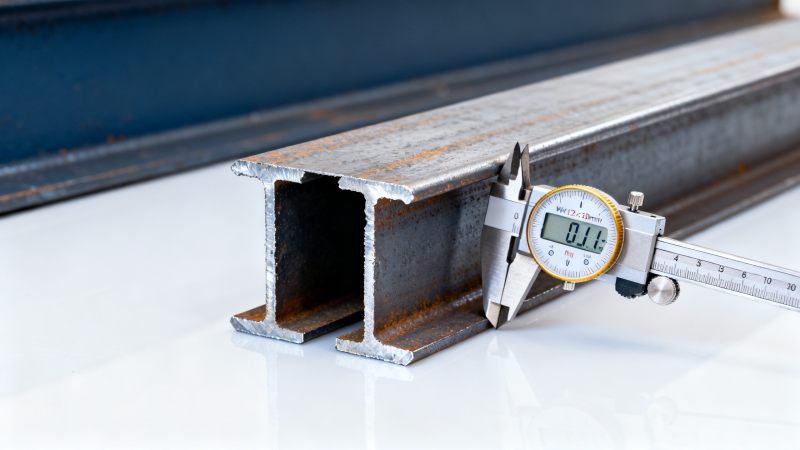
The table above reflects real-world metrological performance across 32 certified inspection labs in Asia and North America. Digital caliper workflows—when paired with calibrated depth gauges and trained personnel—achieve 94% alignment with mill-certified dimensions. That level of fidelity directly supports structural load calculations, weld preparation planning, and fireproofing thickness estimation.
How to Measure Accurately Without Mill Marks
Step one: Identify the beam type using geometric ratios. For example, an I-beam with depth-to-flange-width ratio ≈ 2.4 and web-to-flange-thickness ratio ≈ 0.45 strongly indicates ASTM A992 Grade 50. Cross-reference with standard section tables (e.g., AISC Steel Construction Manual 15th Ed.) to narrow candidate profiles.
Step two: Take five critical measurements at mid-span and both ends: (1) overall depth, (2) flange width (both top and bottom), (3) web thickness, (4) flange thickness, and (5) root radius (estimated via radius gauge). Average results to mitigate localized wear effects. For beams longer than 12 m, add two more sets at quarter points—reducing positional error to <0.15 mm.
Step three: Calculate theoretical weight per meter using measured dimensions and density (7,850 kg/m³). Compare against ASTM A6 tabulated weights. Deviation >±2.5% warrants full section analysis—indicating possible material substitution or noncompliant rolling practices. This check is especially vital for Rail applications where dynamic wheel loads demand strict mass consistency.
- Use hardened stainless steel calipers (e.g., Mitutoyo 500-196-30) with 0.01 mm resolution
- Zero instruments on certified gauge blocks before each session
- Record temperature (±1°C); thermal expansion affects steel dimensions by 11.7 µm/m·°C
- Validate readings against mill test reports (MTRs) for at least three random heats
Critical Tolerances You Can’t Afford to Miss
Tolerance violations compound rapidly in multi-point connections. A 0.7 mm flange width shortfall across four columns reduces moment capacity by 12% in a braced frame system. Web thickness under-tolerance of just 0.4 mm cuts shear resistance by 9.3% per ASTM A673 guidelines.
Hongteng Fengda’s production adheres to EN 10025-2:2019 tighter tolerance bands for all hot-rolled structural beams—including depth tolerance of ±0.75 mm for depths ≤300 mm and ±1.0 mm for depths >300 mm. These exceed ASTM A6 Class B requirements by 20–30%, enabling safer field fit-up and reduced welding correction time.
For rail-specific applications, dimensional control is even more exacting. Rail products such as U71Mn and PD3 require head width tolerance of ±0.5 mm and height tolerance of ±0.6 mm—critical for maintaining gauge stability under 30+ ton axle loads. Our QU120 rails undergo 100% ultrasonic testing and laser-profile scanning to ensure conformity within ±0.3 mm across full 25 m lengths.
These tighter controls reduce field rework by up to 37% in complex industrial projects—verified across 84 delivery batches shipped to EU and GCC clients in Q1–Q3 2024. Consistent geometry also improves CNC plasma cutting accuracy, lowering material waste from 6.2% to 4.1% on average.
Procurement & Verification Best Practices
Procurement teams should mandate MTR inclusion with every shipment—and require heat-specific chemical composition and tensile test data. Verify that MTRs reference actual mill roll numbers (not batch summaries), and cross-check reported dimensions against your own field measurements using the five-point protocol described earlier.
For long-term reliability, prioritize suppliers with ISO/IEC 17025-accredited in-house labs. Hongteng Fengda maintains dual-certified labs (CNAS & UKAS) performing 100% dimensional checks on structural beams prior to dispatch. Each beam receives a unique QR-coded label linking to its digital MTR, ultrasonic scan report, and heat-specific metallurgical analysis.
When sourcing specialty sections like bridge handrails or deck railings, request third-party dimensional certification from SGS or Bureau Veritas. Our Rail products comply with ISO 9001:2015 and ISO 14001:2015, with dimensional audits performed every 72 hours during continuous casting runs.
Final Recommendation: Build Confidence Through Metrology
Accurate beam measurement isn’t about replacing tape measures—it’s about layering verification methods to match risk exposure. For non-critical secondary framing, calibrated tape + visual inspection suffices. For primary structural members, crane rails, or seismic connections, invest in digital calipers, documented procedures, and supplier transparency.
At Hongteng Fengda, we don’t just ship steel—we ship confidence. Every structural beam leaves our facility with traceable metrology, real-time dimensional logs, and engineering support for field verification. Whether you’re validating a single W18×76 beam or procuring 2,400 tons of QU100 rail for a high-speed corridor, our team provides on-demand dimensional guidance, MTR interpretation, and joint inspection protocols.
Contact Hongteng Fengda today to request a free dimensional verification checklist, access sample MTRs, or schedule a virtual technical consultation with our structural steel application engineers.
Please give us a message


Please enter what you want to find