For technical evaluators, verifying galvanized pipe quality means looking beyond surface appearance to coating thickness, mechanical strength, dimensional accuracy, and compliance with ASTM, EN, or JIS standards. As high strength galvanized pipe manufacturers continue to serve demanding construction and industrial projects, understanding the right inspection criteria is essential for reducing sourcing risk, ensuring structural reliability, and selecting suppliers that can deliver consistent, certified performance.
What Should Technical Evaluators Check First?
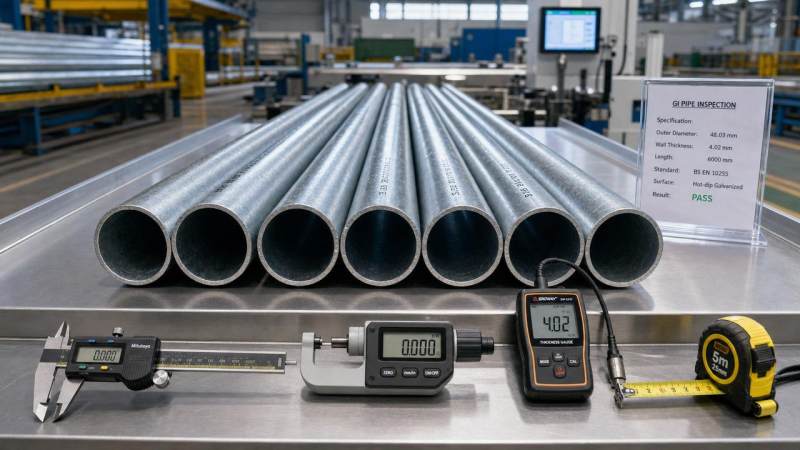
When reviewing galvanized pipe for structural or industrial use, the first task is to separate visual acceptance from engineering acceptance. A bright surface may look acceptable, yet the pipe can still fail coating, strength, or dimensional requirements.
Technical teams usually focus on four linked factors: steel substrate quality, galvanizing consistency, dimensional tolerances, and traceable compliance records. This is where experienced high strength galvanized pipe manufacturers differ from trading-only suppliers.
A sound evaluation should begin with a structured inspection checklist rather than a price discussion. If the factory cannot clearly explain testing methods, raw material control, or standard references, risk rises immediately.
- Confirm the applicable standard first, such as ASTM, EN, JIS, or GB, because coating requirements and tolerance limits may differ by market and project.
- Verify whether the pipe is intended for structural load, fluid conveyance, fabrication, or outdoor exposure, since the acceptance criteria are not identical.
- Check whether the supplier controls both steel forming and galvanizing, or outsources key steps, because process separation often affects consistency and lead time.
Why appearance alone is misleading
Surface gloss does not prove coating mass. Some pipes show a uniform finish but have thin zinc coverage at edges, weld zones, or internal surfaces. Technical evaluators should therefore request measured values instead of relying on photographs or short video inspections.
Likewise, a slightly matte or spangled finish is not necessarily a defect. What matters is whether adhesion, thickness, and corrosion protection meet the specified standard and service environment.
How to Verify Mechanical Strength and Base Steel Reliability
For high-load applications, the zinc layer is only one part of the quality picture. The pipe must also maintain the required yield strength, tensile strength, elongation, and weld integrity after manufacturing and galvanizing.
Technical evaluators should confirm whether the steel grade is suitable for the actual load path, fabrication route, and climatic exposure. High strength galvanized pipe manufacturers serving global projects should be able to align material selection with design codes and practical service conditions.
The table below gives a practical evaluation framework for reviewing base metal and finished pipe quality before approval.
This evaluation method helps prevent a common sourcing problem: acceptable certificates combined with inconsistent production lots. Strong suppliers maintain control from raw steel selection to finished inspection, reducing variation between batches.
Questions worth asking the supplier
- Is the stated strength based on the original strip or on finished pipe testing?
- Can the factory link each bundle to heat numbers and inspection records?
- Are there special controls for welded areas before galvanizing?
- What is the rejection process if one lot falls outside tolerance?
How to Judge Galvanizing Quality Beyond Surface Color
The zinc coating is the main corrosion barrier, but technical review should focus on measurable protection rather than appearance. Coating thickness, adhesion, continuity, and coverage of difficult areas are far more important than shine.
Reliable high strength galvanized pipe manufacturers normally provide coating test data and explain which method was used, such as magnetic thickness measurement, gravimetric testing, or standard sampling procedures.
Use the following table when comparing galvanizing quality across suppliers or projects with different corrosion risks.
The key interpretation is simple: average values alone are not enough. A technically acceptable lot should also control minimum values and critical-point consistency, especially for outdoor structures, industrial frames, and exposed support systems.
Common coating defects that require closer review
- Bare spots near ends or around welded sections, which often indicate poor pretreatment or process instability.
- Excessive ash inclusion or rough lumps that may interfere with fit-up, handling, or downstream fabrication.
- Peeling or weak adhesion after cutting, indicating poor bonding between the zinc layer and base steel.
Which Dimensional and Tolerance Checks Matter Most?
Even when chemistry and coating are acceptable, dimensional inconsistency can create assembly delays, weld fit-up problems, and project-level waste. Technical evaluators should therefore review diameter, wall thickness, straightness, ovality, length tolerance, and end condition.
This is especially important in modular construction, prefabricated racks, support structures, and projects with tight installation windows. Poor tolerance control adds hidden cost even if unit price is lower.
A practical inspection sequence
- Measure outside diameter at several positions to identify ovality or rolling inconsistency.
- Check wall thickness using calibrated tools, not only nominal values stated on documents.
- Inspect pipe straightness over full length, because bending can complicate alignment on site.
- Review end squareness and cutting quality where the pipe will be welded, threaded, or mechanically connected.
Well-managed manufacturers reduce these risks through stable forming equipment, process calibration, and lot-based final inspection. For export projects, consistent packing and bundle identification also support faster receiving inspections at destination.
How Standards and Certifications Reduce Sourcing Risk
Technical evaluators rarely approve galvanized steel products based on samples alone. They also need documentary confidence. That includes mill test certificates, inspection reports, production standard references, and traceable quality management procedures.
For international projects, alignment with ASTM, EN, JIS, or GB is often essential. The right reference standard does not just support compliance; it clarifies acceptance criteria and reduces disputes between procurement, engineering, and site teams.
Mid-project buyers often need more than pipe supply. For example, marine or retaining applications may require complementary steel systems such as Steel Sheet Piles. These products are available in grades including S275, S355, S390, S430, SY295, SY390, and ASTM A690, with production standards such as EN10248, EN10249, JIS5528, JIS5523, and ASTM. Their high strength, reusable design, and suitability for deep water construction or cofferdams make them relevant when a project combines pipe-based structural elements with temporary or permanent ground retention works.
When one supplier understands both structural steel and related engineered products, technical coordination becomes easier. That matters for projects that require compatible standards, dependable export documentation, and controlled lead times across several steel categories.
Documents worth requesting before approval
- Mill test certificate with chemical and mechanical data linked to heat numbers.
- Galvanizing inspection report showing coating thickness method and sampling basis.
- Dimensional inspection record for key tolerances if the project has strict fit requirements.
- Quality management and certification references where required by contract or destination market.
How to Compare Suppliers Without Focusing Only on Price
Low quoted price often hides variation in zinc thickness, raw steel quality, or document support. For technical evaluators, the better approach is total sourcing risk comparison. This includes rework probability, inspection burden, logistics reliability, and responsiveness to nonconformance issues.
Hongteng Fengda supports this decision process by combining structural steel manufacturing experience, export coordination, and strict quality control. For buyers in North America, Europe, the Middle East, and Southeast Asia, that means more reliable communication on standards, production planning, and inspection expectations.
The table below helps technical teams compare high strength galvanized pipe manufacturers using decision criteria that matter in real projects.
This comparison is useful because technical failures are rarely caused by one visible defect. They more often result from a chain of small weaknesses: unclear standards, unstable process control, missing records, and delayed corrective action.
FAQ for Evaluating High Strength Galvanized Pipe Manufacturers
How do I verify whether coating thickness data is reliable?
Ask for the test method, number of measurement points, calibration basis, and whether both average and minimum readings are recorded. Reliable data is specific, repeatable, and tied to a defined lot rather than presented as a generic statement.
Are all galvanized pipes suitable for structural use?
No. Some pipes are intended mainly for general conveyance or light-duty applications. Structural use requires confirmation of mechanical properties, tolerances, weld integrity, and the standard used for manufacturing and testing.
What are the most common mistakes during supplier evaluation?
The most common issues are accepting visual appearance as proof of quality, comparing quotations without matching standards, ignoring dimensional tolerance risks, and failing to confirm traceability before shipment.
When is third-party inspection worth considering?
Third-party inspection is especially useful for large export orders, critical structural applications, first-time supplier approvals, or projects where compliance documentation must satisfy consultants, EPC contractors, or public procurement requirements.
Why Choose Us for Technical Evaluation and Project Support
Hongteng Fengda is a professional structural steel manufacturer and exporter from China serving global construction, industrial, and manufacturing projects. Our experience with angle steel, channel steel, steel beams, cold formed steel profiles, and customized structural steel components helps us support buyers who need more than simple product dispatch.
For technical evaluators, the real value lies in controllable quality and clear communication. We support specification review, standard matching, dimensional confirmation, and project-oriented documentation aligned with ASTM, EN, JIS, and GB requirements where applicable.
If you are comparing high strength galvanized pipe manufacturers, contact us to discuss key technical points before ordering. You can consult us about parameter confirmation, coating requirements, mechanical property expectations, OEM dimensions, delivery schedule planning, sample support, certification references, and quotation alignment with your target standard and end-use scenario.
Please give us a message


Please enter what you want to find