Understanding galvanized steel sheet thickness options is becoming more important as steel applications continue to diversify.
In construction, fabrication, and industrial processing, thickness now affects more than basic strength.
It also influences forming performance, coating durability, transport weight, installation efficiency, and long-term cost control.
This guide explains galvanized steel sheet thickness options in simple language.
It also highlights current usage trends, key selection factors, and practical ways to match thickness with real project demands.
Why galvanized steel sheet thickness options matter more today
The market is shifting toward more precise material selection.
Projects no longer choose sheet thickness only by habit or rough experience.
Instead, buyers compare galvanized steel sheet thickness options against load, environment, finish, and budget targets.
This change is visible across roofing, cladding, ductwork, equipment covers, storage systems, and light structural components.
Thinner sheets are often preferred for easier forming and lower transportation cost.
Thicker sheets are gaining attention where impact resistance, rigidity, or longer service life is required.
As a result, understanding galvanized steel sheet thickness options helps avoid under-specifying or overpaying.
The main thickness ranges are being used more strategically
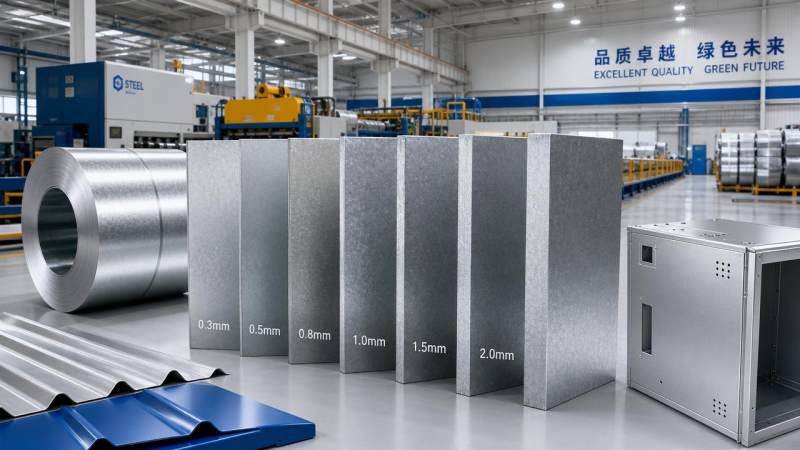
Galvanized steel sheet thickness options are usually discussed in millimeters or gauge.
Exact conversions can vary by system, so millimeter values are usually clearer for technical comparison.
Common thickness groups in simple terms
- 0.25 mm to 0.5 mm: light-duty uses, flexible forming, decorative panels, liners, and packaging-related parts.
- 0.6 mm to 1.0 mm: common for roofing, wall panels, ducts, cabinets, and general fabrication.
- 1.2 mm to 2.0 mm: better stiffness for brackets, enclosures, trays, and machine-related applications.
- Above 2.0 mm: heavier-duty environments needing stronger impact resistance or structural support.
These ranges are not strict rules, but they provide a practical starting point.
The best galvanized steel sheet thickness options always depend on fabrication method and service conditions.
Several industry signals are changing how thickness is selected
Selection standards are becoming more performance-based than purely price-based.
This trend is driven by visible changes in project requirements.
These signals show why galvanized steel sheet thickness options are now discussed earlier in project planning.
Thickness alone is not enough without coating and application context
A thicker sheet is not automatically better in every case.
Galvanized steel sheet thickness options should always be reviewed together with zinc coating, exposure level, and processing needs.
For example, a thin sheet with suitable coating may perform well indoors.
A coastal or humid application may require a different balance of base steel thickness and corrosion protection.
Key factors behind the decision
- Load-bearing requirement
- Span or unsupported distance
- Bending and forming complexity
- Outdoor or indoor environment
- Expected service life
- Transport and installation handling
- Surface finish expectations
In many projects, the best answer comes from balancing all factors rather than maximizing one specification.
A related example appears in wire-based galvanized materials used alongside sheet products.
For fencing, packaging, mesh, and general industrial use, Metal Coil Wire offers practical flexibility.
It is available in Q195 and Q235 low carbon steel.
Its wire diameter ranges from 0.25 mm to 5.0 mm.
Zinc coating thickness is 8 to 25 g/m2, with tensile strength from 350 to 550 Mpa.
The bright, smooth surface and good ductility support wire mesh, tie ropes, barriers, and decoration uses.
Different applications are creating different preferred galvanized steel sheet thickness options
The same material category can serve very different functions.
That is why galvanized steel sheet thickness options should be matched by application group.
This practical grouping makes galvanized steel sheet thickness options easier to compare across real usage scenarios.
What current changes mean for cost, processing, and performance
Thickness decisions affect every stage from sourcing to final installation.
Choosing from galvanized steel sheet thickness options without process review can create hidden costs.
Main impacts to watch
- Thicker sheets increase weight, freight cost, and handling effort.
- Very thin sheets may deform more easily during transport or installation.
- Forming tools and bending radius requirements change with thickness.
- Punching, welding, and cutting efficiency can vary significantly.
- Material waste may increase if the wrong thickness is selected early.
This is why simple thickness comparison is no longer enough.
Galvanized steel sheet thickness options should be linked to the full production and installation path.
The most useful points to review before making a final thickness decision
A structured review helps reduce specification errors.
The following points are especially useful when comparing galvanized steel sheet thickness options.
- Confirm whether the part is decorative, protective, or load-related.
- Check if the environment is dry indoor, humid indoor, outdoor, or corrosive.
- Review whether bending, stamping, or deep forming is required.
- Compare expected service life with coating and base thickness together.
- Estimate total installed cost, not only raw material price.
- Ask for compliance with ASTM, EN, JIS, or GB when needed.
Reliable steel supply also matters.
Hongteng Fengda supports global projects with structural steel manufacturing, customized solutions, and quality control aligned with major international standards.
This helps reduce sourcing risks when sheet products must match broader structural or industrial specifications.
A simple way to judge the best galvanized steel sheet thickness options
Start with function, then check environment, then verify fabrication limits.
After that, compare weight, expected life, and total delivered cost.
This approach makes galvanized steel sheet thickness options easier to evaluate without unnecessary complexity.
For many applications, the right thickness is the one that meets performance needs with the least waste and lowest risk.
If a project includes custom structural steel, formed profiles, or galvanized steel components, reviewing specifications early can save time later.
Use clear thickness ranges, coating requirements, and application details to request more accurate support and quotations.
Please give us a message


Please enter what you want to find