When used outdoors, galv steel conduit is chosen for mechanical strength, impact resistance, and corrosion protection. Still, the service life of galv steel conduit is never fixed. It changes with zinc coating quality, local climate, installation detail, surface damage, drainage, and maintenance frequency.
In construction and industrial projects, this question matters because conduit failure affects wiring safety, downtime, and replacement cost. A realistic understanding of outdoor durability helps improve specification decisions and long-term asset planning.
Outdoor service life of galv steel conduit
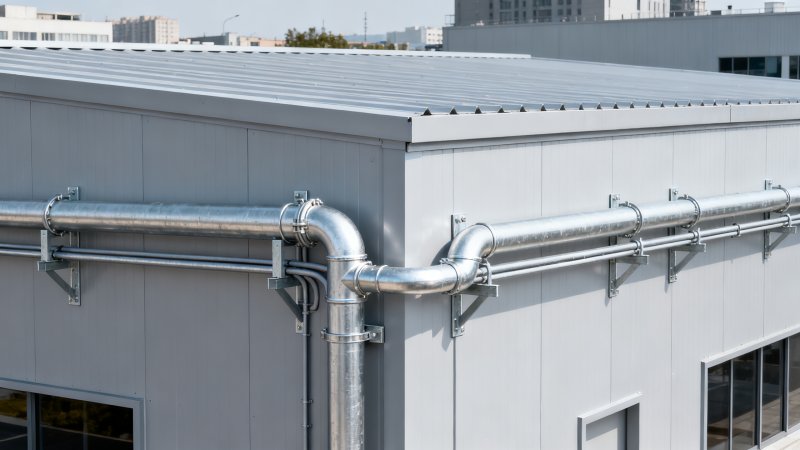
Under moderate outdoor conditions, galv steel conduit can often last 20 to 50 years. In mild inland environments, it may remain functional even longer. In severe coastal or chemical areas, life can be much shorter.
The zinc layer is the main reason for this performance. Galvanizing protects steel by creating a barrier and by offering sacrificial protection when small surface scratches appear.
However, outdoor exposure is rarely uniform. Rainwater retention, salt spray, industrial fumes, and physical damage can accelerate corrosion at specific points, especially threads, bends, couplings, and supports.
Typical life range by environment
What most affects outdoor durability
The lifespan of galv steel conduit depends less on the product name and more on the full corrosion system. Material selection, coating thickness, fabrication quality, and site exposure must be assessed together.
1. Galvanizing quality
A thicker and more uniform zinc coating usually delivers better outdoor life. Conduit produced to reliable standards tends to resist early rusting more effectively than thin or inconsistent coatings.
2. Climate and moisture
Humidity speeds corrosion. Areas with frequent rain, condensation, fog, or poor drying conditions keep the conduit surface active for longer periods and reduce protective life.
3. Salt and airborne contaminants
Salt is especially aggressive outdoors. Coastal wind carries chlorides onto exposed steel. Industrial plants may add sulfur compounds or chemicals that attack zinc and then the underlying steel.
4. Installation details
Even high-quality galv steel conduit can fail early if installed where water collects. Horizontal runs without drainage, damaged threads, or unprotected cut ends are common weak points.
5. Mechanical damage
Outdoor conduit may be hit by tools, vehicles, moving equipment, or debris. Once the galvanized surface is deeply damaged, corrosion can concentrate at that location.
In many industrial systems, conduit is only one part of a larger corrosion-control approach. Related materials such as Stainless Steel Welded Mesh are often specified nearby where filtration, screening, chemical exposure, or architectural durability is needed.
This mesh is available in SS 201, 304, 304L, 316, 316L, and 430. It supports filters, sieve systems, mining, chemical industry, architecture, and residences, with plain weave or twill weave options.
Typical specifications include wire diameter from 0.0008″ to 0.12″, mesh from 2 to 635, roll width up to 240″, and roll length up to 2000′. Its resistance to rust, corrosion, acid, alkali, heat, and chemicals highlights how environment drives material selection across steel applications.
Industry context and current specification focus
Today, outdoor steel systems are expected to balance service life, compliance, cost control, and maintenance simplicity. For that reason, galv steel conduit is often evaluated beyond initial price.
- Projects increasingly compare coating performance by site class, not by generic labels alone.
- Owners want lower life-cycle cost, especially in exposed electrical routes.
- Corrosion hotspots at fittings and cut ends receive more attention during inspection.
- Compatibility with ASTM, EN, JIS, and GB expectations supports global sourcing decisions.
- Outdoor steel products are increasingly selected as part of integrated durability planning.
A structural steel supplier with stable process control can reduce variation in steel chemistry, coating consistency, dimensional accuracy, and lead time. These factors matter when outdoor systems must perform for decades.
Hongteng Fengda, a structural steel manufacturer and exporter from China, supplies angle steel, channel steel, steel beams, cold formed steel profiles, and customized structural steel components for global projects. With production aligned to ASTM, EN, JIS, and GB, the company supports dependable sourcing for construction and industrial applications.
Business value of choosing the right conduit life
Knowing how long galv steel conduit lasts outdoors helps control both direct and hidden costs. The real issue is not only replacement material, but also labor, shutdown, access equipment, and safety risk.
Key value areas
- More accurate budgeting for long-term infrastructure.
- Lower maintenance frequency in exposed environments.
- Better electrical protection against impact and weather.
- Reduced risk of premature corrosion claims or rework.
- Improved selection between galvanized steel and alternative materials.
For many outdoor routes, galv steel conduit remains a cost-effective choice because it combines structural toughness with familiar installation methods. It often performs well where PVC lacks impact resistance or where stainless steel is unnecessary.
Typical outdoor use scenarios and expected suitability
Not every site places the same demand on galv steel conduit. Suitability improves when the exposure class is matched to the material and protective details.
Practical ways to extend outdoor service life
A long-lasting result depends on both product quality and field practice. The following steps usually improve the outdoor performance of galv steel conduit.
- Specify conduit from reliable sources with consistent galvanizing quality.
- Match the conduit type to inland, urban, coastal, or chemical exposure.
- Protect cut ends, threads, and damaged areas after installation.
- Avoid trapped water at low points, brackets, and sealed pockets.
- Use compatible fittings and supports to reduce galvanic or crevice corrosion.
- Inspect periodically for white rust, red rust, peeling, or impact damage.
- Clean deposits in coastal or polluted areas before corrosion concentrates.
Warning signs during inspection
Early detection matters. Surface discoloration may be minor, but red rust at joints, blistering around damaged coating, or corrosion beneath clamps indicates faster deterioration and possible replacement planning.
Selection guidance for the next project stage
If the project requires outdoor electrical protection in standard environments, galv steel conduit is often a strong option with a long usable life. If exposure includes salt, chemicals, or constant wetness, review higher-protection alternatives.
The best next step is to compare environment severity, service-life target, maintenance access, and total installed cost. Then confirm the conduit specification, coating expectation, and fitting details before purchase.
For steel-intensive construction and industrial applications, working with an experienced structural steel supply partner helps improve consistency across materials, standards, and delivery planning. That approach reduces sourcing risk and supports durable outdoor performance over time.
Please give us a message


Please enter what you want to find