Why steel coil pipe inspection matters more before today’s installations
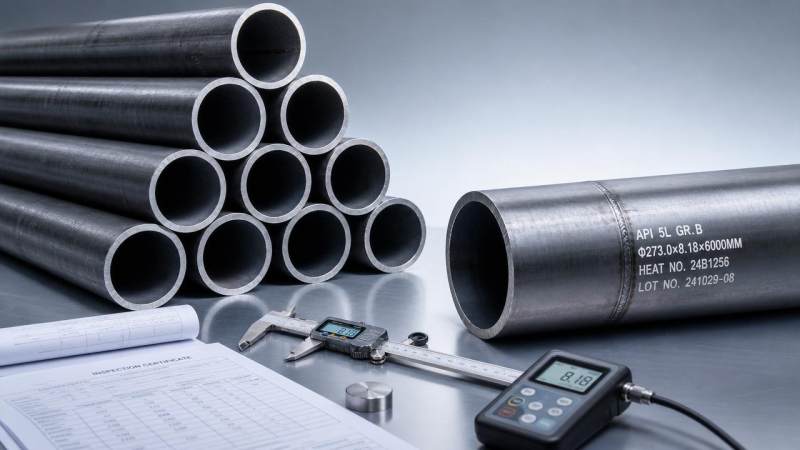
Before installation, steel coil pipe must be checked carefully for safety, fit, and long-term performance in demanding project environments.
Inspection is no longer a routine box-ticking step. It now affects schedule reliability, weld quality, pressure integrity, and site compliance.
Across construction and industrial projects, tolerance expectations are tighter. Delivery times are shorter, while failure costs are much higher.
That is why a practical steel coil pipe inspection process helps detect defects early and prevents hidden installation risks.
A reliable check should cover dimensions, surface condition, roundness, markings, documents, and storage damage before the pipe reaches the line.
Current signals show higher expectations for steel coil pipe quality control
Recent project standards show a clear shift. Buyers expect better traceability, more consistent geometry, and fewer surprises during installation.
This trend affects carbon steel products and stainless applications alike, especially where corrosion resistance and dimensional stability are critical.
For steel coil pipe, small deviations can create alignment problems, welding gaps, clamp stress, and coating damage on site.
Inspection therefore becomes a risk-control function, not only a receiving task. It protects structural performance and installation efficiency together.
Main drivers behind stricter pre-installation checks
The first checkpoints reveal whether steel coil pipe is installation-ready
Begin with visual confirmation. Damage caused by transport often appears before more technical defects are measured.
- Look for dents, flattening, edge deformation, and impact marks.
- Check for rust, scale, oil contamination, or moisture exposure.
- Inspect seam areas for visible cracking, undercut, or uneven finishing.
- Confirm pipe ends are not out-of-round or mechanically damaged.
A visual inspection should be done under good light. Rotate the steel coil pipe when possible to inspect the full circumference.
Dimensional checks prevent fit-up delays later
Measure outside diameter, wall thickness, length, and ovality using calibrated tools. Compare each result with project drawings and standards.
If the steel coil pipe is intended for welded assemblies, end squareness also matters. Uneven ends increase gap variation and welding time.
Straightness should be verified on a flat support. Even slight bowing can create alignment stress during installation.
Material identity should never be assumed from appearance
Always match markings with purchase orders, certificates, and heat numbers. Similar-looking products can differ greatly in performance.
In mixed inventory environments, grade confusion is a real risk, especially between structural and stainless materials.
For corrosion-sensitive uses, one practical comparison point is 304 Stainless steel pipe, widely used in residential decoration, food or medical sectors, and industrial piping systems.
This material is valued for corrosion resistance, solid mechanical properties, good workability, and high cost-effectiveness in many environments.
Common finishes include No.1, 2B, BA, 2K, and 8K, with sizes available from 6mm to 2500mm in outside diameter.
Hidden defects in steel coil pipe create the biggest downstream impact
Not all defects are obvious. Some steel coil pipe issues only become visible after cutting, welding, or pressure testing.
That makes pre-installation screening especially important where pipe supports structural loads or carries process media.
Defects that deserve extra attention
- Lamination near the surface or edge
- Inconsistent wall thickness around the circumference
- Longitudinal seam defects or incomplete fusion
- Micro-cracking at ends after rough handling
- Pitting or localized corrosion under packaging residue
When service conditions are severe, consider NDT methods such as ultrasonic testing, dye penetrant testing, or eddy current inspection.
The best method depends on material grade, wall thickness, seam type, and required acceptance level.
Why defects now affect more than a single pipe section
Modern project sequencing is faster. One rejected steel coil pipe can stop welding teams, delay insulation, and affect downstream testing windows.
This is especially true in export-driven supply chains where replacement lead times are longer than local correction time.
Reliable steel producers address this with stable production, standard compliance, and strong quality systems before shipment.
Hongteng Fengda, a structural steel manufacturer and exporter from China, supports such requirements with controlled manufacturing and customized solutions.
A practical inspection sequence improves consistency across receiving and installation stages
A consistent sequence reduces missed checks and makes steel coil pipe evaluation easier across multiple deliveries and project teams.
Recommended pre-installation sequence
- Confirm packing list, quantity, grade, and identification.
- Inspect packaging damage and unloading impact signs.
- Perform visual checks on the full pipe body and ends.
- Measure key dimensions against drawing tolerances.
- Review certificates and standards compliance records.
- Separate accepted, suspect, and rejected steel coil pipe clearly.
- Record findings with photos and inspection notes.
Simple acceptance criteria to document
What deserves closer attention as steel pipe applications continue to upgrade
As applications become more specialized, steel coil pipe inspection should become more condition-based rather than only checklist-based.
Consider service temperature, corrosion exposure, pressure level, joining method, and the consequence of failure before setting inspection depth.
- Increase surface scrutiny for decorative or hygienic stainless uses.
- Increase dimensional control for prefabricated assemblies.
- Increase traceability checks for regulated export projects.
- Increase NDT coverage where seam integrity is essential.
For longer-term sourcing, choosing suppliers with ASTM, EN, JIS, and GB compliance capability helps reduce inspection uncertainty.
The next step is to standardize how steel coil pipe is approved on site
The most effective response is simple: build a repeatable approval process before installation begins.
Use a short checklist, calibrated measuring tools, traceability verification, and photo documentation for every steel coil pipe delivery.
If project conditions are demanding, define hold points for suspect items instead of pushing them directly into installation.
That approach reduces rework, protects safety, and improves confidence in final system performance from the first installed section onward.
Please give us a message


Please enter what you want to find