Knowing how to calculate I beam weight is essential for accurate purchasing, fabrication, transport, and project cost control. Whether you are comparing I beam vs H beam, checking steel beam factory price, or sourcing from a Steel I Beam supplier in Malaysia, this guide will walk you through the calculation step by step and help buyers, engineers, and project teams make smarter structural steel decisions.
In structural steel procurement, even a small weight error can affect freight planning, quotation accuracy, cutting loss estimates, and crane selection. For project managers and purchasing teams, the difference between a theoretical weight and an actual delivered weight can influence budget approval, warehouse handling, and downstream fabrication schedules.
This article explains the I beam weight formula, shows how to calculate it manually, highlights common mistakes, and connects the calculation to real sourcing decisions. It is especially useful for technical evaluators, operators, quality teams, distributors, and enterprise decision-makers looking for a practical steel beam reference.
Why I Beam Weight Calculation Matters in Real Steel Projects
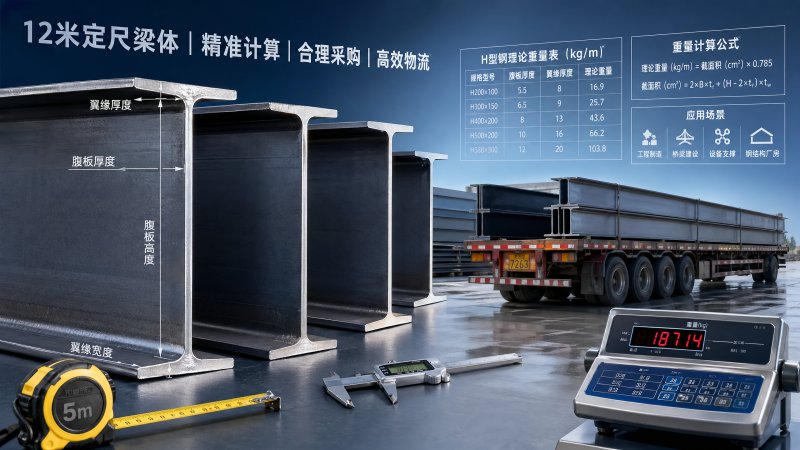
I beam weight is not just a theoretical engineering number. It directly affects 4 critical project areas: material purchasing, transport cost, fabrication planning, and structural load verification. In many export transactions, the quoted unit may be per metric ton, per piece, or per meter, so understanding how weight is derived helps buyers compare offers on the same basis.
For example, if a project requires 120 pieces of 12 m beams, a weight deviation of only 2.5 kg/m can create a total difference of 3.6 tons. That may change container loading plans, truck axle compliance, and the final invoice amount. For finance approvers and commercial evaluators, this is a practical cost-control issue rather than a purely technical detail.
Weight also matters for fabrication shops. Cutting, drilling, welding, galvanizing, and lifting all depend on section mass. A beam with a theoretical weight of 37.3 kg/m behaves very differently in handling from one at 56.7 kg/m. Operators must prepare suitable lifting equipment, while quality and safety teams need to validate storage and site movement procedures.
Another reason to calculate carefully is that different standards such as ASTM, EN, JIS, and GB may list similar-looking beam sizes with different dimensions. A buyer who only looks at nominal size without checking flange thickness, web thickness, and standard designation can easily understate or overstate the actual steel requirement.
Key project decisions influenced by beam weight
- Quotation comparison by kg, ton, piece, or meter.
- Container and truck loading, especially when total cargo is 20–28 tons per unit.
- Fabrication capacity planning for cutting, punching, and welding operations.
- Crane and forklift selection based on single-piece and bundled weight.
- Budget approval, especially on projects with 50–500 tons of structural steel.
The table below shows how weight data connects to common B2B decision points across departments.
The main takeaway is simple: accurate I beam weight calculation reduces uncertainty across technical, commercial, and operational teams. It is one of the easiest ways to improve sourcing discipline before issuing a purchase order.
Step-by-Step Formula to Calculate I Beam Weight
The standard approach is to calculate the cross-sectional area first and then convert it into weight per meter using steel density. For carbon structural steel, the commonly used density is 7,850 kg/m³. In practical beam calculations, this density is stable enough for quotation and planning purposes unless a project specifically requires a different alloy or tolerance basis.
The simplified formula is: weight per meter = cross-sectional area × steel density. If the area is in square millimeters, a convenient version becomes: weight per meter (kg/m) = area (mm²) × 0.00785. This conversion factor saves time and is widely used in steel trading, workshop planning, and preliminary quantity checks.
For an I beam, the cross-sectional area is usually approximated by adding the two flange areas and the web area. In a simplified manual method, area = 2 × flange width × flange thickness + (overall height - 2 × flange thickness) × web thickness. This works well for quick estimating, although standard tables may be more accurate because they account for root radii and section tolerances.
Let us use a sample section with these dimensions: overall height 250 mm, flange width 125 mm, flange thickness 9 mm, and web thickness 6 mm. First, calculate flange area: 2 × 125 × 9 = 2,250 mm². Then calculate web area: (250 - 18) × 6 = 1,392 mm². Total area = 3,642 mm². Weight per meter = 3,642 × 0.00785 = about 28.59 kg/m.
Manual calculation in 5 clear steps
- Confirm the beam dimensions from the drawing or mill standard: height, flange width, flange thickness, and web thickness.
- Calculate total flange area by multiplying flange width × flange thickness × 2.
- Calculate web area using clear web height × web thickness.
- Add the areas to get total cross-sectional area in mm².
- Multiply by 0.00785 to get theoretical weight in kg/m, then multiply by beam length.
Important unit conversion note
Many errors happen because dimensions are mixed between mm, cm, and m. If one dimension is entered in cm while the others are in mm, the final weight can be wrong by 10 times or even 100 times. For purchasing and workshop use, keep all dimensions in mm until the final kg/m conversion. This is usually the safest route.
The following table summarizes the formula and a sample result in a way that procurement and engineering teams can use during pre-order checks.
In actual purchase documents, it is still good practice to check the supplier’s official section table. Manual calculation is ideal for fast verification, but mill tables remain the better reference for final settlement when tolerances, root radii, and standard-specific geometry are involved.
Common Mistakes, Tolerances, and the Difference Between Theoretical and Actual Weight
A common misconception is that theoretical weight and actual delivered weight are always identical. In practice, rolled steel sections are produced within dimensional tolerances. Thickness, straightness, and length variation can all create a difference between the calculated value and the scale weight. Depending on the applicable standard and section size, a small percentage deviation is normal.
Another mistake is ignoring standard differences. Two beams described loosely as “250 I beam” may have different flange widths or thicknesses under GB, JIS, EN, or ASTM-based catalogs. This becomes especially risky in multinational procurement, where design teams, contractors, and suppliers may be referencing different beam tables. Always confirm the full designation, not just the nominal height.
Length treatment is another source of confusion. If the beam is ordered at 6 m, 9 m, or 12 m stock length, the total weight is straightforward. But once cutting allowances, bevel preparation, splice details, or end trimming are introduced, the fabricated piece weight may differ from the raw beam weight. Project estimators should separate raw material quantity from finished assembly quantity.
For logistics, bundle weight should also include packaging, strapping, tags, and sometimes protective coating. These extras are not large compared with steel mass, but in export shipments near a 25-ton loading threshold, even a few hundred kilograms can affect the loading plan. That is why shipping documents often distinguish net weight and gross weight.
4 frequent calculation errors
- Using nominal beam size without checking the exact section standard.
- Applying the wrong unit conversion factor.
- Ignoring rolling tolerances and quoting theoretical weight as final settlement weight.
- Confusing raw beam length with finished fabricated member length.
A related product for deep foundation and cofferdam work
Many buyers who calculate beam weight also manage marine, retaining, or foundation packages where section weight affects transport and installation planning in a similar way. In these cases, Steel Sheet Piles are often evaluated alongside beams for temporary or permanent structural support.
Typical grades include S275, S355, S390, S430, SY295, SY390, and ASTM A690, produced under EN10248, EN10249, JIS5528, JIS5523, and ASTM standards. They are used for construction in deep water and the formation of cofferdams, with single lengths available up to over 80 m depending on project design and production arrangement.
For project teams, the key selection factors are high strength, penetration into hard soil layers, waterproof performance, and reusability across multiple cycles. Certifications such as ISO9001, ISO14001, ISO18001, and CE FPC are also relevant when buyers need consistent compliance records for international tenders and quality control review.
How to Use I Beam Weight in Procurement, Pricing, and Supplier Evaluation
Once the weight per meter is known, buyers can convert technical dimensions into a commercial basis. If a beam weighs 28.59 kg/m and the order quantity is 200 pieces at 12 m each, total theoretical tonnage is 68.62 tons. This number becomes the starting point for supplier quotation comparison, transport cost analysis, and stock availability discussions.
In export sourcing, it is useful to ask whether the supplier quotes by theoretical weight or actual weight. Some contracts settle by theoretical weight according to standard section tables, while others settle by weighbridge measurement. The method should be defined before order confirmation, especially for larger contracts above 100 tons or for mixed-size shipments.
Supplier evaluation should go beyond price per ton. A lower beam price may be offset by inconsistent section tolerance, delayed rolling schedule, or incomplete inspection records. For distributors, EPC contractors, and project owners, a reliable supplier should be able to support ASTM, EN, JIS, and GB requirements, provide stable production lead times, and share clear packing and marking details.
Hongteng Fengda, as a structural steel manufacturer and exporter from China, supports buyers with steel beams, angle steel, channel steel, cold formed steel profiles, and customized structural steel components. For overseas projects, this matters because sourcing teams often prefer a partner that can combine standard sections with OEM fabrication support under one supply chain, reducing communication gaps and scheduling risk.
Supplier comparison checklist
The table below can be used as a practical framework when comparing I beam suppliers for project procurement.
When price, weight basis, standard compliance, and delivery schedule are reviewed together, procurement decisions become far more dependable. This approach is especially valuable for buyers handling multiple beam sizes, mixed standards, or regional export logistics.
Practical FAQ for Buyers, Engineers, and Project Teams
The questions below reflect common concerns from sourcing teams, site engineers, fabricators, and commercial reviewers. Each answer is intended to support real decision-making rather than only theoretical calculation.
How is I beam weight different from H beam weight?
The calculation principle is the same, but the dimensions are usually different. H beams often have wider flanges and thicker sections, which means higher weight per meter for comparable depth. Because of this, buyers should never compare I beam and H beam only by nominal height. A 200 mm deep section in one category may have a significantly different mass from the other.
Should I use manual calculation or standard weight tables?
Use manual calculation for fast checking, early budgeting, and cross-verification of supplier data. Use official standard tables for final commercial confirmation and engineering documentation. On projects with 20 tons or less, a quick manual method may be enough for preliminary budgeting. On projects of 100 tons or more, standard references are strongly recommended to reduce settlement risk.
What is a reasonable tolerance between theoretical and actual weight?
The acceptable range depends on the applicable production standard, beam size, and contract terms. In many practical situations, small deviations are normal due to rolling tolerances and length variation. The important point is not to assume zero difference. Buyers should define the settlement method clearly and review section tolerances before issuing the final order.
What documents should I ask from a structural steel supplier?
At minimum, ask for the section specification, applicable standard, material grade, mill test certificate, quantity list, and packing details. If fabrication or surface treatment is included, request dimensional inspection records and coating information as well. For export projects, lead time confirmation and shipment packing list format are also worth checking early.
How to reduce sourcing risk in 3 steps
- Confirm exact beam designation, standard, and grade before comparing prices.
- Check theoretical kg/m against supplier tables and total project tonnage.
- Align settlement basis, inspection documents, and delivery schedule before payment approval.
Calculating I beam weight step by step helps every stakeholder make better decisions, from engineering review to purchasing approval and site handling. It improves quotation accuracy, reduces logistics surprises, and supports better communication between project owners, fabricators, and suppliers.
For global buyers looking for reliable structural steel supply from China, Hongteng Fengda offers steel beams, angle steel, channel steel, cold formed profiles, and customized structural steel solutions with support for international standards and export delivery needs. If you need help checking beam weight, comparing sections, or planning a sourcing package, contact us today to get customized support, technical details, and a practical quotation for your project.
Please give us a message


Please enter what you want to find