For distributors, agents, and stockists, knowing how often an ASTM stainless steel price list should be updated is essential for accurate quoting, margin control, and competitive sourcing. In a market shaped by raw material volatility, freight changes, and project demand, a timely pricing strategy helps reduce risk and improve customer response. This article explains the key factors that determine update frequency and how reliable steel suppliers support better pricing decisions.
How Often Should an ASTM Stainless Steel Price List Be Updated in Practice?
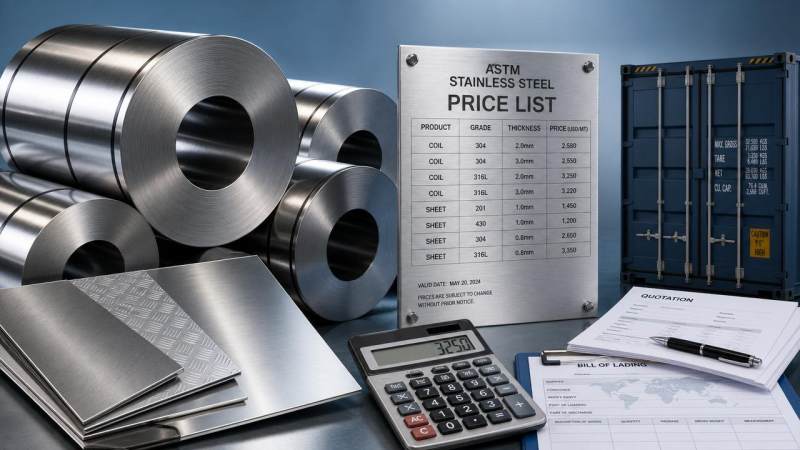
The short answer is this: an ASTM stainless steel price list should not follow one fixed calendar only. For most distributors, monthly updates are the minimum baseline.
In more volatile periods, weekly updates are often necessary. For fast-moving grades, large-volume tenders, or import-based supply, some quotations may need daily confirmation before order acceptance.
This matters because the keyword ASTM stainless steel price list usually reflects a commercial intent, not just an informational one. Buyers want usable pricing guidance they can rely on.
Distributors and agents are rarely asking out of curiosity. They are trying to quote customers accurately, protect margins, compare suppliers, and avoid selling at prices that no longer reflect replacement cost.
That is why the best update frequency depends on three things: market volatility, your inventory turnover, and how long your quoted price remains valid in real business transactions.
What Distributors and Agents Actually Need From a Price List
For target readers such as stockists, agents, and regional distributors, a price list is not just a reference sheet. It is a decision tool tied directly to sales speed.
They care less about a theoretical number and more about whether the listed price can support a real order, a negotiable quote, and a predictable delivery commitment.
In practical terms, they usually focus on five questions. How current is the price? What standard does it cover? Which grades and sizes are included? What is excluded? How long is it valid?
If a supplier sends an ASTM stainless steel price list without validity terms, freight assumptions, quantity conditions, or alloy surcharges, it creates commercial uncertainty instead of clarity.
For this audience, the most useful pricing documents are the ones that connect specification, supply condition, and commercial terms clearly enough to support a rapid quoting decision.
Why ASTM Steel Pricing Changes More Often Than Many Buyers Expect
Many distributors assume steel prices move mainly because of mill adjustments. In reality, ASTM-related stainless pricing is affected by a wider combination of commercial variables.
The first factor is raw material cost. Nickel, chromium, molybdenum, and other alloy inputs can move quickly, especially for stainless grades serving industrial and construction applications.
The second factor is energy and processing cost. Rolling, annealing, pickling, cutting, coating, and finishing all affect the final offer, especially for custom or value-added products.
The third factor is freight. Ocean shipping, inland trucking, fuel costs, container availability, port congestion, and destination surcharges can all change the landed cost significantly.
The fourth factor is demand timing. Large project releases, seasonal construction cycles, and regional shortages can tighten supply and reduce the practical validity of previously issued price lists.
The fifth factor is exchange rate movement. For importers buying from China or other export markets, currency fluctuation can change actual purchasing cost even when base mill pricing stays stable.
Because of these combined influences, a static quarterly price list may be too slow for active distributors, particularly those managing tenders, repeat buyers, or multiple regional markets.
A Practical Update Schedule for Different Sales Situations
There is no single rule for every company, but a tiered update model works well for most steel distributors and trading teams handling ASTM-standard products.
Use monthly updates as your standard reference cycle when the market is relatively stable. This is suitable for internal budgeting, customer guidance, and routine account planning.
Move to biweekly updates when alloy prices, freight costs, or exchange rates show visible movement. This helps keep branch teams aligned without overloading customers with daily revisions.
Use weekly updates for active sales markets, imported material, or categories with fast replacement cost changes. This is often the most practical balance between stability and responsiveness.
Require daily confirmation for large tenders, custom processing orders, uncommon grades, or project business with delayed release timing. In these cases, a list price alone is not enough.
For spot inventory already in your warehouse, you may hold a slightly longer published validity period. For future production or factory-direct supply, a shorter quote validity is safer.
A useful rule is simple: update your list at least as often as your replacement cost can materially affect your gross margin. If the market can erase margin in days, update faster.
What Should Be Included in a Reliable ASTM Stainless Steel Price List
An effective list should do more than show prices by grade. It should help distributors understand exactly what they are quoting and what assumptions support the number.
At minimum, include ASTM standard reference, material grade, dimensions, finish, thickness range, unit weight basis, MOQ, packaging terms, and price validity period.
It should also state whether pricing is ex-works, FOB, CFR, or CIF. This is especially important for exporters and importers comparing offers from different origins.
Where possible, the document should identify whether processing services are included. Cutting, punching, drilling, profiling, or custom fabrication can change price structure considerably.
Good suppliers also clarify whether the list is intended for guide pricing, stock material, or confirmed order basis. That distinction prevents misunderstandings during negotiations.
For multi-product buyers, this level of transparency matters across categories. For example, building-material distributors may also compare coated products like Color Coated Galvalume Steel Coil PPGL for roofing, wall panels, appliances, or fabricated components alongside stainless and structural steel procurement plans.
How Outdated Price Lists Create Hidden Commercial Risks
Many companies notice obvious pricing errors, but the larger danger is often hidden margin erosion. A list can look reasonable while already being commercially obsolete.
If your team quotes from an outdated document, the first risk is underpricing. You may win the order but lose profit when the replacement cost is higher than expected.
The second risk is overpricing. If your list is slower than the market, competitors using newer pricing can respond faster and appear more attractive to end customers.
The third risk is internal confusion. Sales, procurement, and finance may work from different assumptions, causing inconsistent quotations, approval delays, and customer distrust.
The fourth risk is supplier relationship friction. If a buyer expects old pricing to remain valid beyond a realistic period, negotiations become slower and less efficient.
For agents and distributors, these risks are not small operational issues. They directly affect conversion rate, cash flow, inventory turnover, and long-term account retention.
How to Decide Whether Monthly, Weekly, or Daily Updates Are Right for You
The right frequency depends on your actual business model, not on what another distributor does. Start by examining your quote cycle and inventory cycle together.
If most customer orders are fulfilled from existing stock and replenished slowly, monthly list updates may be workable, supported by special confirmation for larger deals.
If your model depends on import replenishment or project-based sales, weekly updates are usually safer because your exposure to future cost movement is much higher.
If you regularly quote large end users, EPC contractors, or fabricators, you should separate indicative price lists from confirmable transactional quotes with short validity windows.
Also review how often your supplier changes production input costs. A mill or exporter with stable capacity and disciplined procurement may support more consistent price intervals.
By contrast, if your supply chain relies on opportunistic sourcing, variable freight routes, or inconsistent stock availability, your list needs more frequent adjustment to stay credible.
How Strong Suppliers Help Distributors Keep Pricing Accurate
A dependable supplier does more than send numbers. They provide a pricing framework that helps distributors make faster and safer commercial decisions.
This includes consistent product specifications, clear standard compliance, timely market communication, realistic lead times, and transparent validity periods for quotations.
For global buyers, it also helps when the supplier can support multiple standards such as ASTM, EN, JIS, and GB. That flexibility reduces sourcing friction across markets.
Hongteng Fengda, as a structural steel manufacturer and exporter from China, supports international buyers with stable production capacity, quality control, and customized supply solutions.
For distributors managing mixed demand across structural and industrial categories, this matters because a supplier relationship is strongest when pricing reliability and delivery reliability work together.
Whether the requirement is angle steel, channel steel, steel beams, cold formed profiles, or customized components, better cost visibility supports better sales planning.
The same logic applies when buyers evaluate coated materials with processing and appearance requirements, such as Color Coated Galvalume Steel Coil PPGL, where thickness, width, paint system, coating thickness, and custom color options can all affect the quotation basis.
Best Practices for Managing Your Internal Price List Process
Distributors should not rely only on supplier updates. Internal price list management is equally important if you want pricing discipline across teams and regions.
First, assign one owner for master price control. This prevents multiple uncontrolled versions from circulating between salespeople, branches, and purchasing teams.
Second, separate reference prices from confirmable prices. A reference list helps commercial planning, while order-stage quotations should include a clear validity deadline.
Third, build trigger rules for non-scheduled updates. For example, revise pricing immediately if alloy surcharges, freight, or exchange rates move beyond a defined threshold.
Fourth, annotate assumptions clearly. Include incoterms, quantity basis, packaging, testing requirements, and any surcharges linked to nonstandard sizes or urgent delivery.
Fifth, track quote-to-order conversion against price age. If older quotes convert poorly or generate disputes, your update cycle is likely too slow for the market.
Finally, educate customers. When buyers understand why validity periods are shorter in volatile conditions, they are more likely to accept quick confirmation procedures.
Conclusion: Update as Often as the Market Requires, Not as Rarely as Possible
If you are responsible for quoting, sourcing, or margin control, the best answer is not a rigid schedule. It is a market-responsive pricing discipline.
For most distributors and agents, a monthly ASTM stainless steel price list is only a starting point. Weekly updates are often more realistic, and some deals need daily confirmation.
The key is to match update frequency with cost volatility, quote validity, and supply-chain risk. When these factors are managed well, your price list becomes a competitive asset.
When they are ignored, the same price list becomes a source of margin loss, slow response, and customer frustration. That is why update frequency should be treated strategically.
In short, update often enough to protect margin, preserve credibility, and support confident quoting. For serious steel distributors, that is the standard that matters most.
Please give us a message


Please enter what you want to find