After uncoiling, a stainless steel coil rod is rarely perfectly straight, and that detail matters in maintenance, repair, and downstream processing.
For steel service, fabrication, and installation work, expected straightness affects fit-up, cutting accuracy, feeding stability, and final appearance.
Understanding how a stainless steel coil rod behaves after release helps separate normal residual curve from actual quality problems.
It also supports faster inspection, better customer communication, and more practical corrective action on site.
Why straightness matters in real uncoiling situations
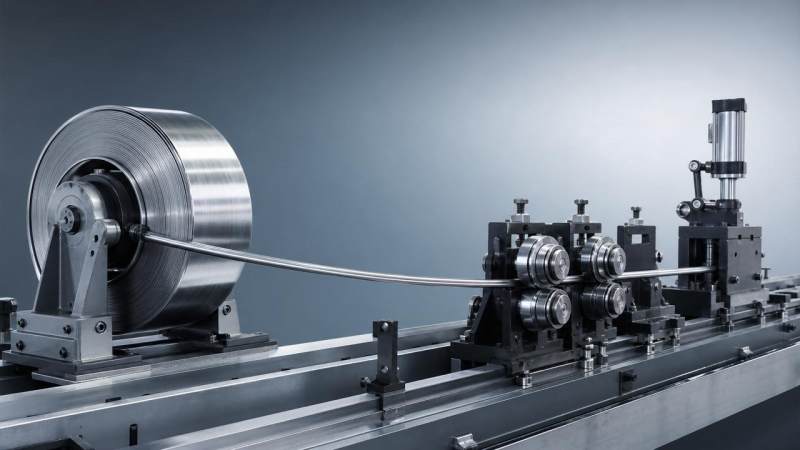
A stainless steel coil rod stores elastic stress while wrapped into coils, so some curvature remains after uncoiling.
That residual set is not automatically a defect. The key question is whether the remaining bend still fits the application.
In manual repair work, slight curvature may be acceptable because operators can align and fix the rod during assembly.
In automated processing, the same stainless steel coil rod may cause feeding issues, tool wear, and inaccurate finished dimensions.
That is why straightness should always be judged by use condition, not by appearance alone.
How to judge straightness by application scenario
Different scenarios place very different demands on a stainless steel coil rod after uncoiling.
A practical inspection starts with the intended process, tolerance window, and downstream handling method.
Scenario 1: Hand fabrication and repair work
For hand bending, bracket repair, light welding, and field adjustment, moderate residual curve is often manageable.
The main judgment points are local kinks, twist, and whether the rod can be aligned without cracking or springback trouble.
Scenario 2: Straight cut-to-length production
If the stainless steel coil rod will be cut into short, straight pieces, curvature becomes more important.
Excess bow can affect measuring accuracy, stacking, and end squareness, especially when high repeatability is required.
Scenario 3: Automated feeding and forming lines
This is the most sensitive case. A stainless steel coil rod with strong memory can wander during feeding.
That can cause misalignment, roller marks, inconsistent forming, or machine stoppage if straightening is inadequate.
Scenario 4: Visual or exposed structural components
When the rod is used in visible frames, rail parts, or decorative supports, visual straightness matters more.
Even small waves may trigger complaints, although the material still meets mechanical requirements.
What affects a stainless steel coil rod after uncoiling
Several factors influence how straight a stainless steel coil rod appears once the coil is opened.
Coil diameter and winding tension
Smaller coil diameters usually create stronger residual curvature because the rod was wrapped more tightly.
High winding tension can also increase stored stress and make the rod harder to flatten naturally.
Rod diameter and section stiffness
Thicker material resists bending more, but once coiled, it may retain a more obvious arc over longer lengths.
Thinner rods may look straighter after handling, yet they can show local waviness more easily.
Grade, temper, and processing history
Different stainless grades respond differently to forming and springback due to strength and work hardening behavior.
Cold worked material often shows stronger shape memory than material processed with a dedicated straightening stage.
Storage, transport, and release method
Improper band removal can cause sudden expansion, creating extra distortion, loops, or localized bends.
Transport damage, side pressure, and poor stacking can also add defects unrelated to original manufacturing quality.
Typical straightness expectations across different situations
There is no universal answer for how straight a stainless steel coil rod should be after uncoiling.
A useful approach is to compare actual shape against process sensitivity and rework cost.
What to check immediately after uncoiling
A fast inspection routine helps determine whether the stainless steel coil rod is usable as-is or needs correction.
- Observe the free shape on a flat floor or table.
- Check for smooth arc versus sharp local bend.
- Look for twist along the rod axis.
- Measure bow over a known reference length.
- Inspect surface marks caused by handling or over-tight binding.
- Test one sample through the real downstream process.
The most useful result is not a visual opinion. It is a measured condition connected to actual process performance.
How scenario needs differ in steel processing and supply
In structural and industrial steel supply, shape control requirements vary widely between products and applications.
For example, coiled stainless products may need post-uncoiling correction, while straight bars are selected for direct use.
Some projects also compare coiled material with other steel formats, depending on forming, welding, and transport needs.
In broader project supply, products such as Wire Rod are used across building material, auto manufacturing, and metallurgical machinery.
That product range commonly follows ASTM, GB, EN, DIN, and JIS standards, with grades including HRB400, HRB500, and ASTM A615 Grade 60.
Although those carbon steel options differ from stainless steel coil rod applications, the same principle applies: choose shape condition by process need, not assumption.
Recommended actions for better fit by scenario
- For manual work, define acceptable bow and reject only kinks, cracks, or severe twist.
- For precision cutting, add a pre-straightening step before final measuring.
- For automated lines, request a trial coil and verify feeding behavior first.
- For visual parts, agree on appearance standards before shipment and installation.
- For mixed orders, separate material by intended process to avoid unnecessary complaints.
These actions reduce confusion when a stainless steel coil rod looks curved but still performs within a practical tolerance band.
Common mistakes when evaluating a stainless steel coil rod
One common mistake is treating any curve as a defect, without considering the original coiled form.
Another is judging straightness before the rod relaxes naturally after careful release from packaging.
Some inspections also ignore the difference between smooth residual arc and concentrated deformation from mishandling.
A further mistake is checking appearance only, without confirming whether the stainless steel coil rod runs normally in production.
The best evaluation combines visual inspection, simple measurement, and an application-based trial.
Next-step guidance for practical quality control
If straightness matters in your project, create an inspection rule before delivery, uncoiling, and processing begin.
Define reference length, allowed bow, handling method, and whether straightening equipment will be used.
When discussing a stainless steel coil rod with a steel supplier, ask for coil size, processing route, and recommended post-uncoiling handling.
For global construction and industrial supply, clear technical communication reduces sourcing risk and avoids avoidable site disputes.
Hongteng Fengda supports structural steel projects with consistent quality control, international standard compliance, and customized supply solutions for varied downstream needs.
In short, a stainless steel coil rod is usually not perfectly straight after uncoiling, but suitability depends on the scenario, tolerance, and processing method.
Please give us a message


Please enter what you want to find